“The Power to Destroy a Thing is the Absolute Control Over It” – Dune Diaries 1.01
An analysis of Frank Herbert’s (in)famous quote featured in the first Dune book & the second film.

“The power to destroy a thing is the absolute control over it”
– Paul Muad’Dib,
This line comes in the tail end of the second dune film and is a direct quotation from the original book. This is about Paul’s threat to nuke the spice reserves on Dune and subsequently topple the patriarchy of the great houses of the Landsraad and the rest of the Imperium. Spice is the drug harvested on Arrakis, representing the greatest export in the Dune universe. It prolongs life, gives one the ability to see the future, and allows “guild navigators” to bend space-time to access interplanetary travel.
Of all of the controversial quotes uttered by Frank Herbert’s character, Paul Atreidies in the first Dune book, this one has always stuck out to me, and I was beyond happy to see its place in the movie. If you critically analyze the quote, the logic seems dubious at best:
To destroy something is to attack it.
An overabundance of evidence in history and military theory has shown humans it’s far easier to defend than to attack.
Having control over a thing refers to the degree of influence one has on it.
The easier one can influence something, the more control they have over it.
Therefore, having “absolute control” over a system would be to defend it, not to attack and destroy it, hence Paul is wrong in his assessment.
This asks the question, why would a character like Paul Atreidies commit such a fallacy when the stakes are so high? The same Paul Atreidies who has trained as a mentat (human-computer), practiced the bene gesserit rituals and has unlocked not only all of his ancestors’ memories but all the possible futures as well. Those who have read the preceding books may be able to answer this question, but for those who still need to, let me assure you, it is not lazy writing by Frank Herbert, it’s very much the opposite. Without going into spoiler territory for the other books and future movies, allow me to explain.
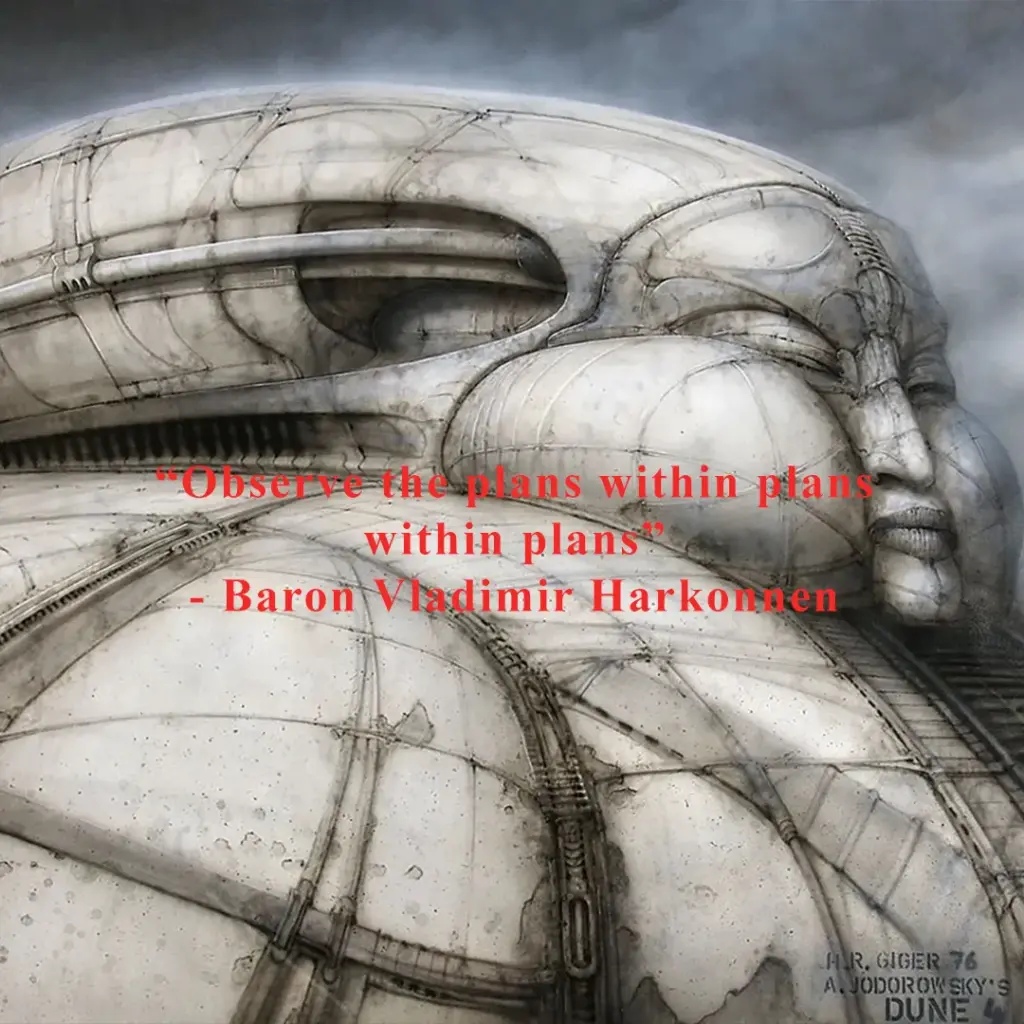
“Observe the plans within plans within plans”
– Baron Vladimir Harkonnen
“The thing the ecologically illiterate don’t realize about an ecosystem is that it’s a system. A System! A system maintains a certain fluid stability that can be destroyed by a misstep in just one niche.”
– Pardot Kynes – “Appendix I: The Ecology of Dune
When Paul says “the power to destroy a thing is the absolute control over it”, he isn’t referring to just the spice reserves, it extends to the power system that the spice is a finite extension of. In part 1, young Paul witnesses how economics (the Guild/CHOAM), politics (The Landsraad), and religion (The Bene Gesserit) can unite to produce a power so chaotic it can obliterate those under its whim. Pardot Kynes’s quote above exemplifies how Frank Herbert pictured this power structure. Just like in ecology, one simple misstep is enough to topple an entire system.
Paul, after reluctantly following his Bene Gesserit mother’s lead, manipulates the Fremen into being their prophet thereby controlling their religion. Then, using his religious power, starts a guerrilla war in the desert with the Fremen to destroy the Harkoneen spice reserves, ousting their economic power. Uniting his religious and economic power, Paul calls for a Jihad, an all-out invasion of the final third of the system, its political power. Though at this point it’s understood Paul’s fedaykin and sandworms have the prowess to defeat anyone in the entire universe, The Landsraad makes it clear they will not simply abide by his demands. Paul, being the prescient being he is, knew how this would shake out, and used the quote as an empty threat. Paul relies on the spice for his religious and economic power just as much as the imperium for its political power. Though he knows this, The Landsraad does not. By threatening one niche component of the system it was destroyed just as Pardot Kynes predicted, and Paul’s jihad succeeds before it even begins.
Among many things, Dune is a treatise on power expanding on the works of thinkers like Thomas Hobbes. Thomas Hobbes was a political philosopher who lived through the English Civil War and witnessed the beheading of King Charles the 1st. Due to his experiences in the war, Hobbes was a staunch pacifist and argued that supreme authority was a right limited to humans. Hobbes argued that authority is necessary no matter how tyrannical it is because it produces order which is a far better alternative to chaos. Hobbes takes this point even further arguing that if a ruler is tyrannical, it is not the ruler’s fault but his people, for if people could rule themselves there would be no need for a governmental structure. Hobbes’s theory may be bleak, but it seems to hold up in court. We only have to look across the Mediterranean to the Middle East for an example of his argument in action today. But at the same time, Hobbes’s theory seems to only account for about half of history’s declarations of war. Sure Hobbes logically cripples revolutions, but what about the wars started by those in power? According to Hobbes, the people are required to swear obedience to those in power. If those in power declare war, the people will inevitably produce the same type of chaos Hobbes is trying to avoid. Circling back to the duneiverse, it was Emperor Shaddam who first declared war on the Atreides by granting them the fiefdom of Arrakis. Emperor Shaddam being a puppet and a shell of a leader presents an obvious (albeit weak) rebuttal to Hobbes. But does Frank Herbert not contradict himself by replacing Paul with the Emperor? Sure Paul may be a much more benevolent and charismatic emperor than Mr.Shaddam, but he’s an emperor nonetheless.
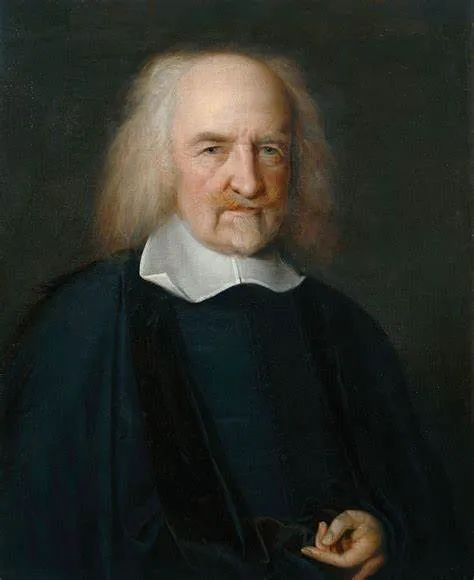
Thomas Hobbes, detail of an oil painting by John Michael Wright; in the National Portrait Gallery, London
“Some have decried Dune as an exemplar of the most toxic tropes lurking in science fiction, calling the novel an orientalist fever dream, a pean to eugenics, and a seductive monument to fascist aesthetics; others look at the same text and see an excoriation of hero-worship, a cautionary tale of revolutionary dreams betrayed, and a warning about Indigenous sovereignty subverted by a charismatic charlatan.” – Joshua Pearson, The Tribune The Contested Politics of ‘Dune’ (tribunemag.co.uk)
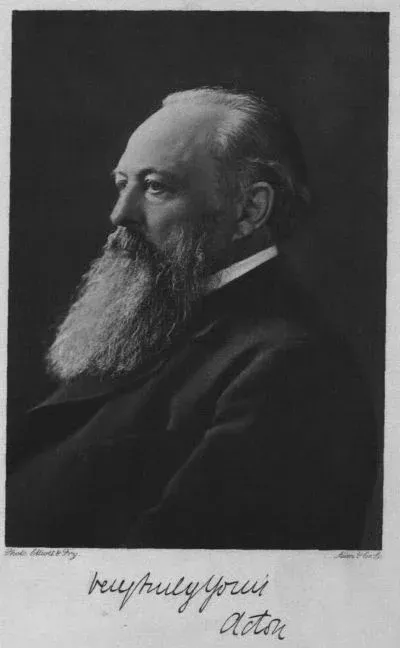
There’s something fascinating about a book that can produce such powerful reactions to diametrically opposed ideologies. Again, those who have read the latter books have a better idea of Herbert’s stance on Hobbes’s authoritarianism. However, without going into spoilers I will do my best to paint of picture of Herbert’s insights from the first two movies (book 1) alone. To do this I’ll bring up another political philosopher, England’s Lord Acton. Lord Acton is famous for the quote “Power tends to corrupt, and absolute power corrupts absolutely”, implying that Hobbes’s authoritarianism won’t get society anywhere. It’s also worth noting Lord Acton was a Confederate and saw Abraham Lincoln’s and the North’s cause as radical tyranny. Obviously, Acton’s politics did not age well, but, his famous quote certainly did. We’re all weary of the evil stirring in the “villains” of the world; the Harkkonens, the Putins, or the Kim Jong Un’s. But what of our heroes, should we not be weary of them as well? Blindly following Paul’s threat to nuke the spice reserves, whether he goes through with it or not, will lead to chaos to an unimaginable degree, a galactic-wide Jihad. Critically analyzing the threat on the other hand proves not only is it illogical, but an empty threat at that. Paul’s prescience only gets him so far, he is playing the political game as much as the rest of them, but only he can see the ensuing effects.
If Paul is the only one aware of the chaos ensuing due to his decisions, he is to blame. Therefore, if Paul creates the chaos he envisions, Hobbes’s authoritarianism fails miserably. This is one of the thought experiments Frank Herbert asks you to enter in the climax of the first book. Hidden between the lines, the plans within plans begin to reveal themself, but only to those paying the utmost attention.
Paul’s military quest was merely a distraction for his Coup d’état. His logical fallacy “The power to destroy a thing is the absolute control over it”, is a veiled threat meant to manipulate his opponent’s emotions and to make a play for the imperium’s political power. At this moment, Herbert’s complex and sometimes even contradictory ideologies begin to unravel, forcing us to look inward at our perceptions of the hero of the story. To some, Paul is the greatest liberator to walk Arrakis, while to others, he’s the fiercest tyrant.
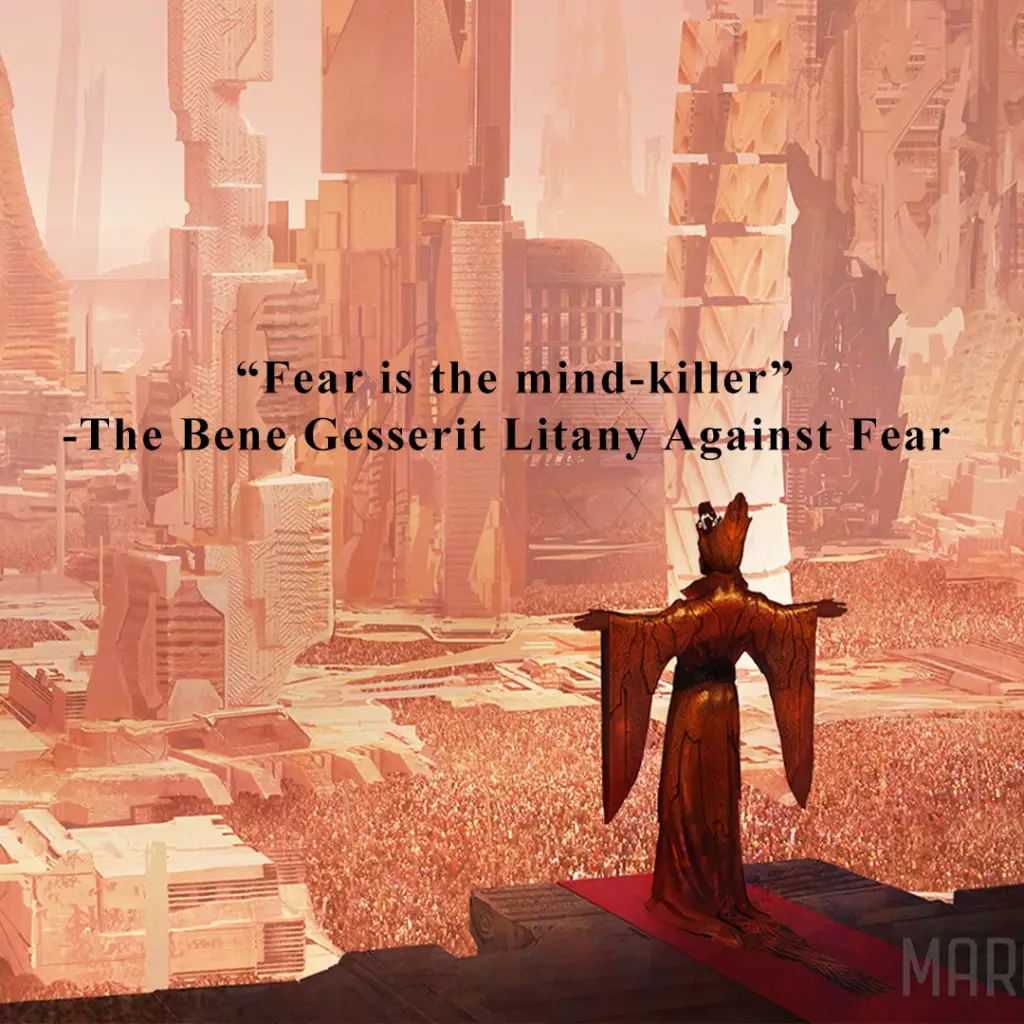
“Fear is the mind-killer”- The Bene Gesserit Litany Against Fear
If you’re still unconvinced by Frank Herbert’s writing prowess, let me refresh you on the Gom Jabbar, the needle Reverend Mother Gaius Helen Mohiam forces against Paul’s neck as he sticks his hand inside the torture box. “Gom Jabbar” translates to “The High Handed enemy”, and is a needle dipped in cyanide designed to bring instantaneous death. We see the Bene Gesserit use the Gom Jabbar to test Paul’s humanity, specifically whether or not his awareness can overcome his animal instincts. If Paul pulled his hand out of the torture box to relieve the pain, his animal instincts would prove too strong and he would die, like a mouse squirming out of a trap. But having sufficient knowledge and awareness of the situation means you have no choice but to endure the pain to live on. As we know, Paul succeeds the Gom Jabbar test and qualifies as a “human” in the eyes of the Bene Gessereit. However, we also know that in the eyes of the Bene Gessereit, Paul is a failed experiment, the product of a defector who knowingly disobeyed the Sister’s orders and foiled the Bene Gesserit 1000+ year eugenic plans. So why is it that when Reverend Mother Gaius Helen Mohiam has the Gom Jabbar to Paul’s neck, she doesn’t kill him right there and finish off the plans she and Emperor Shaddam set forth in the first place? To frame this in another context; Gaius Helen Mohiam has “The power to destroy [Paul], by having absolute control over [him]”, yet she chooses not to without making it clear why.
Reverend Mother Gaius Helen Mohiam chooses not to destroy Paul because she doesn’t believe in Paul’s philosophy. Through their actions, she and the rest of the Bene Gesserit demonstrate having control over a thing is far more than having the ability to destroy it. The religions they’ve manipulated across Arrakis and the Imperium have cultivated an order more benevolent than the alternative. The seeds they’ve planted in the form of rituals and words across cultures produce a far more stable sense of control than destroying whatever power relies on. They recognize dangling the sword of Damocles over their subject’s head will only get them so far. To the Bene Gesserit, destroying a thing is not gaining control over it, that’s like amputating your arm because of a paper cut. A rash, impulsive, and borderline animal instinct to a human problem. A far more appropriate play is to adapt to the wheels of power and to conspire within it. If this Frankenstein creation named Paul Muad’ib turns out to be the Kwisatz Haderach they’ve been prophesying for thousands of years, killing him would be blasphemy, an unimaginable waste of power, like throwing out the world’s fastest computer. The possibility of controlling such power gives the Bene Gesserit delusions of grandeur, visions of a utopia they prophesied centuries ago. Whether or not the Bene Gesserit succeeds in these plans is of little importance to Herbert’s philosophy. The Gom Jabbar is another thought experiment that goes beyond the old adage of what it means to be human, it also asks what control means to you, and why do we as humans seek it in such a primal fashion.
The quote “The power to destroy a thing is the absolute control over it” has been one of the more popular quotes in the first book among the fandom and for good reason. It is one of the first instances Herbert asks the viewer to look inward at their own perceptions of the hero. But without critical thought, it goes over many readers’/viewers’ heads, and they slowly slip into the same tragic hero-worship syndrome we see in the Fremen like Stilgar. Reading between each line the plans within plans slowly reveal themselves, and the scathing critiques of authoritarianism begin to penetrate the consciousness like sunlight poking through the fringes of a curtain. Herbert’s authoritarianism lies in the shadows unlike so much popular media and as a result, paints a much more apt comparison to how these political structures shape reality today. Depending on your situation, It’s easy to predict how politicians like Donald Trump through their sheer recklessness and determination will lead to chaos for example, but what about the seemingly benevolent leaders like Joe Biden? Do we blindly follow their lead because they have our best interests at heart, like Stilgar following Paul, or do we forego our desires and hold onto our principles, like Chani? History has taught us there isn’t an answer to this question, it depends on the individual. However, history has also taught us the lessons of philosophers like Thomas Hobbes and Lord Acton. The best we can do is learn from the knowledge of the past and rely on reason to guide us instead of our base animal instincts, the thing the Bene Gesserit try so hard to stamp out.
References
Brinton, Crane. “Lord Acton’s Philosophy of History.” The Harvard Theological Review, vol. 12, no. 1, 1919, pp. 84–112. JSTOR, http://www.jstor.org/stable/1507914. Accessed 17 Mar. 2024.
Duncan, Stewart. “Thomas Hobbes.” Stanford Encyclopedia of Philosophy, Stanford University, 12 Feb. 2021, plato.stanford.edu/entries/hobbes/.
Harrington, Pat. “Brief Reflections on the Politics of Dune.” Counter Culture, 10 Feb. 2023, countercultureuk.com/2021/10/30/brief-reflections-on-the-politics-of-dune/.
Mosovsky, Jan. “Dune: A Story about Power.” 4liberty.Eu, Liberty Education, 8 Nov. 2021, 4liberty.eu/dune-a-story-about-power/.
Art by: