The Soul of the Sword: When the Pentagon Measures a Soldier’s Faith

“What do I tell a soldier who believes an action is immoral, but also believes that God commanded it?”
An active-duty Army captain working as a non-Christian chaplain posed that question to The Intercept. He was talking about the Pentagon’s new Office of Religious Affairs. He spoke anonymously because he feared retaliation. The question is the kind a chaplain might hear in private after an order has been given and before someone has to live with what it means.
On September 30, 2026, Defense Secretary Pete Hegseth announced that office at Quantico. Its director reports directly to him and the deputy secretary. In Hegseth’s telling, chaplains needed a voice without “bureaucratic dilution.” Some of the chaplains and religious endorsers asked about this new voice say they did not request the microphone.
A Direct Line to the Top. A Question from Below.
There is a real case for giving chaplains more support. A service member stationed far from home should be able to find a religious leader, or someone to talk to about grief and conscience, without begging through a broken chain of command. Hegseth says this is what his office will fix. The Pentagon’s September 30 memorandum says it cannot compel religious participation or diminish the rights of people of any faith or no faith.
Then you read the rest of the memo.
The director has direct access to the secretary and authority to coordinate control of religious-affairs functions. The office will oversee the Armed Forces Chaplains Board and relations with the civilian organizations that endorse chaplains. It will advocate funding for ministry, facilities, training, faith-based homeschool support for military families, faith-based suicide-reduction efforts, and contracts with religious organizations. It will sponsor tools to assess “spiritual fitness,” “spiritual readiness,” and “spiritual resilience.”
A direct line can be a lifeline. It can also be a very efficient way to decide whose needs count.
The anonymous Army chaplain asked whether non-Christian chaplains would be admitted and promoted at the same rates, and whether Jewish, Muslim, Hindu, Humanist and other organizations would receive comparable support. Those are questions about future decisions, not proof that the office has already discriminated. The office had existed for less than a month when he spoke. What we can examine now is the authority written on paper and the people warning about where it leads.
The Spreadsheet Has a Theology.
This problem did not begin with a new office. In June, Rev. Dr. Rebekah Savage joined ten other religious endorsers in a letter objecting to changes in the military’s Religious Affiliations Code list. According to The Intercept’s reporting on the letter, the signatories said the revisions removed or obscured identities including Unitarian Universalists, historically Black churches, and Wiccan and Pagan practitioners. They worried that the codes could affect access to clergy, accommodations, and the allocation of chaplaincy resources.
“Classification is resource allocation,” they wrote.
That sentence is the whole fight in five words. If an institution cannot see your community clearly in its records, it can claim to serve everyone while budgeting as if you barely exist. What looks like a tidy administrative category can decide who gets a room, a chaplain, or a call back.
Savage, a former military chaplain who now helps oversee the Unitarian Universalist Association’s endorsement of chaplains, told The Intercept her organization was not consulted before the new office was established. She did not claim to speak for the whole chaplain corps. That distinction matters. “Chaplains reject the office” is a headline; the documented fact is that identifiable former chaplains and an anonymous active-duty chaplain raised serious objections. A bureaucracy should not have to wait for a unanimous revolt before it listens.
God Sent a Prophet. The Pentagon Made a Poster.
The Office of Religious Affairs did not arrive in a religious vacuum. In August, Pentagon-linked accounts posted images bearing “SEND ME,” a reference to Isaiah 6:8. Hegseth has since described a Send Me Tour as military outreach and recruitment. The phrase sounds made for enlistment. It also comes from a passage in which Isaiah is sent to deliver a warning to his own people, a warning followed by devastation, not an easy promise of victory.
The Intercept asked the Pentagon what the earlier posts meant. At the time, a spokesperson said there was “Nothing to offer you on this.” Its later explanation calls the tour a tribute to those who volunteer to serve. We should not pretend to know every official’s private theological intent. We can read the public message and ask what happens when a state military borrows the voice of divine commissioning.
Hegseth’s own religious imagery and rhetoric add context. His tattoos include a Jerusalem cross and the Latin phrase “Deus vult,” a Crusades-associated slogan also adopted by extremists. A fellow National Guard member flagged the tattoo as a potential concern before Hegseth was removed from a 2021 inauguration security assignment. The tattoo does not itself establish what the new office will do. The secretary’s public language, personnel decisions, and written policy carry the institutional weight.
During his September 30 speech, Hegseth argued that religious support had been neglected and called the military’s battle spiritual as well as physical. Pentagon press secretary Kingsley Wilson told The Intercept that activities are voluntary and that the department protects service members from coercion and discrimination. In the same response, she defended Hegseth by invoking America’s Christian heritage and accused “the Left” of trying to erase it. That is an awkward way to reassure a soldier whose faith isn’t Christianity.
The Shepherd Works for the Commander.
Michel Foucault was a twentieth-century French philosopher who studied how institutions exercise power over everyday life. He described “pastoral power” as a kind of guidance modeled on the shepherd tending each member of a flock: care and knowledge of the individual become ways to govern.
In other words, you do not have to order a person to think a certain way if you can define what a healthy, ready person is supposed to be and then build the systems that reward that definition.
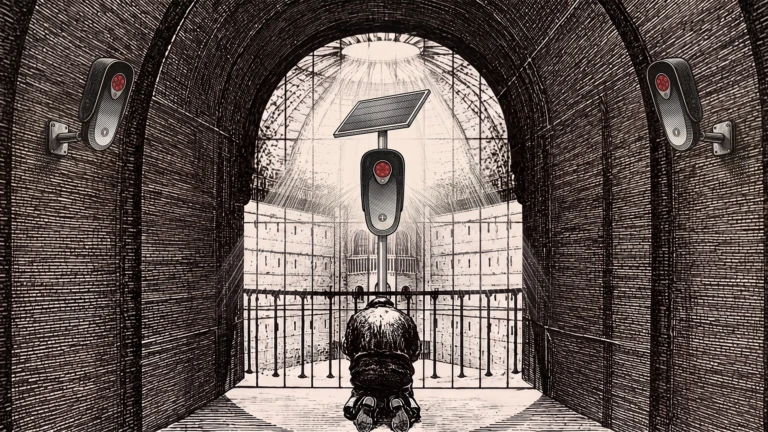
The memo does not specify a Christian test for spiritual readiness. That matters. But it does direct an office close to the secretary to develop research, technology, and analytical tools for assessing spiritual fitness. How do you measure a soul? Does skepticism count as weakness? Does a soldier wrestling with the morality of an operation count as unready, or as someone doing the most serious moral work a soldier can do?
No conspiracy required. A performance metric can turn a difficult human question into a box someone has to tick. A budget can favor programs that fit the metric. An office can defend both choices as support rather than pressure. Bureaucracies are remarkably good at making their own assumptions look like neutral plumbing.
Chaplaincy exists partly because a soldier may need a place where the answer is not predetermined by a mission brief. A chaplain has to serve people who do not share the chaplain’s beliefs. Sometimes that means sitting with a soldier’s refusal, doubt, guilt, or fear. When the institution that commands the mission also oversees the machinery for measuring spiritual readiness, the soldier may reasonably wonder which side of that conversation the machinery is on.
Voluntary on Paper Is Not the End of the Question.
Here is the skeptical objection: militaries have always had chaplains. Supporting religious exercise is not the same thing as establishing a church, and the memorandum expressly protects nonbelievers. All true. A soldier who needs a rabbi, an imam, a pastor, or a quiet space to practice deserves actual support, not a lecture about why religion should disappear from public life.
But what counts as support when the person controlling the budget speaks about warfare in one tradition’s sacred vocabulary? The office can say every prayer service is voluntary. Nobody has to order you into a pew for you to notice which programs get contracts, which kinds of resilience get praised, and which chaplains can advise a commander without worrying about their careers.
The active-duty chaplain’s fears of retaliation and future bias are allegations about risk, not documented outcomes of this new office. The secretary’s memo is the documented machinery. We should keep those categories separate. Otherwise we give the Pentagon an easy way to wave off the central issue as speculation.
The central issue is design. Who sets the categories? Who measures fitness? Who gets funding? Who can say no when the secretary’s preferred language starts to sound like the military’s official moral vocabulary?
A Soldier Can Still Ask Whether the Order Is Wrong.
We usually talk about military readiness as equipment, training, and the ability to follow an order under pressure. There is another kind of readiness: the capacity to recognize when doing so may violate your conscience. That capacity does not make a soldier less useful as a human being. It may make the institution less comfortable.
The chaplain’s question returns here. A soldier is asked to do something violent, believes it is wrong, and hears from above that the cause has divine sanction. Who can that soldier talk to? If the answer is a chaplain whose professional world is increasingly organized by the same leadership that blessed the mission, the conversation changes before anyone says a word.
We pay for the command structure. We applaud the promise of resilience. We ask the people inside it to carry choices most of us will never face. Then we call their doubt a problem to be measured.
The soldier is asking whether the order is right. The new office may be built to ask whether the soldier is ready. Those are not the same question.
Sources
- Austin Campbell, “Hegseth Built a New Pentagon Office for Religion. Military Religious Leaders Wish He Hadn’t,” The Intercept, October 25, 2026: https://theintercept.com/2026/10/25/hegseth-military-christian-religion/
- Secretary of War, “Establishment of the Office of Religious Affairs,” memorandum, September 30, 2026: https://media.defense.gov/2026/Sep/30/2004009308/-1/-1/1/ESTABLISHMENT-OF-THE-OFFICE-OF-RELIGIOUS-AFFAIRS.PDF
- Austin Campbell, “The Pentagon Is Posting Cryptic Biblical Messages on Social Media,” The Intercept, August 6, 2026: https://theintercept.com/2026/08/06/pentagon-department-defense-isaiah-6-8-send-me-iran-war/
- USA Today, “Pentagon establishing Office of Religious Affairs, Hegseth announces,” September 30, 2026: https://www.usatoday.com/story/news/nation/2026/09/30/pentagon-office-of-religious-affairs-hegseth/92028693007