“What do I tell a soldier who believes an action is immoral, but also believes that God commanded it?”
An active-duty Army captain working as a non-Christian chaplain posed that question to The Intercept. He was talking about the Pentagon’s new Office of Religious Affairs. He spoke anonymously because he feared retaliation. The question is the kind a chaplain might hear in private after an order has been given and before someone has to live with what it means.
On September 30, 2026, Defense Secretary Pete Hegseth announced that office at Quantico. Its director reports directly to him and the deputy secretary. In Hegseth’s telling, chaplains needed a voice without “bureaucratic dilution.” Some of the chaplains and religious endorsers asked about this new voice say they did not request the microphone.
A Direct Line to the Top. A Question from Below.
There is a real case for giving chaplains more support. A service member stationed far from home should be able to find a religious leader, or someone to talk to about grief and conscience, without begging through a broken chain of command. Hegseth says this is what his office will fix. The Pentagon’s September 30 memorandum says it cannot compel religious participation or diminish the rights of people of any faith or no faith.
Then you read the rest of the memo.
The director has direct access to the secretary and authority to coordinate control of religious-affairs functions. The office will oversee the Armed Forces Chaplains Board and relations with the civilian organizations that endorse chaplains. It will advocate funding for ministry, facilities, training, faith-based homeschool support for military families, faith-based suicide-reduction efforts, and contracts with religious organizations. It will sponsor tools to assess “spiritual fitness,” “spiritual readiness,” and “spiritual resilience.”
A direct line can be a lifeline. It can also be a very efficient way to decide whose needs count.
The anonymous Army chaplain asked whether non-Christian chaplains would be admitted and promoted at the same rates, and whether Jewish, Muslim, Hindu, Humanist and other organizations would receive comparable support. Those are questions about future decisions, not proof that the office has already discriminated. The office had existed for less than a month when he spoke. What we can examine now is the authority written on paper and the people warning about where it leads.
The Spreadsheet Has a Theology.
This problem did not begin with a new office. In June, Rev. Dr. Rebekah Savage joined ten other religious endorsers in a letter objecting to changes in the military’s Religious Affiliations Code list. According to The Intercept’s reporting on the letter, the signatories said the revisions removed or obscured identities including Unitarian Universalists, historically Black churches, and Wiccan and Pagan practitioners. They worried that the codes could affect access to clergy, accommodations, and the allocation of chaplaincy resources.
“Classification is resource allocation,” they wrote.
That sentence is the whole fight in five words. If an institution cannot see your community clearly in its records, it can claim to serve everyone while budgeting as if you barely exist. What looks like a tidy administrative category can decide who gets a room, a chaplain, or a call back.
Savage, a former military chaplain who now helps oversee the Unitarian Universalist Association’s endorsement of chaplains, told The Intercept her organization was not consulted before the new office was established. She did not claim to speak for the whole chaplain corps. That distinction matters. “Chaplains reject the office” is a headline; the documented fact is that identifiable former chaplains and an anonymous active-duty chaplain raised serious objections. A bureaucracy should not have to wait for a unanimous revolt before it listens.
God Sent a Prophet. The Pentagon Made a Poster.
The Office of Religious Affairs did not arrive in a religious vacuum. In August, Pentagon-linked accounts posted images bearing “SEND ME,” a reference to Isaiah 6:8. Hegseth has since described a Send Me Tour as military outreach and recruitment. The phrase sounds made for enlistment. It also comes from a passage in which Isaiah is sent to deliver a warning to his own people, a warning followed by devastation, not an easy promise of victory.
The Intercept asked the Pentagon what the earlier posts meant. At the time, a spokesperson said there was “Nothing to offer you on this.” Its later explanation calls the tour a tribute to those who volunteer to serve. We should not pretend to know every official’s private theological intent. We can read the public message and ask what happens when a state military borrows the voice of divine commissioning.
Hegseth’s own religious imagery and rhetoric add context. His tattoos include a Jerusalem cross and the Latin phrase “Deus vult,” a Crusades-associated slogan also adopted by extremists. A fellow National Guard member flagged the tattoo as a potential concern before Hegseth was removed from a 2021 inauguration security assignment. The tattoo does not itself establish what the new office will do. The secretary’s public language, personnel decisions, and written policy carry the institutional weight.
During his September 30 speech, Hegseth argued that religious support had been neglected and called the military’s battle spiritual as well as physical. Pentagon press secretary Kingsley Wilson told The Intercept that activities are voluntary and that the department protects service members from coercion and discrimination. In the same response, she defended Hegseth by invoking America’s Christian heritage and accused “the Left” of trying to erase it. That is an awkward way to reassure a soldier whose faith isn’t Christianity.
The Shepherd Works for the Commander.
Michel Foucault was a twentieth-century French philosopher who studied how institutions exercise power over everyday life. He described “pastoral power” as a kind of guidance modeled on the shepherd tending each member of a flock: care and knowledge of the individual become ways to govern.
In other words, you do not have to order a person to think a certain way if you can define what a healthy, ready person is supposed to be and then build the systems that reward that definition.
The memo does not specify a Christian test for spiritual readiness. That matters. But it does direct an office close to the secretary to develop research, technology, and analytical tools for assessing spiritual fitness. How do you measure a soul? Does skepticism count as weakness? Does a soldier wrestling with the morality of an operation count as unready, or as someone doing the most serious moral work a soldier can do?
No conspiracy required. A performance metric can turn a difficult human question into a box someone has to tick. A budget can favor programs that fit the metric. An office can defend both choices as support rather than pressure. Bureaucracies are remarkably good at making their own assumptions look like neutral plumbing.
Chaplaincy exists partly because a soldier may need a place where the answer is not predetermined by a mission brief. A chaplain has to serve people who do not share the chaplain’s beliefs. Sometimes that means sitting with a soldier’s refusal, doubt, guilt, or fear. When the institution that commands the mission also oversees the machinery for measuring spiritual readiness, the soldier may reasonably wonder which side of that conversation the machinery is on.
Voluntary on Paper Is Not the End of the Question.
Here is the skeptical objection: militaries have always had chaplains. Supporting religious exercise is not the same thing as establishing a church, and the memorandum expressly protects nonbelievers. All true. A soldier who needs a rabbi, an imam, a pastor, or a quiet space to practice deserves actual support, not a lecture about why religion should disappear from public life.
But what counts as support when the person controlling the budget speaks about warfare in one tradition’s sacred vocabulary? The office can say every prayer service is voluntary. Nobody has to order you into a pew for you to notice which programs get contracts, which kinds of resilience get praised, and which chaplains can advise a commander without worrying about their careers.
The active-duty chaplain’s fears of retaliation and future bias are allegations about risk, not documented outcomes of this new office. The secretary’s memo is the documented machinery. We should keep those categories separate. Otherwise we give the Pentagon an easy way to wave off the central issue as speculation.
The central issue is design. Who sets the categories? Who measures fitness? Who gets funding? Who can say no when the secretary’s preferred language starts to sound like the military’s official moral vocabulary?
A Soldier Can Still Ask Whether the Order Is Wrong.
We usually talk about military readiness as equipment, training, and the ability to follow an order under pressure. There is another kind of readiness: the capacity to recognize when doing so may violate your conscience. That capacity does not make a soldier less useful as a human being. It may make the institution less comfortable.
The chaplain’s question returns here. A soldier is asked to do something violent, believes it is wrong, and hears from above that the cause has divine sanction. Who can that soldier talk to? If the answer is a chaplain whose professional world is increasingly organized by the same leadership that blessed the mission, the conversation changes before anyone says a word.
We pay for the command structure. We applaud the promise of resilience. We ask the people inside it to carry choices most of us will never face. Then we call their doubt a problem to be measured.
The soldier is asking whether the order is right. The new office may be built to ask whether the soldier is ready. Those are not the same question.
On an Army Cyber Command slide, a piece of software lands on an Ubuntu laptop. It surveys the network, finds other machines, and makes copies of itself tailored for an iPad, an Apple desktop, and a Windows 11 PC. Then the network changes. The software copies itself again.[1]
The Army calls this ECHOTRIBBLE. The slide calls the copies “replicas.” The procurement documents call the proposed system an “Agentic C2 Framework Tool.”[1][2] A reasonable person might call it a worm. The distinction matters, because one of those descriptions is much easier to put in a contract.
The Laptop Was Only the Beginning
ECHOTRIBBLE is not a finished weapon whose behavior we can inspect in the wild. It is a prototype effort. The Cyber Fusion Innovation Center, working with Army Cyber Command and its technology center, solicited industry proposals for an agent that would move through digital environments, identify threats or targets, and neutralize them with “minimal human oversight.” The solicitation names contested, cloud-native, and air-gapped environments. It also asks for stealth.[2]
Those words are broad. The June presentation is less abstract. Its example starts with an Army binary placed on a laptop. During a survey, it identifies other potential targets on the same network. At the next scheduled communication window, it asks for modules to move to devices of interest, then produces device-specific replicas. The slide says the agent should be “semi-autonomous” and work on certain rule-based tasks without human oversight.[1]
The sequence is the story. One placement becomes several. A network change becomes a reason to propagate again. Humans define the mission at the beginning; the software handles the next move.
The assessment-event release asks for “safe, rule-bound propagation,” meaning movement under configured conditions or predefined triggers. It also asks for memory-resident execution, randomized activity schedules, process-name obfuscation, low-bandwidth encrypted callbacks, debugger detection, and policy-driven “Self-Destruct/Heal Logic.” The same document describes a lab mode and a field mode, and says LLM integration is optional.[2]
That last detail is easy to miss. “AI agents” makes it sound like a chatbot with a rifle. The public requirements permit rule-based decision logic, with a small language model as an option. Whatever gets built, the dangerous feature is not a machine having opinions. It is software allowed to act across machines faster than a person can review every step.
Sixty-Five Pitches. One Selected for Award.
This has already moved beyond an idle whiteboard session. According to the Cyber Fusion Innovation Center, 65 whitepapers were submitted, five participants gave virtual demonstrations in October 2026, and one company was selected for award on October 8. The center said a statement of work and contract action were still forthcoming.[3]
Selected for award is not the same thing as deployed. The public materials do not establish that an ECHOTRIBBLE agent has been fielded, how well a prototype performs, what targets would be authorized, or whether any final system can reliably clean itself up. Those are not fussy qualifications. They are the difference between a frightening design brief and a verified operational claim.[2][3]
The center describes the effort in terms of forensics, malware analysis, incident response, and defense of Army networks. The Intercept, citing documents it reviewed and a contractor Q&A, reports that the effort is “primarily focused” on offensive missions; in that account, neutralizing a target could mean disabling it or deleting a threat from it. Army Cyber Command did not answer the outlet’s questions about measures to prevent unintended damage.[3][4]
There is a real ambiguity here about mission framing. There is much less ambiguity about the mechanism the Army requested. You do not ask for cross-platform propagation, covert callbacks, optional persistence, and field-mode execution because you only need a spreadsheet to sort incident reports.[1][2]
The Self-Destruct Button Is Part of the Sales Pitch
The proposed agent can be configured to delete itself. That sounds responsible. If the mission ends, clean the machine and leave. If the rules are clear, constrain movement to authorized systems. What is the problem?
Start with the Army’s own hypothetical. The agent sees a network, identifies a target, downloads or requests what it needs to reach that target, and makes tailored copies. Once that happens, the operator’s view is mediated by the software’s reporting. The procurement document asks for covert, low-bandwidth beaconing and “minimal remote management.” Those features can be useful against an adversary. They also make the system harder to observe when something goes wrong.[1][2]
A deletion rule is not proof that every replica has deleted itself. The public documents specify a desired capability, not an independent audit of its success. If a machine is offline, a rule fails, a copy is modified, or the agent misidentifies the edge of its authorized environment, someone still has to know where every copy went. We do not have public evidence that ECHOTRIBBLE has failed at any of this. We also do not have public evidence that it can pass those tests.
The program asks the software to be hard for the target to detect and easy for its owner to control. That is the contradiction. Stealth and control are being purchased together, as if making a thing less visible to everyone else does not complicate the job of checking on it yourself.
The product brochure practically writes its own horror movie. The less cinematic risk is a bug report nobody can reliably deliver.
Virilio Would Ask About the Shipwreck
Paul Virilio was a French thinker who studied technology, speed, and war. His argument about the accident was simple: invent a new capability and you invent a new way for it to fail. As he put it in an interview, “To invent the train is to invent derailment; to invent the ship is to invent the shipwreck.” In other words, a failure is not some alien thing that interrupts the technology. It belongs to what the technology makes possible.[5]
The invention here is not just the digital payload. Malware that spreads between machines is old news. The novelty the Army is seeking is the combination of adaptation, mission-directed behavior, stealth, and reduced human supervision in a tool meant to operate across changing networks.[1][2]
So what is its shipwreck? Not necessarily a robot uprising. That is the easy version to dismiss. The harder one is a system that does its assigned job according to its own limited picture of a network, moves through a machine that was never meant to be part of the operation, and leaves damage or an undiscovered copy behind. The Intercept quotes AI security executive Hyrum Anderson asking whether an agent might pass through a U.S. water utility on its way to an adversary’s infrastructure and disrupt that utility too. That is a hypothetical, not a reported ECHOTRIBBLE incident.[4]
The operator wants reach without friction. The defender wants a boundary the operator cannot cross. The agent encounters a world in which both sides use shared infrastructure and machines change hands, addresses, and roles. How precisely does a rule written before deployment know which machine becomes the wrong one tomorrow?
The Best Argument for Building It Is Also the Trap
The serious defense of this project is that cyber operations already happen. Human operators are slow, adversary networks change, and a modular tool could help detect threats or dismantle hostile infrastructure before it hurts anyone. The public solicitation asks for configurable limits, lab testing, tracing, and rule-bound movement. Those are attempts to manage risk, not admissions that the Army wants chaos.[2]
I buy the need to study defenses. I do not buy the idea that the word “rule-bound” settles the question of accountability. A rule can limit an action only if the system can recognize the conditions to which the rule applies. A log can explain what happened only if the agent stays observable. A cleanup routine can be trusted only if somebody can verify the cleanup on every machine it touched.
No conspiracy required. Procurement rewards a tool that can persist through changing systems, move quietly, and require fewer people in the loop. Those are precisely the qualities that make a failure harder to spot and stop. The same document can ask for “no persistent footprint” and provide an optional persistence toggle. The contradiction is right there in the specification.[2]
What would count as proof of restraint? A controlled demo is not a field deployment. A successful attack simulation is not evidence that neighboring systems are safe. And a system that reports it has erased itself presents a peculiar verification problem: the witness is the thing we were supposed to make disappear.
The Network on That Slide Looks Like Ours
In the Army’s slide, the iPad and desktops are targets inside a tidy diagram. Outside the diagram, networks are owned by people. A small business may share a service with a defense contractor. A hospital may buy software from the same provider as a military office. That is why the route an agent takes can matter as much as the target it reaches. This is a risk scenario, not a claim that ECHOTRIBBLE has entered any civilian network.[1][4]
We have become accustomed to calling infrastructure “the cloud” as though it floats above the places where people live. But the cloud is machines. A cyber weapon moves through machines. The decision to let software select its next step transfers some of the judgment about those machines out of the operator’s hands.
Virilio’s shipwreck is not a prediction that this particular prototype will escape. It is a demand that we count the failure while the system is still being specified. The Army has publicly asked industry to make a tool that can copy itself, hide, act with little supervision, and delete itself afterward. Its partner has selected a proposed solution for award. The public still has no demonstration that every copy can be accounted for.[1][2][3]
We want the protection of a tool that can go anywhere. We also want the reassurance that it will never go where it should not. Who gets to check that second promise after the first one works?
Death as a Service: What It Means When the Pentagon Livestreams an Execution
The Last Public Execution Drew a Crowd of 20,000
1936. Rainey Bethea, hanged in Owensboro, Kentucky. Twenty thousand people showed up.
They bought souvenirs. They bought the pictures. The crowd that came to see justice stayed to see the show, and the state watched its own ceremony turn into an entertainment product. Public executions had taught the government a lesson it never forgot: crowds don’t flinch at state violence. They enjoy it.
So the state moved killing behind walls. The corpse belonged to the state. The spectacle belonged to everyone else, and the spectacle was the problem.
Ninety years later, the Pentagon announced a livestream.
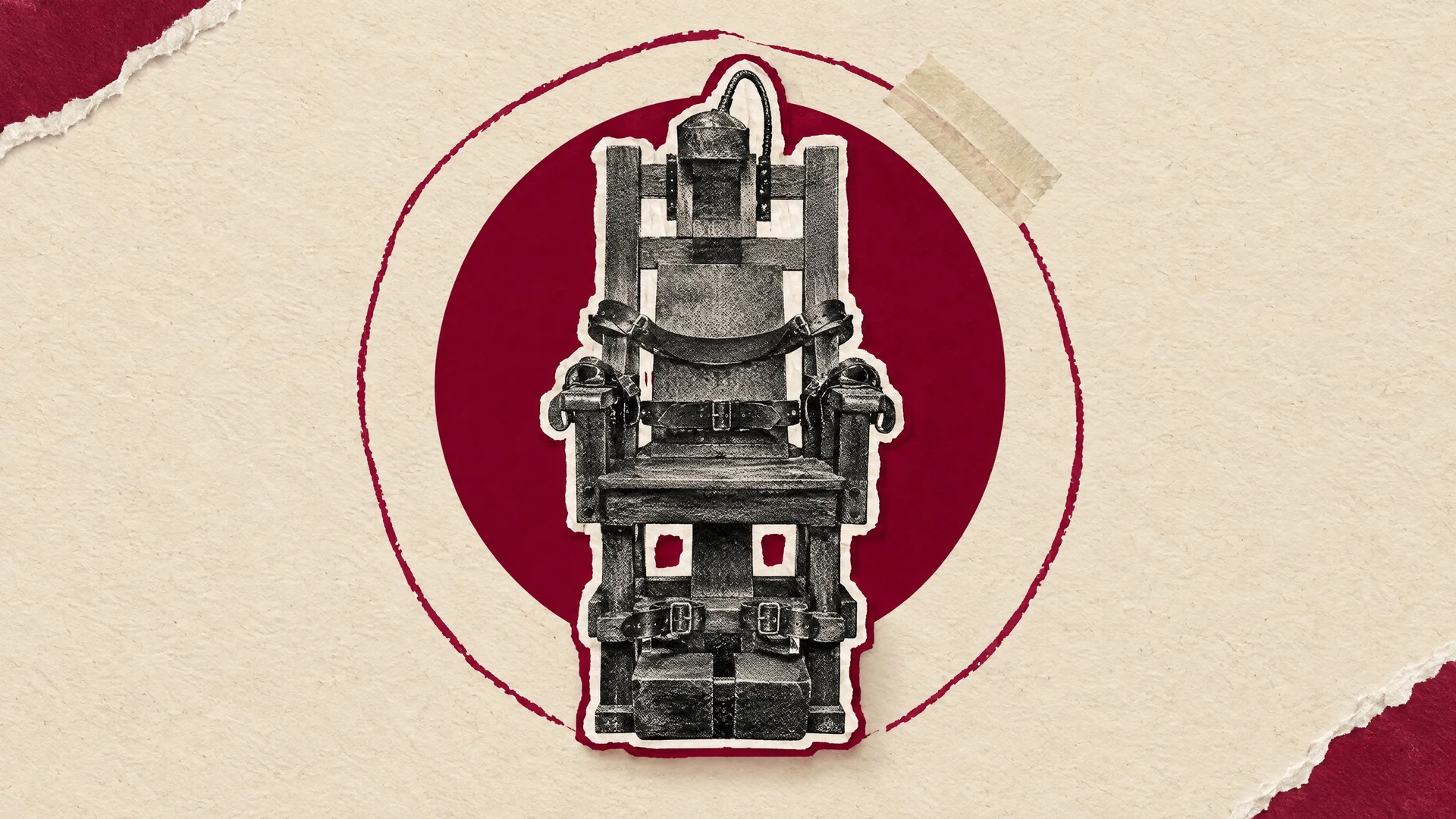
On December 3rd, 2026, the U.S. military will execute Nidal Hasan by firing squad at Fort Hood, the base where he killed thirteen people, and the execution will be livestreamed. Defense Secretary Pete Hegseth explained why: “We’ll make sure that people are able to watch it. That it’s public. Because people need to understand that there’s serious consequences for these types of things.”
Asked whether Hasan had made any final requests, Hegseth said: “Don’t care. We’ll see him on December 3rd.”
The Man in the Wheelchair
Hasan was an Army psychiatrist. On November 5, 2009, he walked into the medical building at Fort Hood and opened fire. Thirteen dead. Thirty-two wounded. He fired nearly 150 rounds inside and kept firing outside, until two civilian police officers, Kimberly Munley and Mark Todd, shot him and put him on the ground.
The gunfire paralyzed him from the chest down. Hasan has been in a wheelchair since 2009. He was convicted by court-martial in 2013 of thirteen counts of premeditated murder and thirty-two counts of attempted murder. The Supreme Court declined to review his case last year.
One of the thirteen dead was Private Francheska Velez, twenty-one, pregnant. Witnesses heard her screaming “my baby, my baby” as she was shot.
Seventeen years later, the man who killed her is scheduled to die in a chair, strapped in, in front of a row of rifles, on the same base where she died. The state calls the operation “Resolute Justice.” It sounds like a video game update.
The Rules Say Lethal Injection. The Plan Says Rifles.
Here’s where the procedure starts to confess.
Army regulations say military executions are carried out by lethal injection. The Pentagon’s plan is a firing squad. A firing squad is a departure from the written rule, and the written rule is being set aside for a reason nobody at the Pentagon is eager to say out loud: lethal injection has become a gamble. Earlier this month, the only woman on Tennessee’s death row survived two doses of pentobarbital.
When the poison stops working, the state reaches for the guns.
This gives Hasan’s execution a pile of firsts. The military hasn’t executed anyone since 1961, when Private John Bennett was hanged. The Army hasn’t used a firing squad since 1945, when Private Eddie Slovik was shot for desertion in World War II. The federal government has never livestreamed an execution to the public. It will be the first execution broadcast in world history, and it will happen at 2 p.m. Eastern on December 3rd, at the site of the shooting, seventeen years to the day after the massacre.
The venue was not an accident. The original plan, part of an operation to move soldiers off military death row, called for executions at the federal prison in Terre Haute, Indiana. Officials walked it back. The shooting happened at Fort Hood, so the killing will, too.
Symbolism as policy.
Why the State Stopped Executing People in Public
The United States did not move executions behind walls because it got squeamish. It moved them because public executions were a bad show in the worst way: the audience kept voting the wrong way.
In the old hanging days, the crowd did not stand there in solemn witness. It ate. It drank. It hooted at the condemned and cheered the hangman and grabbed for the rope as a keepsake. The state wanted the ceremony to read as justice. The crowd read it as an afternoon. Every public execution ended with the state handing its own authority over to a carnival, and by 1936 it was done. Rainey Bethea’s hanging was the last one, and the reason it was the last one was not mercy. It was embarrassment.
The state learned the lesson institutionalized in every death chamber since: killing is a state function, and state functions do not sell tickets.
So how the hell do you get from “state functions do not sell tickets” to “the Pentagon will livestream an execution”?
The answer is in the word livestream.
Debord Called This the Spectacle
Guy Debord is a French theorist from the 20th century who spent his career describing how social life gets replaced by its representation. In other words: we don’t live in reality anymore. We live in a picture of reality, and somebody owns the picture.
For Debord, the spectacle is not a collection of footage. It is a social relationship conducted through images. An execution livestream is that relationship in its purest form. One man dies, and the state’s bond with its citizens runs through a buffering icon.
The old public execution was a ritual the state staged in person. The livestream is a product the state ships. Twenty thousand people in a Kentucky field, or a platform’s entire user base staring at the same progress bar. Same ceremony. New distribution deal.
Watch the pieces fall into place. The platforms won’t say whether they’ll carry it. The FCC punted the question. Saturday Night Live is already running jokes. The most significant planned broadcast of the year is a state execution, and nobody in charge can tell you which app it will be on.
And here is the part that should make you slow down. Hegseth’s stated justification is deterrence: people need to understand there are serious consequences. But deterrence is a theory about preventing future killers. The livestream is a plan about reaching current viewers. The state isn’t trying to convince anyone not to shoot up a base. It’s trying to make sure the killing reaches an audience, because an execution that happens in private no longer counts as a consequence. It has to be seen to be believed, and it has to be seen to be real.
No conspiracy required. The spectacle doesn’t need a villain in a control room. It just needs the incentives to line up: a Secretary who wants a demonstration, a date on the calendar, a camera that already exists.
Who Isn’t in the Frame
Look at the announcement again. It names a deterrent. It names a schedule. It names a method. It does not name the thirteen dead, and it does not name their families.
There is no public conversation about what it costs the family of Francheska Velez to have the killing of their daughter’s killer replayed as scheduled programming. No conversation about the survivors, who will see the trailer for the event on a platform they opened for something else. The spectacle has no field for that. It never does.
That is the tell. A livestreamed execution is not justice with an audience. It is an audience with a body count.
The Arguments Nobody Gets to Finish
The case for broadcasting it is not stupid, and it deserves its say. Transparency. The public’s right to witness what the state does in its name. The families’ right to see the sentence carried out. All real.
But answer one question honestly. The people who most want to watch a man die at state hands, do they want to watch because they need to see justice, or because they’d have bought a souvenir in Owensboro? And the people who most need to see the state’s power, the ones who would rather look away, the livestream does not give them a choice. It does not ask for consent. It asks for attention, and attention is the only currency the spectacle recognizes.
The plan may not even survive. Hasan can still file a habeas petition in civilian court. One Yale law lecturer put it plainly: the case might outlast the current administration. What the stream would actually show, the volley, the moment, the aftermath, is undecided.
The state has announced a product before it has a distribution deal.
The Audience Is Part of the Procedure
Here is where the lens turns back on you.
The state abolished public executions because the crowd was undisciplined. It could not trust twenty thousand people to behave like a jury. The livestream solves that problem completely. Now the audience is assembled alone, each of us behind the same screen, present and absent at once. Close enough to see. Far enough to say we weren’t there.
The stream doesn’t need your approval. It needs your presence, and it has already banked it, because you are reading about it, because everyone is reading about it, because the announcement itself was the first episode.
Public used to mean the people could watch the state.
Six kids drive into a quiet neighborhood, jump out, and start pulling door handles on parked cars. No smashed windows. No tools. In a city like Atlanta, pull ten F-150 door handles and about three will be unlocked. One may have a gun inside.
That night, somebody’s gun was stolen.
The owner posted on Nextdoor: “Oh my gosh. I forgot my gun in my car, and it’s now gone.”
One neighbor who saw the post was an electrical engineer named Garrett Langley. He went to the police. The major he spoke with was, in Langley’s telling, “fairly apathetic.” Nobody had been physically hurt. There were no fingerprints and no useful evidence.
But the major told him what would change that.
A license plate.
So Langley built a plate reader by hand. An Android phone sealed inside a waterproof box, pointed at the entrance to his neighborhood. It photographed every car that entered. Within 30 days, it knew who lived there and who did not.
Two months later, another unlocked car. Another stolen gun. Langley gave police the plate of the one vehicle his system did not recognize. A lookout went out. Hours later, police found the vehicle, recovered the gun, and made an arrest.
Nine years later, that phone in a waterproof box had become a company valued at $7.5 billion. More than 100,000 cameras. Thousands of cities. One searchable network logging the movements of drivers across the United States.
And here is what one person could do with it.
In 2025, a sheriff’s deputy in Texas entered a search reason into Flock’s database: “had an abortion, search for female.” The query reached 83,345 cameras across 6,809 networks.
No warrant.
One deputy. One search. A national dragnet.
How did one stolen gun become one of the largest surveillance networks in American history?
From Victim to Watchman
Garrett Langley was not a police officer or defense contractor. He was an engineer whose previous startup, an airline seat-upgrade app, had been acquired by Cox Enterprises. Forbes noted that he had no experience in law-enforcement technology.
What he had was a prototype and a detective telling him it worked.
Langley called two former Georgia Tech classmates, Paige Todd and Matt Feury, and told them to quit their jobs. The three launched Flock Safety around a dining-room table in March 2017. They went through Y Combinator and sold a simple promise:
Evidence, not just footage.
Then came the decision that built the network. It was not a technical breakthrough. It was a sales strategy.
Police procurement is slow. Budgets. City councils. Requisitions. Public meetings. Flock went around that process by selling subscriptions to homeowners’ associations and neighborhood groups. Private citizens could approve a camera immediately, then share its footage with police voluntarily.
The state did not build the network.
Neighborhoods bought it and handed the state the keys.
Flock does not merely sell cameras. It leases them for roughly $2,000 to $3,000 per camera each year. By 2025, the company said it had passed $300 million in annual recurring revenue, growing about 70 percent in a year. Its investors include Andreessen Horowitz, Founders Fund, Kleiner Perkins, Tiger Global, and Y Combinator.
But nobody pays a $7.5 billion valuation for poles with lenses attached.
Every new neighborhood makes the system more valuable to every agency already using it. A camera records a plate. The network makes that plate searchable across jurisdictions. One HOA sees the entrance to one subdivision. Thousands of connected cameras see a person’s route.
The product is not the camera.
The product is the database.
Flock found another growth channel in local television. Langley has said the company’s first tens of millions in recurring revenue came “strictly off of five o’clock news.” When a camera helped solve a crime, Flock contacted the local station. Crime produced coverage. Coverage produced fear. Fear produced another subscription.
Fear was not a side effect.
Fear was the marketing department.
By 2025, Langley was no longer talking about one stolen gun. He told Forbes that Flock’s goal was to eliminate virtually all crime in America within a decade.
Not reduce it.
Eliminate it.
The founding story is compelling: a frustrated neighbor built a tool the police needed. A victim became a watchman. A camera solved a crime.
Then the camera became a network, and the watchman stopped being identifiable.
The Policies Say No. The Logs Say Yes.
Flock’s public position sounds reassuring. The company says customers own their data. Its website has stated that Flock will not share, sell, or access footage and that nobody at the company monitors it.
Whenever abuse comes up, the defense is familiar: Flock builds the tool. Customers decide how to use it.
Public records tell a different story.
MuckRock allows people to file Freedom of Information requests and publish the results. Search its archive for Flock Safety and you find contracts, emails, shared-network lists, and audit logs from departments across the country.
One records request produced a week of logs from Frisco, Texas.
Seven days. June 1 through June 7, 2026.
102,883 searches.
Most were not performed by Frisco police. Houston Police conducted 20,346 searches. Dallas Police conducted 17,598. The Texas Department of Public Safety conducted 11,607. Agencies with no jurisdiction in Frisco reached into the suburb’s camera network tens of thousands of times.
The same disclosure listed 590 organizations in the shared network. Police departments. Campus officers. Hospital districts. Home Depot. Lowe’s. Private corporations could operate their own cameras, flag vehicles, and generate alerts inside the same system used by law enforcement.
Flock does not need to share the data manually.
The network shares it by design.
The same architecture created three routes for federal access. A local agency can share directly. A local officer can conduct a search on behalf of a federal agency. Or a setting can expose a network beyond the jurisdiction that bought it.
Records reviewed by journalists and researchers found thousands of immigration-related searches. Agencies in Virginia conducted nearly 3,000 in twelve months. Denver logged more than 1,400 despite the city’s sanctuary policy. Atlanta denied cooperating with immigration enforcement while audit records showed searches performed on ICE’s behalf.
Then came Johnson County, Texas.
A woman’s partner reported that she had self-managed an abortion. A deputy entered her description and search reason into Flock. The query crossed state lines, including into states where abortion was legally protected, and returned sightings of her vehicle in Dallas.
Whatever your politics on abortion, the mechanism is the story. A state’s legal protection ended at its border.
The cameras did not.
The Electronic Frontier Foundation later obtained more than 12 million search logs from over 3,900 agencies. Among them were searches connected to political protests and animal-rights activists. First Amendment activity, converted into license-plate queries.
When officers wanted to obscure what they were doing, some entered “investigation” as the reason or reused case numbers unrelated to the search.
Cities often did not understand the reach of their own systems. Mountain View discovered that a broad lookup feature had been enabled on 29 of its 30 cameras without the city’s knowledge. Outside agencies searched its data hundreds of thousands of times. Syracuse’s network reportedly received 4.4 million searches in one year. Oxnard restricted access to California, only for a vendor-side issue to switch nationwide sharing back on.
Evanston canceled its contract. Flock allegedly reinstalled the cameras without permission.
How the fuck does that happen?
Even when nobody abuses the database, the database can be wrong. A Flock camera in Toledo reportedly confused a seven with a two. Police forced an innocent driver to the ground at gunpoint, a dog bit him, and he was jailed. Other false alerts have led officers to stop grandparents and families with children at gunpoint.
The database does not have to be right.
It only has to be believed.
The Algorithmic Panopticon
In 1787, English philosopher Jeremy Bentham designed a prison.
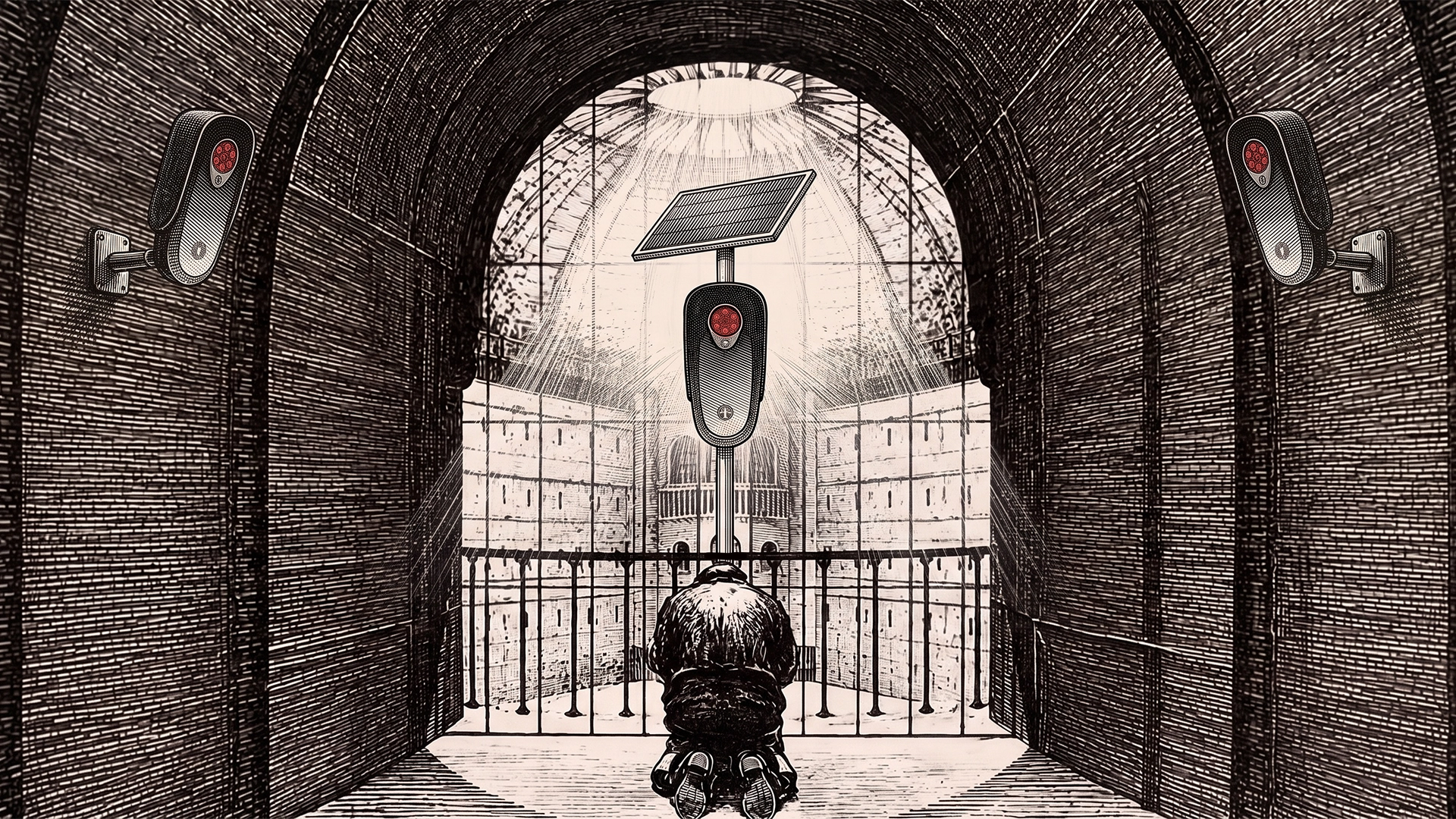
The cells formed a ring around a central watchtower. The prisoners were always visible. The tower’s windows prevented them from knowing whether a guard was looking back.
That uncertainty was the mechanism.
If an inmate could never verify when he was being watched, he had to behave as though he always was. Bentham called the design the Panopticon. He considered it a humane technology: discipline without chains, order without constant force.
In 1975, Michel Foucault recognized what the blueprint actually described.
Foucault was a French philosopher who spent his career studying the inner workings of power. In Discipline and Punish, he argued that the Panopticon was more than a prison. It was a diagram of modern society.
The genius of the tower is not the guard. It is the guard the prisoner builds inside himself.
Foucault wrote that power becomes “automatized and disindividualized.” Nobody has to occupy the tower continuously. Surveillance only needs to be possible, believable, and built into the environment. The prisoner does the remaining work.
This produces the standard objection: nobody is sitting behind a desk following your Honda to Trader Joe’s.
That objection is Foucault’s point.
The system does not require continuous observation. It requires uncertainty. You do not know whether an officer, federal agent, corporation, or HOA administrator will search your plate. You only know that they can.
Imagine driving to a protest. A clinic. An immigration lawyer’s office. The cameras exist on the route, but the search is invisible. Somewhere in the back of your mind appears a small question:
Maybe I should not go.
That hesitation is the panopticon working.
Bentham’s tower needed a guard who might be watching.
Flock’s tower has a search bar.
There is an honest limitation to the analogy. A panopticon nobody knows about cannot discipline anyone. Bentham’s inmates had to see the tower. Most Americans still do not know what a Flock camera looks like.
For them, the system is not yet a panopticon.
It is a dragnet.
But every investigation, canceled contract, and camera added to the DeFlock map makes the network more visible. Public awareness allows resistance. It also activates the psychological mechanism Foucault described.
You now know the grid exists.
Tomorrow you may notice it on your commute.
Power From the Bottom Up
The Panopticon explains what surveillance does. It does not fully explain who built this one.
Foucault rejected the idea that power is something the state simply owns and points downward like a weapon. Modern power, he argued, travels “capillary-wise.” It circulates through the smallest channels of ordinary life: schools, workplaces, hospitals, neighborhoods, and families.
People do not merely receive power.
They participate in it.
They classify each other. Report each other. Enforce norms. Collect records. Modern power makes authority less visible while making the population more visible.
Now return to Flock’s sales model.
Congress did not fund the network. No president announced it. HOAs, shopping centres, cities, and private companies assembled it subscription by subscription. Residents purchased the cameras with their own dues and mounted them at the entrances to their own neighborhoods.
Then they connected them to police.
This is sometimes called surveillance deputization. Ordinary people become extensions of a policing apparatus without anyone formally deputizing them.
The boundary between public and private authority did not get smashed in a dramatic takeover. It dissolved while looking like a neighborhood-watch upgrade.
And disciplinary power does more than observe. It sorts.
Research in Virginia’s Hampton Roads region found Flock cameras disproportionately concentrated in and around Black neighborhoods. Other audit logs showed officers using racial slurs for Romani and Traveller communities as reasons for “Convoy” searches.
The camera may read every plate using the same software.
The network does not watch every community equally.
The Total Sensorium
Late in an interview, Langley described the metric he uses to judge Flock’s success:
“For every crime that occurs that doesn’t get solved, it means we didn’t have enough cameras. That’s, to me, the easiest rubric.”
Follow that logic to its conclusion.
Every unsolved crime is evidence of insufficient surveillance. The correct number of cameras is always more. The final camera can only be installed after the final crime has been solved.
The plate reader becomes an entry point.
Flock’s Raven product adds audio detection. The company markets it for identifying gunshots, but the system can also flag voices, fireworks, and racing vehicles. The gaze develops ears.
Flock moved into “Drone as First Responder” technology after acquiring Aerodome and developing its Alpha drone. The gaze takes flight.
Then there is Nova.
Internal documents reported by 404 Media describe a product combining license-plate data with public records, property information, commercial data, and data-breach material. The stated capability is blunt: police can “jump from LPR to person.”
The system stops tracking vehicles and starts assembling people.
Foucault called this relationship power-knowledge. Systems of power create knowledge about a person, and every new record expands what institutions can do to the person inside it.
The database does not passively record you. It produces an institutional version of you.
Once the file exists, the next question is how it will be used.
The audit log supplied the answer:
“Had an abortion, search for female.”
Watching the Watchers
June 2026. Dayton, Ohio.
City workers approached surveillance cameras their own city paid for and covered them with trash bags.
Officials had discovered that Dayton’s Flock data was searched thousands of times for immigration enforcement, contrary to city policy. The cameras remained under contract. While the legal questions moved through the system, the city physically blinded its own panopticon.
Foucault wrote that where there is power, there is resistance.
Cities have canceled contracts. Privacy commissions have rejected deployments. Legislators have proposed warrant requirements, sharing restrictions, and limits on data retention. Some people have mapped cameras, blocked their infrared systems, covered their lenses, or cut the poles down.
Software engineer Will Freeman created DeFlock, a crowdsourced public map containing more than 100,000 plate-reader locations.
It is tempting to say the map defeats the Panopticon by making the cameras visible. Bentham’s inmates could already see the tower. Visibility was how the tower disciplined them.
DeFlock reverses the direction of observation.
Researchers call this sousveillance: watching from below. Map the cameras. Request the logs. Publish the contracts. Place the people inside the tower under observation.
The watchers become watchable.
But the map has a double edge. Every new pin helps people avoid or challenge the network. Every pin also reminds them the network exists. Resistance and discipline expand together.
Langley initially described opposition to Flock as coordinated attacks from groups seeking to weaken public safety. He called DeFlock a “terroristic organization” driven by chaos. After a bipartisan backlash, he apologized and acknowledged that critics had valid concerns.
Asked about websites mapping his cameras, he said: “Assuming no one is committing a crime, it’s perfectly fine.”
Read that again.
If you have done nothing wrong, being watched is no problem. For years, that was the argument for pointing Flock cameras at everyone else. When the gaze turned toward the company, accepting the same principle required a national backlash.
Whether the apology marks a change of heart or a change in public-relations strategy remains an open question.
The audit logs will answer it.
The Camera We Bought
One of the largest surveillance networks in American history was never imposed through a single law.
No vote. No decree. No dramatic expansion of federal power.
We bought it.
With HOA dues. With private security budgets. With city-council line items most people never read. We installed it on our streets, pointed it at our neighbors, and gave police access because a company promised evidence, safety, and solved crimes.
Garrett Langley did not force every town to join. He built a product, and institutions across the country lined up to deputize themselves.
That is the uncomfortable part.
The system wanted this more than he did.
Foucault’s warning was never limited to an authoritarian ruler staring down from a tower. Modern power rarely arrives wearing a crown. It travels through ordinary institutions and willing participants. It presents itself as administration. Efficiency. Care.
Or a subscription service costing $2,500 a year.
The cancellations prove the network can be dismantled. Dayton bagged its cameras. Other cities walked away. But hundreds of new municipalities continued signing contracts while the revolt grew.
Resistance and surveillance are racing across the same map.
Which side does your town land on?
You can check now. The map exists.
And remember how all of this began. One camera. An Android phone inside a waterproof box. A frustrated engineer trying to catch whoever stole a gun from an unlocked car.
The thief took the gun.
What has been taken since is a lot harder to recover.
References
Bentham, J. (1791). Panopticon; or, The Inspection-House.
Foucault, M. (1975). Discipline and Punish: The Birth of the Prison.
Foucault, M. (1976). Society Must Be Defended: Lectures at the Collège de France.
Flock Safety. Trust and Transparency materials and product documentation.
MuckRock. Flock Safety contracts, shared-network records, and agency audit logs.
Electronic Frontier Foundation. Flock Safety public-record investigations and ALPR litigation.
American Civil Liberties Union. Get the Flock Out campaign and Flock Safety research.
404 Media. Reporting on Flock network access, federal searches, camera security, and Nova.
Forbes. Reporting and interviews concerning Flock Safety, Garrett Langley, company growth, and opposition to the network.
Cheeky Pint. “Garrett Langley of Flock Safety” interview transcript.
In Fallout, the company selling protection from the end of the world is also helping to cause it.
Vault-Tec markets underground shelters to terrified Americans. Safe rooms. Clean water. A future for your family after the bombs fall. What its customers do not know is that many of the vaults are human laboratories. The survivors are not residents. They are test subjects.
The shelter is the product.
The people inside are the data.
This is the franchise’s central joke, and it is barely a joke anymore. Fallout imagines an America where corporations have grown so powerful that nuclear annihilation becomes another market opportunity. Vault-Tec sells survival. RobCo sells the machines running what remains. Arms manufacturers sell the war. Each company claims to be protecting civilization while building the machinery that destroys it.
Then Amazon turned it into a television show.
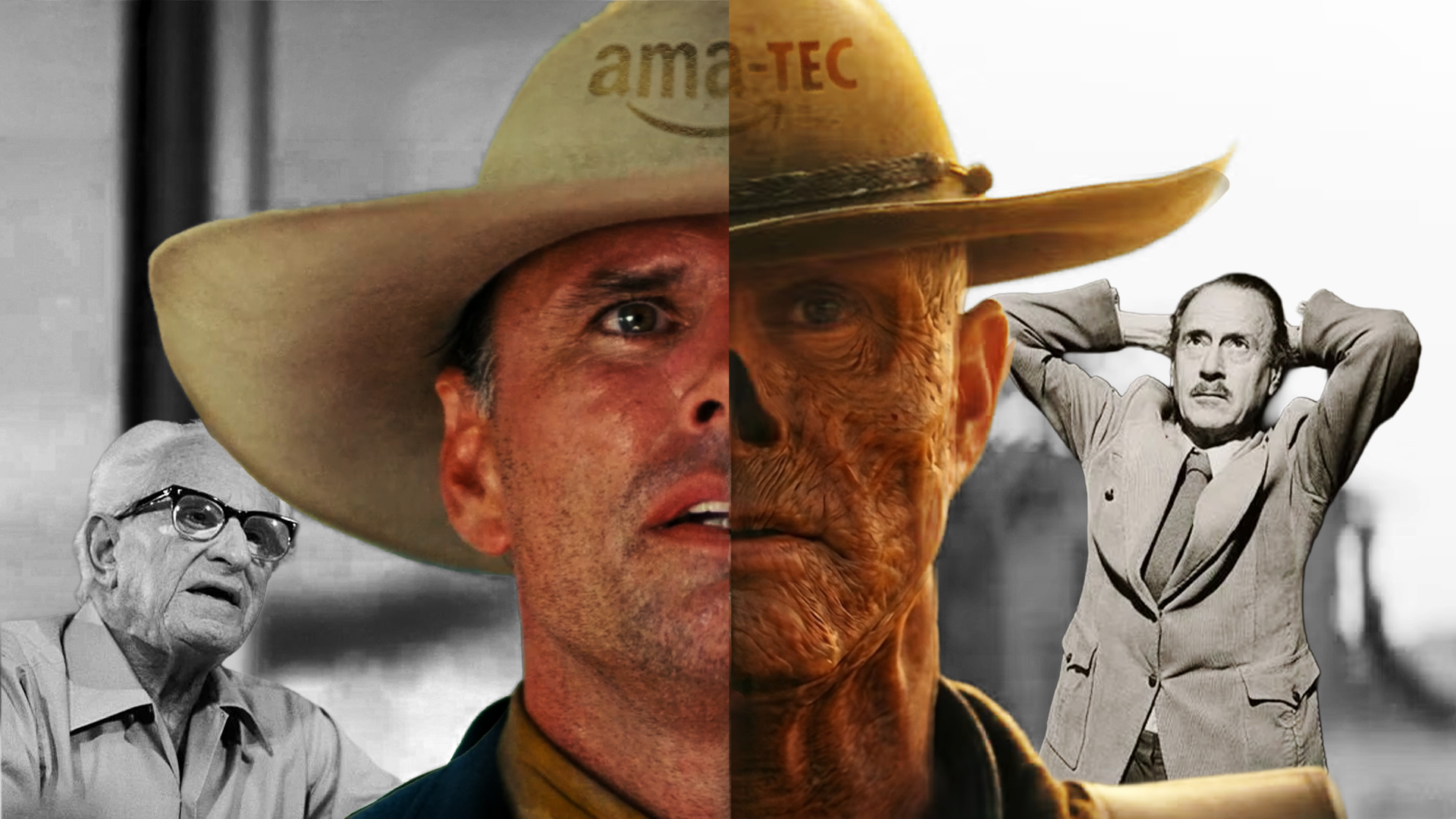
Yes, Amazon. The company that operates the storefront, the delivery network, the cloud infrastructure, the home surveillance devices, the voice assistants, and the streaming platform produced a prestige drama warning that private infrastructure will eventually swallow public life.
The contradiction is so obvious that co-showrunner Graham Wagner acknowledged it. The games carried what he called a “peak ’90s, Adbusters, anti-corporate energy.” Putting that story on Amazon, he said, was “too delicious for words.”
He is right.
But the joke goes deeper than Amazon paying for a show that makes companies like Amazon look evil. The show does not threaten Amazon despite its politics. Its politics make it valuable to Amazon.
Your disgust is part of the product.
The Corporation at the End of the World
Fallout has always been about more than nuclear war.
The bombs are the punchline. The setup is a society that treats every human need as a market waiting to be captured.
Food becomes a branded chemical substitute. Domestic labor becomes a robot. Personal computing becomes a Pip-Boy strapped to your arm. Safety becomes a subscription to Vault-Tec. Even the apocalypse gets a sales department.
The franchise’s factions turn different forms of modern power into mythology. Vault-Tec is private infrastructure masquerading as public salvation. RobCo is technological monopoly dressed as innovation. The Enclave fuses corporate secrecy with the military state. Mr. House is the billionaire sovereign: a man who saves one city with private missile defenses, then rules it through cameras, contracts, and a robot army.
None of them see themselves as villains.
Vault-Tec believes it is preserving humanity. House believes democracy is inefficient. The Enclave believes power belongs to the people capable of using it. Each begins with a recognizable promise: safety, progress, order.
Then the promise becomes absolute.
That is what makes the Amazon adaptation so sharp. Amazon does not resemble Vault-Tec because Jeff Bezos has a secret button that launches nuclear missiles. It resembles Vault-Tec because both companies present private infrastructure as the natural solution to public failure.
Need groceries? Amazon. Need entertainment? Amazon. Need web hosting? Amazon Web Services. Need a camera on your door, a speaker in your kitchen, or a network connecting the devices in your neighbourhood? Amazon has an answer.
Every answer adds another room to the vault.
The comparison is not perfect, and it does not need to be. Satire works by exaggerating a structure until we can finally see it. Fallout takes the logic of corporate dependence and follows it past the point where the marketing language collapses.
What happens when a company becomes responsible for so much of daily life that leaving it feels less like changing stores and more like leaving society?
You get a vault.
Or a platform.
The branding changes. The relationship does not.
McLuhan Had the Answer in 1964
Marshall McLuhan was a Canadian media theorist who studied how communication technologies alter human perception and social organization.
His most famous line is also one of the most misunderstood:
The medium is the message.
McLuhan’s point was not that content means nothing. It was that the structure of a medium changes society more deeply than the particular content passing through it.
A railway can carry wheat, soldiers, tourists, or copies of The Communist Manifesto. Whatever sits inside the train, the railway reorganizes cities, work, distance, and time. Its social effect comes from the scale and pattern it introduces.
Prime Video works the same way.
Fallout can say Vault-Tec is evil. It can mock monopolies, privatized government, military contractors, and billionaire fantasies. But you encounter every one of those ideas through an Amazon subscription, inside an Amazon interface, selected by an Amazon recommendation system.
The content says: fear corporate infrastructure.
The medium says: corporate infrastructure is where culture lives.
You are not watching Amazon from outside Amazon. You are using an Amazon account, on an Amazon platform, to consume Amazon’s criticism of companies that behave like Amazon. If you bought snacks for the premiere, there is a decent chance Amazon delivered those too.
McLuhan compared content to a piece of meat carried by a burglar to distract the watchdog. We stare at what the story says while the medium quietly changes the pattern around us.
The story gives you Vault-Tec.
The platform gives Amazon your time, your attention, your viewing history, and another reason to renew next month.
The message is not “corporations are bad.”
The message is Prime Video.
Content is irrelevant. Subscription is the ideology.
Debord Saw the Critique Become a Commodity
Guy Debord was a French Marxist theorist who argued that modern life had been replaced by representations of life.
He called the result the spectacle.
The spectacle is not merely television, advertising, or social media. It is a social order where our relationships with politics, culture, other people, and even ourselves are increasingly mediated through images and commodities.
In other words, we stop participating in the world and begin consuming representations of participation.
We do not resist corporate power. We watch a show about resisting corporate power.
We do not survive the wasteland. We buy a Vault 33 hoodie and spend Saturday roaming a digital version of it.
We do not overthrow Vault-Tec. We make memes about Vault-Tec on platforms owned by other corporations.
Debord understood that the spectacle could absorb rebellion. In thesis 59 of The Society of the Spectacle, he argued that dissatisfaction itself becomes a commodity once the economy develops the ability to process it as raw material.
That sentence could be Amazon’s commissioning strategy.
The company does not need every show to praise corporate power. Praise is boring. Rebellion sells. Cynicism sells. The feeling that you understand how rigged everything is sells extremely well.
This process is often called recuperation: oppositional ideas are absorbed by the dominant culture, stripped of their practical threat, and sold back as style.
Punk becomes a shirt at the mall.
Che Guevara becomes a poster.
Anti-capitalism becomes a content category.
Fallout does not hide its criticism inside an obscure subplot. The criticism is the hook. Vault-Tec’s smiling mascots, corporate experiments, and homicidal sales logic give the show its identity. Amazon can then convert that identity into subscriptions, merchandise, clips, discourse, and renewed interest in a game franchise worth billions.
The stronger the critique, the better the engagement.
The spectacle does not censor dissent. It gives dissent a production budget.
Marcuse’s Pressure Valve
Herbert Marcuse was a German-American philosopher who studied how advanced industrial societies neutralize opposition without always needing to suppress it.
His phrase for part of this process was repressive desublimation.
The idea sounds more complicated than it is. A stable system can protect itself by giving people controlled access to the feelings and desires that might otherwise challenge it.
Let them rebel.
Just make the rebellion convenient, pleasurable, and commercially available.
Older forms of censorship told artists what they could not say. Platform capitalism discovered that it can let them say almost anything, provided the speech returns as inventory.
You can hate the corporation for eight episodes.
The next episode starts automatically in ten seconds.
This is what makes Fallout more useful than corporate propaganda. Propaganda asks us to believe that companies are good. Most people would laugh. Fallout agrees with our suspicion. It tells us the companies are monstrous, the executives are insane, and the system is marching toward disaster.
We feel seen.
Then we feel entertained.
Then the feeling passes.
The anger has nowhere to go except back into the subscription. Corporate criticism becomes a leisure activity provided by the corporation. The system sells us the emotional release of rejecting it without requiring that anything be rejected.
This does not mean Amazon executives held a secret meeting and selected Fallout as a psychological weapon against the left. That explanation gives them too much credit.
No conspiracy is required.
The incentives already align. Amazon wants prestige programming that attracts and retains viewers. Viewers want stories that acknowledge their distrust of concentrated power. Writers want enough money and freedom to tell those stories. The result is sincere art operating inside a system capable of converting sincerity into revenue.
The critique can be real.
The absorption can be real too.
Marcuse’s point was not that mass access to art is bad. It was that incorporation changes art’s relationship to the existing order. The work that once stood apart as a refusal becomes another option in the catalogue.
Rebellion. Comedy. Drama. “Customers also watched.”
Capitalist Realism in the Wasteland
Mark Fisher was a British cultural critic who described a world where capitalism no longer appears to be one political system among others. It feels like reality itself.
He called this capitalist realism.
Fisher opens his book with a line attributed to Fredric Jameson and Slavoj Žižek: it is easier to imagine the end of the world than the end of capitalism.
Fallout takes that literally.
The bombs fall. Governments collapse. Cities become radioactive ruins. Humanity crawls underground, mutates, starves, and kills for clean water.
Capitalism survives.
Bottle caps become currency. Mercenaries sell violence. Caravans move goods. Corporations remain embedded in the bunkers and machines beneath the rubble. Mr. House turns Las Vegas into a private city-state. Vault-Tec continues its experiments through systems set in motion centuries earlier.
The world ends.
The business model does not.
This is why Amazon producing Fallout feels less like a contradiction than the final expression of the show’s argument. Capitalism can imagine its own crimes. It can dramatize its own collapse. It can show us the boardroom where executives discuss the profitability of nuclear war.
What it struggles to imagine is an outside.
Even our warnings arrive as services. Even our disgust has a monthly fee. Even the apocalypse is intellectual property moving through a vertically integrated distribution system.
And I say this as someone who loves Fallout. The games more than the show, but both. The satire is sharp. The world is funny, ugly, and painfully recognizable. None of that becomes false because Amazon paid for it.
The problem is believing recognition equals resistance.
Watching Vault-Tec behave exactly like we expect a corporation to behave can make us feel politically alert. We spotted the metaphor. We understood the reference. We know who the bad guys are.
Then the credits roll and the interface recommends another critique.
Amazon does not need to convince you it is innocent.
It only needs to convince you to keep watching.
That is the Fallout paradox. The show warns that corporations will turn the end of the world into a product, and the corporation turns that warning into a product.
War never changes.
Neither does the checkout page.
References
Debord, G. (1967). The Society of the Spectacle.
Fisher, M. (2009). Capitalist Realism: Is There No Alternative? Zero Books.
Kurczynski, K. (2008). “Expression as Vandalism: Asger Jorn’s ‘Modifications.’” RES: Anthropology and Aesthetics, 53/54.
Marcuse, H. (1964). One-Dimensional Man: Studies in the Ideology of Advanced Industrial Society. Beacon Press.
McLuhan, M. (1964). Understanding Media: The Extensions of Man. McGraw-Hill.
Wagner, G. (2024). Interview with TheGamer on adapting Fallout for Amazon.
Spoiler alert: Plato did not write about large language models 2,400 years ago.
But he did imagine a group of people chained inside a cave, staring at images projected onto a wall and mistaking those images for reality. Today, billions of us spend hours staring into illuminated rectangles filled with people we have never met, places we have never visited, and events we cannot verify.
At least Plato’s shadows were cast by real objects.
Ours can be generated by a GPU.
The travel vlogger walking through Peru may never have left their bedroom. The model selling subscriptions on Instagram may not exist. The politician’s voice may have been cloned. Most of the time, we only notice when the illusion breaks: six fingers, mangled text, a reflection that follows the wrong laws of physics.
The glitch is the moment the prisoner sees the wall.
And the comparison gets stranger. Generative AI does not merely produce shadows. Inside its models, concepts are organized as mathematical relationships in high-dimensional spaces. Chair. King. Woman. Justice. Beauty. Not as physical objects or lived experiences, but as coordinates inferred from patterns in human data.
Plato called his abstract structure the Forms.
AI researchers call theirs latent space.
They are not the same thing. But they are close enough to create a deeply uncomfortable question: did we use computation to discover a mathematical structure beneath reality, or did we build the most convincing cave in human history?
The Original Cave
Plato presents the Allegory of the Cave in Book VII of The Republic.
Imagine prisoners chained inside a cavern from childhood. They cannot turn their heads. Behind them burns a fire. Between the fire and the prisoners, puppeteers carry statues of people, animals, and objects along a raised walkway.
The fire casts shadows onto the wall.
The prisoners give those shadows names. Dog. Tree. Person. Because the wall is all they have ever seen, they do not understand the shadows as representations of something else. The image is the object. The echo is the voice. The projection is reality.
Then one prisoner is freed.
He turns toward the fire and the objects casting the shadows. The light hurts. What he had called reality suddenly looks thin and fraudulent. When he is dragged outside, the sun blinds him again. Slowly, painfully, he learns to see the world that produced the images.
For Plato, this is a story about education, knowledge, and the difference between appearance and truth. The sensible world gives us partial and unstable impressions. Reason points beyond those impressions toward what Plato called the Forms: the intelligible, unchanging structures that make knowledge possible.
In other words, the chair in your kitchen can break, rot, or lose a leg. The concept of a chair does not.
No two chairs are identical. A plastic patio chair, a Victorian throne, and a 1970s beanbag barely resemble one another. Yet we place them inside the same category without much effort. Plato’s answer was that particular objects participate, imperfectly, in a stable Form.
The physical chair changes.
Chair-ness remains.
Plato believed knowledge meant turning away from the shifting shadows and toward the structure behind them. Generative AI appears to do something similar. It consumes millions of particular examples and compresses their relationships into mathematics.
But appearances can be deceiving.
Especially when appearances are the only thing the machine has ever known.
The Forms Inside the Machine
An AI model has never sat in a chair.
It has no sore back. No memory of cheap classroom plastic. No instinctive understanding that a chair is something a tired body collapses into after work.
It has data.
Images. Captions. Text. Pixels. Tokens. Patterns left behind by people who have encountered chairs in the world.
During training, a model learns statistical relationships within that data. Similar features and concepts become organized near one another in a high-dimensional representational space. Dissimilar things move farther apart. The model does not store one perfect JPEG labelled CHAIR. It learns enough of the recurring structure to generate a new chair that never physically existed.
This is where the Platonic comparison becomes seductive.
The model looks across countless imperfect examples. It ignores many of their accidental details. The paint. The dust. The room. The angle of the camera. What remains is a mathematical structure capable of producing another recognizable example.
A human sees a chair and thinks of sitting.
The machine sees a position relative to other positions.
One of the most famous demonstrations comes from word embeddings. In these systems, words are represented as vectors: long lists of numbers placing them inside a mathematical space. Researchers found that some relationships could be approximated through arithmetic:
king − man + woman ≈ queen
The result is not magic, and it does not prove that a machine has discovered the eternal essence of royalty. It shows that the training data contains a relational structure the model can encode geometrically. Gender, status, geography, tense, and countless other patterns become directions through a space.
That distinction matters.
Plato’s Forms are supposed to be more real than the objects we perceive. An embedding is downstream from human language. It inherits our categories, associations, omissions, and prejudices. Plato’s Form of Justice is an objective standard. An AI model’s representation of justice is a statistical fossil made from everything people have written about it.
One aims at truth.
The other predicts what comes next.
Still, the resemblance is difficult to ignore. We have taken concepts that once seemed immaterial and rendered their relationships as geometry. Abstract philosophy became something we can probe inside a machine.
We moved the Forms out of heaven and into a data centre.
The Platonic Representation Hypothesis
In 2024, researchers Minyoung Huh, Brian Cheung, Tongzhou Wang, and Phillip Isola gave this comparison a name: the Platonic Representation Hypothesis.
Their claim is not that neural networks have proven Plato right. It is that as different AI models become more capable, their internal representations appear to become more alike. Large vision and language models trained on different data and different tasks can organize relationships between objects in surprisingly similar ways.
The authors hypothesize that these models may be converging toward a shared statistical model of reality.
Think about how strange that is.
One machine learns through images. Another through text. Another through audio. They begin from different sensory shadows, built by different companies with different architectures, yet may form comparable maps underneath.
If every sufficiently capable model starts drawing the same map, there are two possible explanations.
The first is mundane: the models are trained on overlapping human culture, optimized through related methods, and rewarded for capturing the same useful correlations.
The second is Platonic: there really is a common structure beneath the data, and intelligence tends to find it.
The paper presents a hypothesis, not a revelation. Later work has challenged how much of the apparent convergence survives stricter measurement. Some broad similarities may partly reflect model scale, while local relationships remain more convincing.
The map is appearing.
We still do not know whether it belongs to reality or to the machinery we use to measure it.
The Reverse Cave
Plato’s prisoner escapes by moving from images toward their source.
AI moves in the opposite direction.
It begins with records of human experience: photographs, books, conversations, paintings, videos. These are already representations. The model compresses them, then produces new text and images from that compression. When those outputs spread across the internet and enter future training sets, the next model learns from representations of representations.
Shadows trained on shadows.
Researchers have warned that repeatedly training models on generated data can degrade their outputs, a problem commonly described as model collapse. Rare features disappear. Errors compound. The strange edges of reality get replaced by the model’s statistically safe centre.
The average consumes the exception.
This is not only a technical problem. A model trained on the past does not discover Beauty or Justice in Plato’s sense. It learns which faces have historically been labelled beautiful and which decisions have been described as just. Bias does not enter the cave as sabotage. It enters as training data.
No conspiracy is required.
The model reflects the archive. The archive reflects the institutions that preserved it. The institutions reflect the people who had the power to record, publish, classify, and exclude.
Then the output returns to us wearing the authority of mathematics.
We ask the model what a CEO looks like. What a criminal looks like. What a beautiful woman looks like. What a trustworthy voice sounds like. The machine gives us the statistical answer, and the statistical answer produces more images, more stories, more hiring decisions, more expectations.
The shadow becomes evidence for itself.
Plato worried that prisoners would defend the wall because it was the only reality they understood. We may do something worse. We may let the wall update the world until reality begins to resemble its projection.
What If the Shadow Is Perfect?
Right now, AI reveals itself through mistakes.
The sixth finger. The impossible reflection. The confident lie. These glitches reassure us that there is still a meaningful border between the image and the thing it imitates.
But what happens when the errors disappear?
Imagine a generated world where the physics are exact, every voice is convincing, and every interaction responds as a person would. The light hits the water correctly. The stranger remembers your last conversation. Nothing breaks the illusion because the illusion behaves exactly as expected.
Is a perfect shadow still a shadow?
The rationalist answer is no. Gottfried Wilhelm Leibniz dreamed of a universal symbolic language in which disputes could be reduced to calculation. Modern physicist Max Tegmark goes further, arguing that physical reality is itself a mathematical structure. From this view, if a model captured every relationship perfectly, nothing essential would remain outside the map.
The math would not describe reality.
The math would be reality.
David Hume would be less impressed. A machine can learn every statistical relationship between fire, smoke, pain, and heat without ever feeling a flame. It has the pattern without the impression. The description without the sensation.
Immanuel Kant creates an even harder boundary. Human beings never encounter the thing-in-itself directly; we experience the world after it has been organized by our own faculties of perception. AI is trained on the products of those faculties. It is a filter built from the output of another filter.
A goggle for our goggles.
From that view, even a flawless model would remain downstream from reality. It could produce the perfect map of human experience while knowing nothing of what exists beyond it.
So which is it?
Did the machine find the structure of the universe, or the structure of our descriptions of the universe?
The answer depends on whether you believe a perfect representation leaves anything behind.
The Map Over the Territory
Jorge Luis Borges imagined an empire whose cartographers became so precise that they produced a map on the same scale as the empire itself.
One mile of paper for one mile of land.
The map covered the territory it was supposed to represent. Later generations abandoned it, leaving torn fragments across the desert.
Generative AI reverses Borges’s ending. We are not abandoning the map. We are moving onto it.
Our friendships pass through recommendation systems. Our jobs are filtered by scoring models. Our art is scraped into datasets, compressed into vectors, regenerated, and fed back into the culture. Our conversations train systems that will shape later conversations. The representation no longer sits beside the world as a passive copy. It selects what we see and alters what gets made.
The map recommends the territory.
The territory adapts.
The updated territory trains the next map.
Plato wanted the prisoner to turn around, endure the pain of the light, and search for the source of the shadows. We are taking the source material and using it to make the shadows brighter. More responsive. More personal. More comfortable than whatever waits outside the cave.
Maybe AI is approaching a World of Forms: a common mathematical structure toward which different intelligences converge.
Or maybe latent space is only the cave perfected. Not truth, but a model of everything humanity has already mistaken for truth.
Either way, we are no longer just watching shadows on the wall.
We are feeding them.
And eventually, they will feed us back to ourselves.
References
Huh, M., Cheung, B., Wang, T. & Isola, P. (2024). The Platonic Representation Hypothesis. arXiv:2405.07987.
Mikolov, T., Chen, K., Corrado, G. & Dean, J. (2013). Efficient Estimation of Word Representations in Vector Space. arXiv:1301.3781.
Plato. Republic, Book VII, 514a–521b.
Shumailov, I. et al. (2024). AI Models Collapse When Trained on Recursively Generated Data. Nature, 631, 755–759.
Borges, J. L. (1946). On Exactitude in Science.
Gröger, F., Wen, S. & Brbić, M. (2026). Revisiting the Platonic Representation Hypothesis: An Aristotelian View. arXiv:2602.14486.
“We are as gods and might as well get good at it.” — Stewart Brand, 1968
Stewart Brand wrote that in the first Whole Earth Catalog — the bible of the counterculture. The same counterculture that dropped acid hoping to dissolve hierarchies, that saw the personal computer as the new LSD, that genuinely believed technology could liberate humanity from the prison of industrial capitalism.
Fifty-six years later, Elon Musk personally decides which posts 300 million people see on what used to be our version of the public square. Jeff Bezos owns the infrastructure through which over 40% of American e-commerce flows, collecting a cut of every transaction like a feudal lord taxing river crossings. Mark Zuckerberg runs a machine that knows you’re pregnant before your family does, that predicts your politics with more accuracy than you could articulate yourself, that shapes your reality through algorithms you’ll never see.
Brand was right. These men are gods. They got good at it.
But he never defined “we.” In the 21st century, it’s obvious: “we” never meant all of us. The hippies didn’t destroy the hierarchy — they built a new one. The libertarians didn’t eliminate authority — they privatized it. The tech utopians who promised to democratize everything created the most concentrated power structure in human history.
When we dreamed of the future, we imagined liberation. What we got was technofeudalism.
The Californian Ideology
In 1995, British academics Richard Barbrook and Andy Cameron noticed something strange happening in the West and published an essay about it: The Californian Ideology.
Their argument was simple and explosive. The hippies and the yuppies — the acid-dropping communalists and the free-market fundamentalists, the people who wanted to burn the system down and the people who wanted to optimize it — had inexplicably merged into a single ideological force.
This shouldn’t have been possible. These two groups had been at war.
On one side: conservative capitalists. Reagan Republicans. Believers in unfettered private enterprise, supporters of the Vietnam War, people who saw hippies as a genuine threat to American civilization. On May 15, 1969, Reagan literally sent the National Guard to raid Berkeley radicals protesting the war on campus. One man was shot dead. Over 125 needed hospital treatment. This wasn’t a policy disagreement. It was a pseudo-civil war.
On the other side: the counterculture. Dreamers who opposed imperialism, sexism, mindless consumerism, and everything the establishment represented. Deeply influenced by Marshall McLuhan, who argued that the convergence of media, computing, and telecommunications would produce a virtual democracy free from inequality. They believed technology would overthrow big business and big government — not through organizing or fighting for state power, but automatically. The tools themselves would do the liberating.
Twenty-five years after Reagan’s National Guard raid, Barbrook and Cameron argued these two sides had synthesized. And the glue was technological determinism — the shared belief that technology, by its very nature, produces freedom.
You could be anti-establishment and pro-market. A rebel and an entrepreneur. You could rage against institutional authority while building your startup. Drop acid on the weekend, optimize stock options on Monday. As Barbrook and Cameron wrote: “The Californian Ideology happily answers this conundrum by believing in both visions at the same time — and by not criticising either of them.”
This caught fire because most participants in both movements were skilled information workers — programmers, engineers, marketers — who worked within or adjacent to the emerging tech industry. Unlike assembly line workers, they couldn’t easily be replaced. They had autonomy, creative control, good pay, interesting problems. They had power over their labor in a way most people didn’t.
There was no need to keep protesting. This was the dream. And when these hippies got burnt out of corporate culture, they became entrepreneurs themselves. They stopped demanding public solutions and started trying to fix problems individually. They accepted that liberation depends on your personal talent, your hustle, your ability to surf the wave of technological change.
But for this mythology to hold — for the self-made entrepreneur to feel real — you have to ignore how Silicon Valley was actually built.
The first computer was funded by a £17,470 British government grant in 1834. IBM only built the first programmable digital computer because the U.S. Defense Department commissioned it during the Korean War. The entire internet was built with taxpayer dollars through DARPA. GPS, touchscreens, voice recognition, search algorithms — all came from publicly funded research. When Japanese companies threatened American dominance in microchips in the 1980s, the libertarian computer capitalists of California had no ideological qualms about joining a state-sponsored cartel to fight them off.
Silicon Valley didn’t invent DIY culture. They commercialized it. They took the collective achievements of hobbyists and privatized them for profit.
The new left’s suspicion of institutions wasn’t wrong. Governments do fund the military-industrial complex. Corporations do exploit workers. But their response — exit the system, build alternative digital communities, let tech do the liberating — led them to abandon the fight for collective power. And that vacuum was filled by privatized power that put all its faith in markets.
Treating technology as a force of nature, inevitable and beyond politics, sounds like optimism. It’s actually surrender. It’s saying: we shouldn’t try to collectively shape the future. We should let whoever owns the tools decide.
The Californian Ideology is the con. It’s how you get people to accept oligarchy while believing they’re living through liberation.
The hippies who built it — the ones who genuinely thought they were creating freedom — ended up building institutions more powerful and more oppressive than anything the 1960s radicals were fighting against. Facebook controls public discourse more effectively than any government propaganda. Amazon dominates retail more completely than Standard Oil ever dominated energy. Google surveils you more thoroughly than the FBI ever dreamed of.
And the people running these companies still see themselves as rebels. Outsiders. Disruptors.
They didn’t escape the Man. They became the Man — just with better PR.
From Ideology to Infrastructure
Silicon Valley companies all say the same things: “We’re building tools that empower individuals. We’re creating open systems where anyone can compete. Information wants to be free.”
What they actually built: platforms that require you to surrender control to use them, walled gardens with switching costs so high you’re essentially trapped, and a surveillance apparatus that rivals the NSA.
Ideology alone doesn’t build monopolies. You need mechanisms. Three of them, specifically.
Engineering Dependence
Mark Zuckerberg didn’t invent social networking. What Facebook figured out was how to make your relationships proprietary.
MySpace was first and bigger. But it was a mess — fake profiles, bots, catfishing. Facebook’s innovation was requiring mutual friend connections. Someone had to vouch for you. This created a verified social graph: a network of authenticated relationships. And once you built that graph, it became impossible to replicate elsewhere.
You don’t use Facebook because you like Facebook. You use it because your family, your friends, and your colleagues are on it. The software isn’t special. The network — years of connections, photos, memories — is irreplaceable.
Internal emails obtained by the FTC reveal Facebook understood this explicitly. January 2012: “Photos are perhaps one of the most important ways we can make switching costs very high for users… it will be very tough for a user to switch if they can’t take those photos and associated data/comments with them.”
They weren’t subtle about it. The FTC called it the “ratchet effect” — switching costs that increase over time. The longer you use Facebook, the more trapped you become.
Google+ proved the trap works. Google spent $585 million building a competitor. Unlimited resources, billions of users, the best engineers on earth. It failed spectacularly — 90% of users couldn’t stay on the platform for more than five seconds. Why? As Facebook’s internal emails noted: “People who are big fans of G+ are having a hard time convincing their friends to participate because switching costs would be high due to friend density on Facebook.”
You could build a technically superior product with infinite money and it wouldn’t matter. Facebook won not because it was better, but because it achieved critical mass first. Network effects at scale make you invincible.
Google operates on the same logic, different mechanism. More users generate more queries. More queries produce better training data. Better algorithms attract more users. Repeat. The August 2025 DOJ ruling revealed the scale: Google receives nine times more web queries per day than all rivals combined. Nineteen times more on mobile. Over 90% of unique search phrases on the web are only ever seen by Google — giving them an insurmountable algorithmic advantage their competitors will never close.
Amazon’s version: external sellers pay up to 50% of each sale back to Amazon, yet can’t leave because their customers are all there. A 2023 FTC lawsuit revealed Amazon was copying external vendors’ products, selling them cheaper, and burying the competition in their own algorithm. It’s not a marketplace. It’s a managed extraction system where the emperor decides who lives and who dies.
Regulatory Arbitrage
Did you know Uber and Lyft aren’t classified as transportation companies? They’re “technology platforms that connect riders with drivers.” The semantics matter because taxi companies follow taxi regulations — vehicle safety, background checks, commercial insurance, labor laws. Technology companies don’t.
When California passed a law requiring gig companies to classify drivers as employees, Uber, Lyft, and DoorDash responded by threatening to shut down operations and raising over $200 million for a ballot initiative. Proposition 22 passed with 59% approval — built on a campaign of consumer incentives, discounts, and manufactured dependence. A UC Berkeley study found drivers post-Prop 22 earn an average of $5.97 per hour after expenses.
When legislative lobbying fails, you take it directly to voters with overwhelming spending. When that’s not enough, you hire the government itself. Tech lobbying went from $19.2 million combined in 2010 to $124 million in 2020. Meta alone spent $25 million in 2024. Six major tech companies employ roughly 300 lobbyists — one for every two members of Congress. 86% of Facebook’s lobbyists previously worked in government. 94% of Congress members with jurisdiction over privacy and antitrust received money from Big Tech PACs or lobbyists.
What that money buys: performative congressional hearings where CEOs give non-answers. Privacy bills so watered down they’re meaningless. Enforcement actions that result in settlements — fines that sound enormous but represent fractions of revenue, with no admission of wrongdoing.
Surveillance Capitalism
Harvard professor Shoshana Zuboff spent years studying Google and concluded they invented a new economic logic she calls surveillance capitalism: “the unilateral claiming of private human experience as free raw material for translation into behavioural data.”
Before 2001, Google used your data to improve search. Symbiotic — you get better results, they get better algorithms. After 2001, they realized that same data could predict which ads you’d click on. Those predictions were worth money. So they started keeping behavioural surplus — data not needed to improve their service, just valuable to advertisers. Google went from $19 million in revenue in 2000 to $3.5 billion in 2004.
But it goes beyond prediction. As Zuboff writes: “The shift is from monitoring to what data scientists call actuating. Surveillance capitalists develop economies of action, as they learn to tune, herd, and condition our behaviour with subtle cues, rewards, and punishments that shunt us toward their most profitable outcomes.”
You think you’re choosing. The algorithm is studying what makes you click, what makes you buy, and engineering your environment to produce more of both. You’re not the customer. You’re the raw material.
In January 2012, Facebook conducted what may be the largest psychological field experiment in history: they manipulated the emotions of 689,003 users without consent by altering their news feeds. When positive content was reduced, people produced fewer positive posts. When negative content was reduced, the opposite occurred. Facebook demonstrated it could systematically alter your emotional state at scale by controlling your information environment. When this came to light in 2014, they pointed to their data use policy as consent.
The antitrust framework was completely unequipped to respond. Under the Consumer Welfare Standard, antitrust lawsuits can only focus on consumer prices. But these companies don’t charge for their services. It wasn’t until Lina Khan published Amazon’s Antitrust Paradox that people began to understand how inadequate the framework was — and by then, the monopolies were too entrenched, the switching costs too high, the political will too weak.
Three mechanisms. Engineering dependence. Regulatory arbitrage. Surveillance capitalism. Built deliberately, carefully, profitably. The Californian Ideology became infrastructure.
And that infrastructure ushered in something scholars are only now finding words for.
Technofeudalism
Amazon takes 45% from third-party sellers as of 2024. Not 45% of profit. Not 45% of revenue. 45% of an entire sale. If you sell a $100 product, Amazon takes $45 before you’ve paid for manufacturing, shipping, storage, or your own time.
In 2014, Amazon took 10%. In ten years they more than quadrupled the tribute. Not because Amazon got better at anything. Not because it started providing more value. Simply because it could. Because once you’re on Amazon, leaving isn’t an option. Your customers expect Prime shipping. Your competitors are there. The algorithm has learned your business. You’re trapped.
This isn’t capitalism. Capitalism is about competition — businesses fight for market share by offering better products or lower prices. Amazon doesn’t compete anymore because it owns the market itself.
Greek economist Yanis Varoufakis calls this technofeudalism.
To understand the shift, you have to understand what capital has become. Traditional capital — factories, machines, assembly lines — was physical. It took raw material and labor and transformed them into commodities. The most valuable capital on the planet today is cloud capital: the algorithms, platforms, servers, and data structures that hold the world’s information. Cloud capital doesn’t produce commodities. It produces behaviour.
As Varoufakis puts it: “Cloud capital is not there to produce, but it is there to modify your behaviour.” Amazon’s algorithm doesn’t make products — it shapes what you want to buy and how much you’ll pay. Facebook’s feed doesn’t create content — it trains you to keep scrolling. TikTok doesn’t produce videos — it learns exactly what will keep you watching until 3 AM on a work night.
This is the first form of capital in human history that accumulates without requiring waged labor. It just needs you. Scrolling. Clicking. Training the machine to train you.
Under traditional capitalism, profit comes from production — you exploit labor, make things, sell them for more than they cost. And profit is vulnerable. Competitors can undercut you. Workers can organize. Markets shift. Under cloud capital, income comes from rent. Rent comes from owning the land where economic activity happens. You don’t compete. You own the territory and extract payment from anyone who wants to use it.
Medieval lords didn’t compete in markets. They owned the fiefdom. If you wanted to farm, trade, or live there, you paid tribute.
Apple takes 30% of every App Store transaction — not because Apple built the app, not because Apple competed and won, but because if you want to reach iPhone users, you must go through Apple’s land. That’s rent. Amazon copies successful third-party products, promotes its own versions, and crushes the competition — not through better production, but through control of territory. That’s rent. Google doesn’t create content. It taxes everyone trying to be found. That’s rent.
The shift from profit to rent is the shift from capitalism to feudalism. And it happened so smoothly most people didn’t notice.
Varoufakis describes Amazon as “an algorithmically constructed Panopticon where, unable to see each other, we only see Jeff’s all-seeing algorithm.” You search for running shoes. Your friend searches for running shoes. You get completely different results — not because Amazon is showing you the best options, but because the algorithm has calculated which shoes will extract the maximum money from you specifically, based on your browsing history, purchase history, estimated income, and how desperate it thinks you are.
You’re not shopping in a market. You’re in a personalized extraction chamber.
But here’s the question the ideology still has to answer: how do you extract rent from billions of people generating your wealth for free and still believe you’re the hero? How do you justify this to yourself and to the world?
You need a religion.
The Theology of Exit
On November 15, 2016, Peter Thiel walked into Trump Tower — not as a donor looking for access, but as a kingmaker. He’d backed Trump publicly, spoken at the Republican National Convention, donated $1.25 million to the campaign. Now he was helping staff the transition team.
But in his own mind, Thiel wasn’t playing politics. He was executing an exit strategy.
Thiel has spent decades funding projects that sound like science fiction: seasteading (sovereign nations on floating platforms in international waters), life extension research, New Zealand doomsday bunkers, parallel governance structures, crypto as escape from government currencies. Every single one shares the same premise: the system is broken beyond repair, so the enlightened must exit.
Don’t reform democracy. Exit from it. Don’t accept mortality. Exit from it. Don’t work within institutions. Build parallel ones and leave.
Political scientist Albert Hirschman identified two responses to broken systems. Voice: stay and fight, organize, reform from within — fundamentally democratic, because you can’t leave, so you have to make things better for everyone. Exit: find the door and go somewhere else — fundamentally individualistic, because if you have the resources, you’re gone.
Democracy requires voice. Silicon Valley’s entire mythology is built on exit.
Don’t like working for IBM? Exit and start Apple. Don’t like regulation? Exit to crypto. Don’t like Earth? Exit to Mars. When you’ve exited from everything except reality itself, you just aim exit at bigger targets: democracy, mortality, human limitations, the present tense.
Three theologies underpin this impulse.
The Singularity is Ray Kurzweil’s religion. He’s 76, takes 100 supplements a day, and believes he’s going to live forever — literally. His logic: technology accelerates exponentially, AI is approaching the Singularity (where artificial intelligence becomes self-improving), and at that point death becomes optional, consciousness can be uploaded, biology is just a phase we’re passing through. Kurzweil works at Google as Director of Engineering. What this theology means in practice: present-day problems are rounding errors. Why fix healthcare or climate change when AGI will either solve everything or end everything? Therefore, the people building AI are doing the most important work in human history and shouldn’t be constrained by regulations, ethics committees, or democratic oversight. Sam Altman recently secured $7 trillion in funding commitments for AI infrastructure. You don’t raise $7 trillion to make a better chatbot. You raise it because you believe you’re ushering in the Kingdom of God.
Longtermism started reasonably enough — use evidence and math to do the most good — then Oxford philosophers got involved. The logic: the future could contain trillions of people, so a 0.01% reduction in existential risk is worth more than saving a million lives today. Therefore, accumulating vast wealth is ethical if you’ll donate it to the right causes. Therefore, the ends justify the means, and the future matters infinitely more than the present. Sam Bankman-Fried stole $8 billion from customers and convinced himself it was moral because he planned to donate to AI safety research. When caught, he genuinely seemed confused that people were angry. In his framework, he was maximizing expected value across possible futures. The fraud wasn’t a deviation from the theology. It was the theology taken seriously.
Yarvinism is the political theology. Curtis Yarvin argues under the pen name Mencius Moldbug that democracy is a failed experiment, elections are theater, and countries should be run like corporations. If you don’t like how your country is run, exit to a better-run one. Turn citizenship into a subscription service. His readers include Peter Thiel, parts of the Trump administration, and a significant chunk of tech elites who won’t say his name in public but know his ideas. Thiel funded Yarvin’s work. He backs politicians like JD Vance who discuss these ideas openly. In 2009, Thiel wrote: “I no longer believe that freedom and democracy are compatible.” That’s not a warning. It’s a mission statement.
Three theologies, one impulse. They differ in target but share the same DNA: technological determinism (progress is inevitable, just accelerate it), elite vanguardism (only a small group understands), contempt for democratic deliberation (too slow, too stupid), and escape as the answer (don’t reform, exit). They all transform might into right. If you’re rich enough to fund life extension, you deserve immortality. If you’re powerful enough to exit democracy, democracy must have been failing anyway.
Look at the pattern. Thiel: made his fortune in tech, funds life extension research, influenced by Yarvin, backs Trump and Vance, funds seasteading and New Zealand bunkers, invests in AI. Musk: buys Twitter to control public discourse, promotes crypto as escape from government currency, builds rockets for literal planetary exit, develops AI while warning about it. These aren’t contradictions. They’re all the same philosophy. They’re all exit.
Without the theology, what they’re doing sounds monstrous: we’re billionaires extracting rent from your unpaid labor while escaping all democratic accountability, hoarding resources while the world burns, accumulating power that would make feudal lords jealous.
With the theology: we’re building the future. Democracy is too slow for existential challenges. Present suffering is a rounding error compared to infinite future value. The enlightened few must guide humanity to the Singularity. You’re trapped in the present. We’re thinking in centuries.
The theology transforms oligarchy into sacred duty. Rent extraction becomes shepherding humanity. They’re not lords. They’re prophets.
Sam Bankman-Fried is the clearest example of what happens when the theology is taken to its logical conclusion. He genuinely believed the math. Future people matter infinitely more than present people. Therefore, accumulating wealth through fraud was ethical if deployed toward the right causes. He’s now serving 25 years.
Did the theology fail? Or did it work exactly as designed?
Both. It failed in the obvious sense. But it worked in the sense that mattered: it gave him permission. Permission to steal billions. Permission to lie to investors and regulators. Permission to believe normal rules didn’t apply because he was working on the real problems. The theology didn’t prevent his downfall. It caused it. It gave him a framework where destroying himself and everyone around him felt like moral clarity.
And the goalposts always move. Kurzweil has been predicting the Singularity since the 1990s — currently estimated 2045. Thiel has been talking about seasteading since 2008. Still on land. The Mars colony, the uploaded consciousness, the escape from democracy, the end of mortality — always twenty years away, always just over the horizon.
But that’s the point. The exit doesn’t need to arrive for the theology to work. As long as it’s perpetually imminent, it justifies anything today.
What We’re Left With
The Californian Ideology promised liberation through technology. Disruption. Decentralization. Power to the people.
What we got was cloud capital extracting rent. Platforms replacing markets. Feudalism with better marketing.
And when you ask how they justify it, this is the answer: they built a religion where they’re the prophets and we’re too primitive to understand.
They exit from mortality while we die from preventable diseases. They exit from democracy while we lose what little voice we had. They exit from ethics while we suffer the consequences. They exit from the present while we’re trapped in it.
Stewart Brand said “We are as gods and might as well get good at it.”
Some people took him seriously.
The rest of us are living in the world they built — a world designed for their exit and our captivity.
References
Barbrook, R. & Cameron, A. (1995). The Californian Ideology. Mute Magazine.
Hirschman, A.O. (1970). Exit, Voice, and Loyalty. Harvard University Press.
Khan, L. (2017). Amazon’s Antitrust Paradox. Yale Law Journal.
Kurzweil, R. (2005). The Singularity Is Near. Viking.
McLuhan, M. (1964). Understanding Media. McGraw-Hill.
Varoufakis, Y. (2023). Technofeudalism: What Killed Capitalism. Bodley Head.
Zuboff, S. (2019). The Age of Surveillance Capitalism. PublicAffairs.
Between 2020 and 2021, 109 soldiers assigned to Fort Bragg died. Only four of those deaths occurred in overseas combat. All the rest took place stateside. Rolling Stone Murders. Overdoses. Suicides. The military filed them under “non-combat deaths” and moved on.
America’s largest military base was killing its own soldiers faster than any enemy could.
This isn’t a story about bad apples. It’s a story about a factory. One that takes in patriotic young people, trains them in violence, deploys them repeatedly, prescribes them opioids, teaches them the drug trade, then abandons them to die. Investigative journalist Seth Harp spent five years documenting this story. What he found was the Fort Bragg Cartel.
From Patriot to Dealer: The System That Built Freddie Huff
The clearest window into how this system works isn’t William Lavigne, the Delta Force operator found executed on a Fort Bragg training range in December 2020. It’s the man investigators immediately suspected in his death: Freddie Wayne Huff II.
Former cop. Former DEA agent. By 2020, one of the largest cocaine traffickers on the East Coast.
Huff’s career trajectory is not an anomaly. It’s a logical outcome. Over 13 years in law enforcement he reportedly seized over $9 million in drug money, and when he joined the DEA’s El Paso Intelligence Center he learned everything about the drug trade: the routes, the players, the smuggling methods, every hole in the system. Then his dying mentor told him the quiet part out loud. “What you think you’re doing is noble. But they want it here. You’re a pawn. Everything you’re doing is in vain.”
Not long after, Huff was fired for pulling over a drunk driver who happened to be a major donor to the North Carolina governor. The official pretext was selling an old pair of state-issued boots on eBay for $0.99. The most successful cop on the East Coast, fired for a $0.99 eBay listing. If you search police boots on eBay right now you’ll find hundreds of pairs sold by active and former officers nationwide.
The government took his job, his pension, his identity. So Huff applied his training to the other side. He already knew where every hole in the system was because he’d spent 13 years plugging them. By 2016 he was trafficking 50 to 100 kilos of cocaine across the border every seven days through a partnership with Las Zetas, Mexico’s most militarily sophisticated cartel. Over a million dollars a week.
His distribution network? Fort Bragg soldiers. Special operators with firsthand knowledge of drug networks from protecting poppy fields in Afghanistan, unparalleled access to military vehicles and security clearances, and the tactical training to sell drugs in situations that would kill an average civilian.
[INTERNAL LINK OPPORTUNITY: link to the Hell’s Angels philosophy essay when discussing how systems produce criminals through the same logic they claim to fight]
The Machine That Made Them
To understand why Fort Bragg soldiers were lining up to work for a cartel, you have to understand what Fort Bragg did to them first.
By 2007, Afghanistan was producing 93% of the world’s non-pharmaceutical opiates. Wikipedia That number didn’t exist before the US invasion. The Taliban had nearly eradicated poppy cultivation by 2001 through religious conviction and a desire for international legitimacy. Then American soldiers arrived, needed the warlords who controlled the poppy trade to fight the insurgency, and the fields came back. Fort Bragg special operators found themselves in an impossible position: fighting a counterinsurgency while protecting the very drug networks fueling the global heroin trade.
They came home broken by that contradiction. PTSD. Traumatic brain injuries. Chronic pain. And opioid prescriptions. Between 2001 and 2009, opioid prescriptions in the military quadrupled, with service members prescribed at rates significantly higher than civilians. The department responsible for overseeing all of this was, per a 2024 GAO report, understaffed by 30%, with no accurate data collection standards and incomplete personnel information. Nobody was tracking how many prescriptions each soldier was receiving from different providers. Nobody was watching the totals add up.
When the prescriptions weren’t enough, soldiers reached out to their networks. The same military colleagues selling drugs could hook them up with a path to sell themselves. A single Freddie Huff cocaine run could net a soldier’s entire annual salary. These are people who survived IEDs and Taliban ambushes. Selling to their Fort Bragg colleagues wasn’t even the most dangerous thing they’d done that week.
Hannah Arendt watched Adolf Eichmann’s trial and was struck not by his monstrousness but by his sheer mediocrity. He was a bureaucrat who never stopped to ask whether his job was good for the human condition. He was just following orders. Lavigne, Huff, the 13 other Fort Bragg soldiers later confirmed as part of Huff’s distribution network, they’re all Eichmann. Ordinary people processed through a system that normalized atrocity, never given the tools to think beyond it. Prosecuting individuals ensures the cycle repeats. The machine keeps running.
This Is What Foucault Warned Us About
Michel Foucault argued that modern state power doesn’t announce itself like a king ordering an execution. It operates through optimization and management. The state decides who lives and who dies based on their value to the system.
Fort Bragg is a perfect case study. The military protected William Lavigne through failed drug tests, a bar fight, a domestic violence case, and a murder, because indicting a Delta Force operator meant admitting Fort Bragg had a problem. It was only when Lavigne became a liability too large to contain that he ended up executed alongside Timothy Dumas on a training range, and the military wasted no time framing both deaths as an isolated incident committed by a 20-year-old civilian named Kenneth Quick. All court documents remain sealed. No one is asking who benefited.
The dead soldiers’ families have had their life insurance policies revoked. Rolling Stone The wives insist their husbands had no drug habits until they were stationed in Fayetteville. The system made them. The system broke them. The system is still running.
The war on terror and the opioid crisis aren’t two separate problems. They’re one system with two faces. Both enrich the powerful while destroying the vulnerable. Both run on lies. And both are designed to continue indefinitely.
If Seth Harp hadn’t spent five years on this story, the Fort Bragg Cartel would have stayed exactly where Fort Bragg intended: buried.
Sources
Books
Harp, Seth. The Fort Bragg Cartel: Drug Trafficking and Murder in the Special Forces. PublicAffairs, 2024.
Arendt, Hannah. Eichmann in Jerusalem: A Report on the Banality of Evil. Viking Press, 1963.
On February 28, 2026, the United States and Israel launched nearly 900 strikes in the first twelve hours of what the Pentagon dubbed Operation Epic Fury — killing Supreme Leader Ali Khamenei in the opening wave and triggering hundreds of Iranian retaliatory missiles across the Persian Gulf. Encyclopedia Britannica
Frank Herbert saw it coming in 1965. In his 1980 essay Dune Genesis, he wrote it plainly: “The scarce water of Dune is an exact analog of oil scarcity. CHOAM is OPEC.” Tombsofkobol He published Dune eight years before the OPEC embargo made resource dependency a household terror. He’d been watching since 1953, when the CIA overthrew Iran’s democratic government to keep the oil flowing. Seventy-three years later, the same resource logic has produced an active shooting war.
This isn’t a coincidence worth remarking on. It’s a system doing exactly what systems do.
This wasn’t accidental prophecy. Herbert was doing research. He worked as a political speechwriter in Washington in the 1950s, where he observed what his son Brian later described as “the megalomania of leadership and the pitfalls of following magnetic, charming politicians.” His first novel, Dragon in the Sea (1956), was explicitly about Cold War submarine crews fighting over enemy oil reserves.
The geopolitical material was all there. In 1953, the CIA and MI6 executed Operation Ajax — overthrowing Iran’s democratically elected Prime Minister Mohammad Mossadegh and reinstalling the Shah, all to protect Anglo-American oil interests. OPEC was founded in 1960, five years before Dune hit shelves. Herbert absorbed every piece of it and built a universe around one central insight: when imperial powers fight over a desert’s most valuable resource, the desert people always pay the price.
The Harkonnen extraction regime on Arrakis isn’t metaphor. It’s history. The Anglo-Iranian Oil Company reported £40 million in after-tax profits in 1947 while paying Iran £7 million. Workers earned fifty cents a day without running water. The fiction and the facts are the same document.
[INTERNAL LINK OPPORTUNITY: link to the Silicon Valley essay when discussing imperial resource extraction and who actually profits]
Every Layer of Dune Maps Onto Iran with Uncomfortable Precision
The structure is schematic, not symbolic.
CHOAM is OPEC, Herbert told us himself. The Padishah Emperor needed the Landsraad’s cooperation to control it — just as no single Western nation could overthrow Mossadegh without a partner. The Spacing Guild’s monopoly on transportation mirrors how the Strait of Hormuz — which carries roughly 20% of global petroleum — functions as a chokepoint that constrains even the most powerful resource owners. Encyclopedia Britannica When Iran partially closed it in February 2026, oil and gas prices surged to their highest levels since the 1970s energy crisis. Wikipedia
The Fremen revolution happened twice. In 1979, Ayatollah Khomeini returned from fifteen years of exile. Millions greeted him. His rise carried explicit messianic overtones — crowds claimed his face appeared on the moon, that he was the Hidden Imam returning. A journalist noted he never claimed to be that imam, but never bothered to reject the allusion either. That calculated ambiguity is precisely Paul Atreides with the Lisan al-Gaib prophecy. The revolution that followed was immediately swallowed by war — the Iran-Iraq conflict killed up to a million people. Herbert’s warning about revolutionary fervor consuming its own people was not theoretical. It was a calendar.
Then there’s the Bene Gesserit. Their Missionaria Protectiva plants religious myths on vulnerable planets so they can be exploited later — what Herbert called “religious engineering.” Operation Ajax was the Missionaria Protectiva in action: CIA operatives planted fabricated propaganda in Iranian newspapers, posed as communists to bomb religious leaders’ homes, and bribed street mobs to manufacture the conditions for a coup. The CIA then created and trained SAVAK — Iran’s secret police — which Amnesty International later described as running one of the world’s worst human rights records. They didn’t force compliance. They engineered the cultural conditions so the myths became self-sustaining. The Bene Gesserit genius. The Langley playbook.
The Resource That Makes You Powerful Is the Same One That Destroys You
Academic economists have a term for it: the resource curse. Countries rich in natural resources tend to end up with weaker institutions, more corruption, and greater conflict than countries without them. Iran is the textbook case. Oil revenue funded the Shah’s authoritarian modernization and the Islamic Republic’s repression apparatus with equal enthusiasm. The rentier state theory explains the mechanism: when governments derive revenue from oil rather than taxation, citizens lose their leverage. No taxation, no representation. The resource that makes Iran strategically vital to the entire world is the same resource that invites foreign intervention, funds its own oppressors, and keeps its people poor.
This is Dune‘s central mechanism. The spice makes Arrakis the most important planet in the universe and the most miserable place to live. Herbert knew. He told us.
The uncomfortable question isn’t whether Dune predicted the Iran war. It’s why seventy years of warnings produced the same outcome anyway. Herbert’s answer was grim: we don’t follow charismatic leaders into disaster by accident. We do it because the systems that produce those leaders are designed to make the alternative unthinkable.
The full podcast episode goes deeper — the history, the parallels, and what Herbert’s warning actually means for what comes next.
Sources
Primary Texts
Herbert, Frank. “Dune Genesis.” Omni, Vol. 2, No. 2, July 1980, p. 72.
“Everyone believes in something. Some believe in god, I believe in the Angels.” That quote comes from a woman named Mama Beverly, who hung around the Hell’s Angels Oakland chapter in the 60s. She said it before the club sold her for twelve cents.
Hold both of those things at the same time. The devotion and the brutality. Because that tension — that’s the whole story.
The Hell’s Angels aren’t a motorcycle club. They’re a criminal-cult-enterprise that looks like a family, operates like a corporation, and functions like a religion. And once you stop trying to fit them into a box, something uncomfortable starts to emerge: their contradictions don’t make them alien. They make them a mirror.
The Ideology That Shouldn’t Work, But Does
Here’s the thing about the Hell’s Angels philosophy that nobody wants to sit with: it’s riddled with contradictions that somehow cohere.
They’re anarchists who enforce a strict internal hierarchy. They’re the most aggressively individualist organization in America — and they practice something closer to communism than capitalism. When an Angel gets arrested, the chapter pools its money for his defense. When he goes to prison, the club supports his family. When he gets out, there’s a place to sleep and a role to fill. As Hunter S. Thompson observed, the fiscal logic of the Angels runs on the same principle Marx spent volumes trying to articulate: from each according to his ability, to each according to his need. They just got there through methamphetamine distribution instead of theory.
Then there’s the swastikas. The easy read is that the Angels are ideological Nazis. The accurate read is that they’re not — they’re shock artists who figured out the most efficient way to communicate total social rejection. As Sonny Barger himself put it, the swastikas “don’t mean nothing.” They’re a “fuck off” sign. The problem is that symbols don’t stay ironic forever. When you wear the uniform long enough, you start to become what the uniform represents — and over the decades, their ironic use of Nazi imagery attracted people who weren’t being ironic at all.
And then there’s this: in 1965, the same men who refused to pay taxes, ignored every American law, and built their own civilization outside the state — sent a telegram to President Lyndon Johnson volunteering for “behind-the-lines gorilla duty in Vietnam.” They hate the American government but love American violence. They’re patriots without citizenship. Tribal nationalists in leather jackets.
What Their Contradictions Are Actually Telling You
This is where the Hell’s Angels philosophy stops being about bikers and starts being about everyone else.
The Angels took every myth America tells about itself — the frontier spirit, the self-made man, the warrior code, the outlaw hero — and refused to let those stories die when the suburbs arrived. They’re what happens when you take American mythology seriously enough to actually live it. And what you get isn’t freedom. You get a closed system with no exit, funded by violence, sustained by collective loyalty, and photographed by a media industry that needed a boogeyman more than it needed the truth.
The media didn’t just cover the Hell’s Angels. They created them. Before 1965 they were a regional nuisance. After Time and Newsweek got hold of them, they became America’s nightmare — and the Angels, who understood image better than most PR firms, couldn’t resist. They became exactly what the coverage said they were. Which raises an uncomfortable question: were they ever anything more than what we needed them to be?
The deepest thing their philosophy reveals isn’t about crime or violence or counterculture rebellion. It’s about the social contract itself. The Angels looked at the deal civilization offers — work hard, follow the rules, defer gratification, trust the system — and called it a sucker’s game. And looking at the world they were handed? It’s hard to say they were entirely wrong.
The only difference between an Angel and someone having a panic attack on the subway is that the Angel already made peace with meaninglessness. He’s not waiting for the system to reward him. He stopped pretending it would.
They’re Not America’s Opposite. They’re America’s Conclusion.
The Hell’s Angels are what you get when American individualism runs its logic all the way to the end, strips away the social cushioning, and decides to stop performing. They’re not monsters. They’re us, without the self-delusion.
That’s what makes them worth studying. And it’s what the full documentary goes into — the history, the philosophy, the contradictions, and what all of it says about the country that built them.
Sources
Books
Thompson, Hunter S. Hell’s Angels: A Strange and Terrible Saga. Ballantine Books, 1966.
Barger, Ralph “Sonny.” Hell’s Angel: The Life and Times of Sonny Barger and the Hell’s Angels Motorcycle Club. HarperCollins, 2000.
Dobyns, Jay. No Angel: My Harrowing Undercover Journey to the Inner Circle of the Hells Angels. Crown Publishers, 2009.
Articles & Academic Sources
Lyman, Michael D., and Gary W. Potter. “Outlaw Motorcycle Gangs: Aspects of the One-Percenter Culture for Emergency Department Personnel to Consider.” National Library of Medicine, PMC, 2014. https://pmc.ncbi.nlm.nih.gov/articles/PMC4100862/
Websites & Official Sources
Hells Angels Motorcycle Club. “The Founding of The Hell’s Angels Motorcycle Club.” hells-angels.com. https://www.hells-angels.com/