
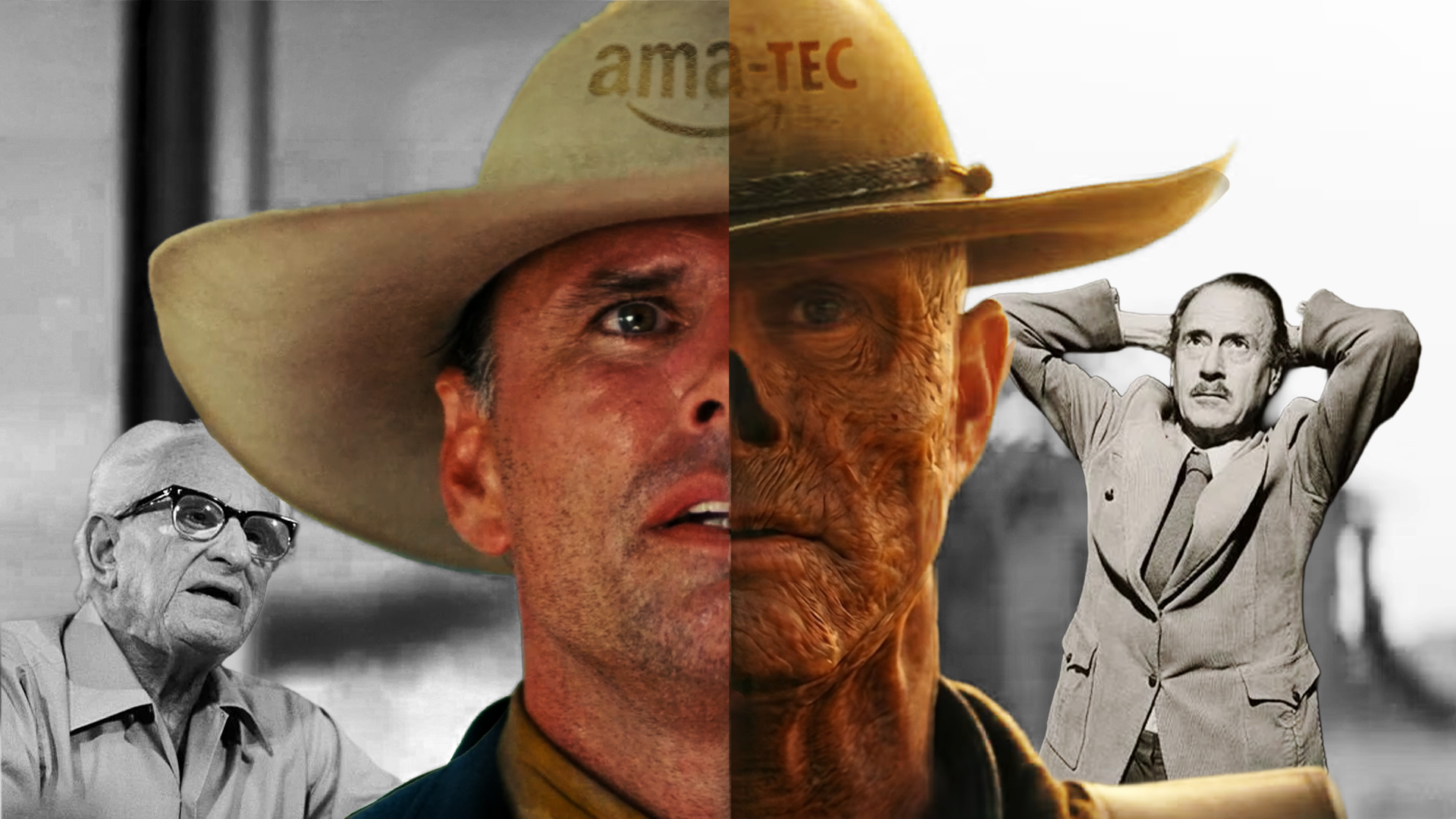
In Fallout, the company selling protection from the end of the world is also helping to cause it.
Vault-Tec markets underground shelters to terrified Americans. Safe rooms. Clean water. A future for your family after the bombs fall. What its customers do not know is that many of the vaults are human laboratories. The survivors are not residents. They are test subjects.
The shelter is the product.
The people inside are the data.
This is the franchise’s central joke, and it is barely a joke anymore. Fallout imagines an America where corporations have grown so powerful that nuclear annihilation becomes another market opportunity. Vault-Tec sells survival. RobCo sells the machines running what remains. Arms manufacturers sell the war. Each company claims to be protecting civilization while building the machinery that destroys it.
Then Amazon turned it into a television show.
Yes, Amazon. The company that operates the storefront, the delivery network, the cloud infrastructure, the home surveillance devices, the voice assistants, and the streaming platform produced a prestige drama warning that private infrastructure will eventually swallow public life.
The contradiction is so obvious that co-showrunner Graham Wagner acknowledged it. The games carried what he called a “peak ’90s, Adbusters, anti-corporate energy.” Putting that story on Amazon, he said, was “too delicious for words.”
He is right.
But the joke goes deeper than Amazon paying for a show that makes companies like Amazon look evil. The show does not threaten Amazon despite its politics. Its politics make it valuable to Amazon.
Your disgust is part of the product.
The Corporation at the End of the World
Fallout has always been about more than nuclear war.
The bombs are the punchline. The setup is a society that treats every human need as a market waiting to be captured.
Food becomes a branded chemical substitute. Domestic labor becomes a robot. Personal computing becomes a Pip-Boy strapped to your arm. Safety becomes a subscription to Vault-Tec. Even the apocalypse gets a sales department.
The franchise’s factions turn different forms of modern power into mythology. Vault-Tec is private infrastructure masquerading as public salvation. RobCo is technological monopoly dressed as innovation. The Enclave fuses corporate secrecy with the military state. Mr. House is the billionaire sovereign: a man who saves one city with private missile defenses, then rules it through cameras, contracts, and a robot army.
None of them see themselves as villains.
Vault-Tec believes it is preserving humanity. House believes democracy is inefficient. The Enclave believes power belongs to the people capable of using it. Each begins with a recognizable promise: safety, progress, order.
Then the promise becomes absolute.
That is what makes the Amazon adaptation so sharp. Amazon does not resemble Vault-Tec because Jeff Bezos has a secret button that launches nuclear missiles. It resembles Vault-Tec because both companies present private infrastructure as the natural solution to public failure.
Need groceries? Amazon. Need entertainment? Amazon. Need web hosting? Amazon Web Services. Need a camera on your door, a speaker in your kitchen, or a network connecting the devices in your neighbourhood? Amazon has an answer.
Every answer adds another room to the vault.
The comparison is not perfect, and it does not need to be. Satire works by exaggerating a structure until we can finally see it. Fallout takes the logic of corporate dependence and follows it past the point where the marketing language collapses.
What happens when a company becomes responsible for so much of daily life that leaving it feels less like changing stores and more like leaving society?
You get a vault.
Or a platform.
The branding changes. The relationship does not.
McLuhan Had the Answer in 1964
Marshall McLuhan was a Canadian media theorist who studied how communication technologies alter human perception and social organization.
His most famous line is also one of the most misunderstood:
The medium is the message.
McLuhan’s point was not that content means nothing. It was that the structure of a medium changes society more deeply than the particular content passing through it.
A railway can carry wheat, soldiers, tourists, or copies of The Communist Manifesto. Whatever sits inside the train, the railway reorganizes cities, work, distance, and time. Its social effect comes from the scale and pattern it introduces.
Prime Video works the same way.
Fallout can say Vault-Tec is evil. It can mock monopolies, privatized government, military contractors, and billionaire fantasies. But you encounter every one of those ideas through an Amazon subscription, inside an Amazon interface, selected by an Amazon recommendation system.
The content says: fear corporate infrastructure.
The medium says: corporate infrastructure is where culture lives.
You are not watching Amazon from outside Amazon. You are using an Amazon account, on an Amazon platform, to consume Amazon’s criticism of companies that behave like Amazon. If you bought snacks for the premiere, there is a decent chance Amazon delivered those too.
McLuhan compared content to a piece of meat carried by a burglar to distract the watchdog. We stare at what the story says while the medium quietly changes the pattern around us.
The story gives you Vault-Tec.
The platform gives Amazon your time, your attention, your viewing history, and another reason to renew next month.
The message is not “corporations are bad.”
The message is Prime Video.
Content is irrelevant. Subscription is the ideology.
Debord Saw the Critique Become a Commodity
Guy Debord was a French Marxist theorist who argued that modern life had been replaced by representations of life.
He called the result the spectacle.
The spectacle is not merely television, advertising, or social media. It is a social order where our relationships with politics, culture, other people, and even ourselves are increasingly mediated through images and commodities.
In other words, we stop participating in the world and begin consuming representations of participation.
We do not resist corporate power. We watch a show about resisting corporate power.
We do not survive the wasteland. We buy a Vault 33 hoodie and spend Saturday roaming a digital version of it.
We do not overthrow Vault-Tec. We make memes about Vault-Tec on platforms owned by other corporations.
Debord understood that the spectacle could absorb rebellion. In thesis 59 of The Society of the Spectacle, he argued that dissatisfaction itself becomes a commodity once the economy develops the ability to process it as raw material.
That sentence could be Amazon’s commissioning strategy.
The company does not need every show to praise corporate power. Praise is boring. Rebellion sells. Cynicism sells. The feeling that you understand how rigged everything is sells extremely well.
This process is often called recuperation: oppositional ideas are absorbed by the dominant culture, stripped of their practical threat, and sold back as style.
Punk becomes a shirt at the mall.
Che Guevara becomes a poster.
Anti-capitalism becomes a content category.
Fallout does not hide its criticism inside an obscure subplot. The criticism is the hook. Vault-Tec’s smiling mascots, corporate experiments, and homicidal sales logic give the show its identity. Amazon can then convert that identity into subscriptions, merchandise, clips, discourse, and renewed interest in a game franchise worth billions.
The stronger the critique, the better the engagement.
The spectacle does not censor dissent. It gives dissent a production budget.
Marcuse’s Pressure Valve
Herbert Marcuse was a German-American philosopher who studied how advanced industrial societies neutralize opposition without always needing to suppress it.
His phrase for part of this process was repressive desublimation.
The idea sounds more complicated than it is. A stable system can protect itself by giving people controlled access to the feelings and desires that might otherwise challenge it.
Let them rebel.
Just make the rebellion convenient, pleasurable, and commercially available.
Older forms of censorship told artists what they could not say. Platform capitalism discovered that it can let them say almost anything, provided the speech returns as inventory.
You can hate the corporation for eight episodes.
The next episode starts automatically in ten seconds.
This is what makes Fallout more useful than corporate propaganda. Propaganda asks us to believe that companies are good. Most people would laugh. Fallout agrees with our suspicion. It tells us the companies are monstrous, the executives are insane, and the system is marching toward disaster.
We feel seen.
Then we feel entertained.
Then the feeling passes.
The anger has nowhere to go except back into the subscription. Corporate criticism becomes a leisure activity provided by the corporation. The system sells us the emotional release of rejecting it without requiring that anything be rejected.
This does not mean Amazon executives held a secret meeting and selected Fallout as a psychological weapon against the left. That explanation gives them too much credit.
No conspiracy is required.
The incentives already align. Amazon wants prestige programming that attracts and retains viewers. Viewers want stories that acknowledge their distrust of concentrated power. Writers want enough money and freedom to tell those stories. The result is sincere art operating inside a system capable of converting sincerity into revenue.
The critique can be real.
The absorption can be real too.
Marcuse’s point was not that mass access to art is bad. It was that incorporation changes art’s relationship to the existing order. The work that once stood apart as a refusal becomes another option in the catalogue.
Rebellion. Comedy. Drama. “Customers also watched.”
Capitalist Realism in the Wasteland
Mark Fisher was a British cultural critic who described a world where capitalism no longer appears to be one political system among others. It feels like reality itself.
He called this capitalist realism.
Fisher opens his book with a line attributed to Fredric Jameson and Slavoj Žižek: it is easier to imagine the end of the world than the end of capitalism.
Fallout takes that literally.
The bombs fall. Governments collapse. Cities become radioactive ruins. Humanity crawls underground, mutates, starves, and kills for clean water.
Capitalism survives.
Bottle caps become currency. Mercenaries sell violence. Caravans move goods. Corporations remain embedded in the bunkers and machines beneath the rubble. Mr. House turns Las Vegas into a private city-state. Vault-Tec continues its experiments through systems set in motion centuries earlier.
The world ends.
The business model does not.
This is why Amazon producing Fallout feels less like a contradiction than the final expression of the show’s argument. Capitalism can imagine its own crimes. It can dramatize its own collapse. It can show us the boardroom where executives discuss the profitability of nuclear war.
What it struggles to imagine is an outside.
Even our warnings arrive as services. Even our disgust has a monthly fee. Even the apocalypse is intellectual property moving through a vertically integrated distribution system.
And I say this as someone who loves Fallout. The games more than the show, but both. The satire is sharp. The world is funny, ugly, and painfully recognizable. None of that becomes false because Amazon paid for it.
The problem is believing recognition equals resistance.
Watching Vault-Tec behave exactly like we expect a corporation to behave can make us feel politically alert. We spotted the metaphor. We understood the reference. We know who the bad guys are.
Then the credits roll and the interface recommends another critique.
Amazon does not need to convince you it is innocent.
It only needs to convince you to keep watching.
That is the Fallout paradox. The show warns that corporations will turn the end of the world into a product, and the corporation turns that warning into a product.
War never changes.
Neither does the checkout page.
References
Debord, G. (1967). The Society of the Spectacle.
Fisher, M. (2009). Capitalist Realism: Is There No Alternative? Zero Books.
Kurczynski, K. (2008). “Expression as Vandalism: Asger Jorn’s ‘Modifications.’” RES: Anthropology and Aesthetics, 53/54.
Marcuse, H. (1964). One-Dimensional Man: Studies in the Ideology of Advanced Industrial Society. Beacon Press.
McLuhan, M. (1964). Understanding Media: The Extensions of Man. McGraw-Hill.
Wagner, G. (2024). Interview with TheGamer on adapting Fallout for Amazon.