In this video, a partnership with Future Now, I got the chance to interview Toronto content creator Supafly (Chris Markland).
We go deep on why superhero narratives have stood the test of time, how they evolve to mirror society’s anxieties and hopes, and what happens when the line between hero and anti-hero starts to blur. Supafly also opens up about his personal journey — growing up without a father figure, finding moral blueprints in characters like Superman and Spider-Man, and a powerful encounter at a Walmart that changed the way he thinks about what it means to truly help someone.
When I was 10 years old, my mom took me to see the Jean-Michel Basquiat exhibition at the AGO. Like most art-obsessed kids, I was immediately transfixed by these ginormous canvases so blatantly breaking every rule I thought I understood about art. I was having a mental orgasm trying to decode the layers of meaning woven within the art straight from Basquiat’s soul like I was Indiana Jones searching for the Kingdom of the Crystal Skull.
This little snot-nosed white kid from upper-middle class Toronto was learning about the history of racism, colonialism, rampant unchecked capitalism, etc. likely for the first time in his life because Basquiat brought chaos to an industry once obsessed with order two decades prior.
Basquiat’s art inspired a deep passion for all things radical. It taught me art is only as beautiful as the message and sanctity behind it. I no longer looked at DuChamp’s urinal, or Picasso’s cubes, or Warhol’s soup with a sense of bewilderment. I finally understood them for what they are. RADICAL & REVOLUTIONARY TRIUMPHS OF THE SOUL.
Art became the ultimate symbol of humanity for me. When I had trouble comprehending life wasn’t fair, art reminded me it never was. Whenever I got a little down on myself or my ego got a little too strung out, art levelled me off. I studied it like a religion.
May 2025
Looking at art like a quasi-religious experience is the only way I know how to live life. So, like any passionately religious person, I can’t help but get slightly irritated to borderline irate when the essence of a work of art is manipulated for whatever reason.
This painting could’ve been one of the few paintings that changed my and millions of other people’s lives. But nope, some blood diamond company thought it’s better off sitting in their warehouse for 30 years instead.
Boo hoo. I know I sound like the “Monster Energy is Satan” lady we all know and love. But the meaning behind a work of art is important. Stories are how we communicate.
There are good stories and bad stories. Unfortunately, when I go on social media and come across the art that’s so popular there, the majority seems to make up the latter.
I know I know, if Connor McGreggor was reading this he’d probably say something like “Who the fook is this guy???”. wELL aCKcHUALY, I’m OG Bubby Jaustin, Mr. McGreggor. I curated multiple exhibitions for Toronto Metro University, one of the dopest art schools in Canada, bitch.
When I talk of bad “storytelling” in the art industry I merely mean redundant storytelling. We’ve all seen it. The 16 year old white kid inspired by Basquiat innocently mimicking the aesthetic with at best zero semblance of substance and at worst ignorantly racist.
Although Social media likes to gang up on these people it’s hard to blame someone who doesn’t know any better. I also can’t blame social media as it’s entirely dependent on aesthetics. Of course a Basquiat or Harring copycat will rise to the top because that’s what’s popular. Radicalism doesn’t reward the algorithm.
So if it’s not the fault of the artist nor of social media, why is it that so many people are copying Basquiat and his contemporaries? Why is the popular art on social media stuck in the past? I can tell you with confidence today’s contemporary galleries aren’t struck by this phenomenon. So why are artists choosing to abide by the algorithm instead of reality???
It took a lot of research but I think I’ve come up with a solution.
The Ghost of Rebellion: Mark Fisher’s Hauntology
“The past cannot be forgotten, the present cannot be remembered”
Mark Fisher’s concept of “hauntology” perfectly captures what’s happening with the Basquiat copying phenomenon on social media. For Fisher, our culture is haunted by the ghosts of lost futures—times when artistic rebellion seemed capable of creating genuine change.
Basquiat represents exactly this kind of lost possibility—a moment when art could still shock, disrupt, and manifest something truly new.
When Fisher writes about “the slow cancellation of the future,” he’s describing our current inability to produce cultural forms that don’t reference the past.
ArtTok creators aren’t just copying Basquiat’s aesthetic; they’re grasping for the rebellious energy his work once embodied, an energy that seems increasingly impossible to generate anew in our algorithmically-optimized present.
In “Capitalist Realism,” Fisher argues that capitalism absorbs and neutralizes all resistance to it.
Nothing makes this clearer than watching Basquiat’s anti-establishment art—once a genuine threat to institutional power—transform into a set of recognizable visual tropes perfectly suited for garnering likes and followers.
The radical has been domesticated, commodified, and returned to us as content.
Beyond Reality: Baudrillard’s Simulation
“We live in a world where there is more and more information, and less and less meaning.” ― Jean Baudrillard, Simulacra and Simulation
This brings us to Baudrillard’s theory of simulacra, which helps explain why these Basquiat copies feel so empty despite their technical proficiency.
Baudrillard described four orders of simulation, with the fourth being the most relevant here: representations that bear no relation to any reality whatsoever.
The Basquiat copycats on TikTok exist in this fourth order. They’re not trying to represent Basquiat’s reality or even mask its absence.
Instead, they’ve created a pure hyperreality where the “Basquiat style” circulates as a set of floating signifiers completely divorced from their original context.
The crown motifs that once symbolized Black excellence become mere design elements.
The anatomical diagrams that spoke to the exploitation of Black bodies under capitalism become trendy visual tropes.
As Baudrillard might put it, we’re witnessing the death of the original reference.
When these artists copy Basquiat, they’re not referencing Basquiat himself or the social conditions he was responding to—they’re referencing other copies of Basquiat.
This creates a closed system of reference that spirals further and further from any grounding in lived experience or political urgency.
The Performance of Art: Debord’s Spectacle
“Where the real world changes into simple images, the simple images become real beings and effective motivations of hypnotic behavior.” ― Guy Debord, Society Of The Spectacle
The Basquiat copying phenomenon exemplifies this perfectly. What we’re seeing isn’t art in the traditional sense but the performance of “being an artist” for social media consumption.
Crucially, Debord’s concept of “recuperation” explains how capitalism and mainstream culture absorb and neutralize radical ideas.
TikTok has transformed Basquiat’s anti-establishment art into a trendy, marketable style—”recuperating” its revolutionary potential and rendering it harmless.
The platform doesn’t just distribute these copies; it actively shapes their production through its algorithmic incentives.
The spectacle isn’t just the images being shared but the entire ecosystem around them:
The artist performance videos showing the creation process
The engagement metrics
The comments section debates about authenticity
The merchandise links in bios
Basquiat’s actual art has disappeared, replaced by what Debord would call the “pseudo-world” of representation.
The Cycle of Cultural Recuperation
These three theoretical perspectives combine to reveal a disturbing cycle of cultural recuperation:
Authentic artistic rebellion emerges (Basquiat’s original work)
It gets stripped of its aura through reproduction
These reproductions create a hyperreal simulation (Baudrillard)
The simulation becomes spectacle for consumption (Debord)
The culture becomes haunted by the loss of authentic rebellion (Fisher)
The most important insight from this theoretical synthesis is that social media platforms aren’t neutral spaces where this copying happens to occur—they’re active agents that accelerate and intensify these processes.
TikTok’s algorithm, with its preference for visually striking, immediately recognizable content, creates the perfect environment for the flattening of Basquiat’s multidimensional critique into easily reproducible visual tropes.
What results is a situation where:
Authentic artistic rebellion becomes increasingly difficult (if not impossible)
Copies seem more “real” than originals
Art is valued not for its conceptual depth or political significance but for its ability to generate engagement
The horrifying conclusion is that these Basquiat copies aren’t just aesthetically derivative—they represent the complete inversion of everything Basquiat’s art stood for.
The Broader Implications For Contemporary Art & Culture
This Basquiat copying phenomenon isn’t isolated—it’s emblematic of a broader shift in how art functions in the digital age.
When algorithms determine visibility, authenticity becomes secondary to recognizability.
What we’re witnessing is not just aesthetic mimicry but the collapse of art’s critical function.
As social media platforms reward visual immediacy over conceptual depth, we see similar patterns of flattening across all art forms.
The tragedy isn’t just that Basquiat’s style has been reduced to a template, but that the very possibility of genuinely disruptive art becomes increasingly remote.
What This Means for Artistic Originality in the Digital Age
We find ourselves in a paradoxical moment: never have more people been creating and sharing art, yet never has originality seemed more elusive.
This isn’t about blaming young artists for copying Basquiat—it’s about recognizing the systemic forces that make such copying inevitable.
Perhaps genuine artistic rebellion today means rejecting algorithmic logics altogether—creating work designed to be unshareable, unquantifiable, or invisible to digital metrics.
Or maybe it means creating within these platforms but against their grain, using their tools to expose their limitations.
Whatever form it takes, the next artistic revolution won’t look like Basquiat’s—because it can’t. It will need to find new ways to confront a system that has already incorporated rebellion into its business model.
While I was in university looking for internships, I stumbled across the media company Embreate, and their award-winning brand Future Now. Future Now is a Science-Fiction based content creation team that seeks to explore the future through the lens of storytelling.
Being the Sci-Fi nerd I am, I knew it was the perfect fit for me to begin my media career. So I put everything I had into my application & eventually landed a role as an intern video editor.
That was a few years ago. Since then, Scott (the creator of Embreate) and I have worked together on a variety of projects, and I’m happy to say he’s became a mentor and friend.
Anyways, while Embreate has focused their attention behind the scenes, as of late they took a backseat on content creation. While producing other projects, the Future Now social medias ended up going cold, leaving their audience hanging.
Scott has asked me to change this and bring Future Now back to life.
Instead of going Dr. Frankenstein on the operation, the two of us have decided to take more of a Dr. Morneau approach instead. What I mean is, we’ve decided to rebrand FN.
While Future Now used to be an interactive Sci-Fi concept where creators all across the world wrote & produced their stories in an ever-connected universe. It is now the hub for exploring the all things related to the future, through the lens of storytelling.
Scott & I don’t just want to create stories for the sake of creating stories. We want to create content that actually seeks to examine & solve today’s most crucial problems. This is exactly what all quality Sci-Fi does right. They don’t just ask “What If”, they ask “What Now”.
In order to explore the future, we can’t just rely on the stories we & our team creates. So we’ve decided to bring it back to the basics and explore What Has Sci-Fi Taught Us from it’s infancy.
Along with uploading our stories to our ever-expanding Patreon, we’re also beginning to create Sci-Fi related content exploring the genre’s greatest masterpieces, unpacking what makes them so transcendent, and how these stories have impacted & predicted the future.
Scott & I have been A/B testing a variety of methods to go about this. One such method is a “What Has Sci-Fi Taught Us” podcast where we pick a random Sci-Fi topic and go ham discussing everything we can about it.
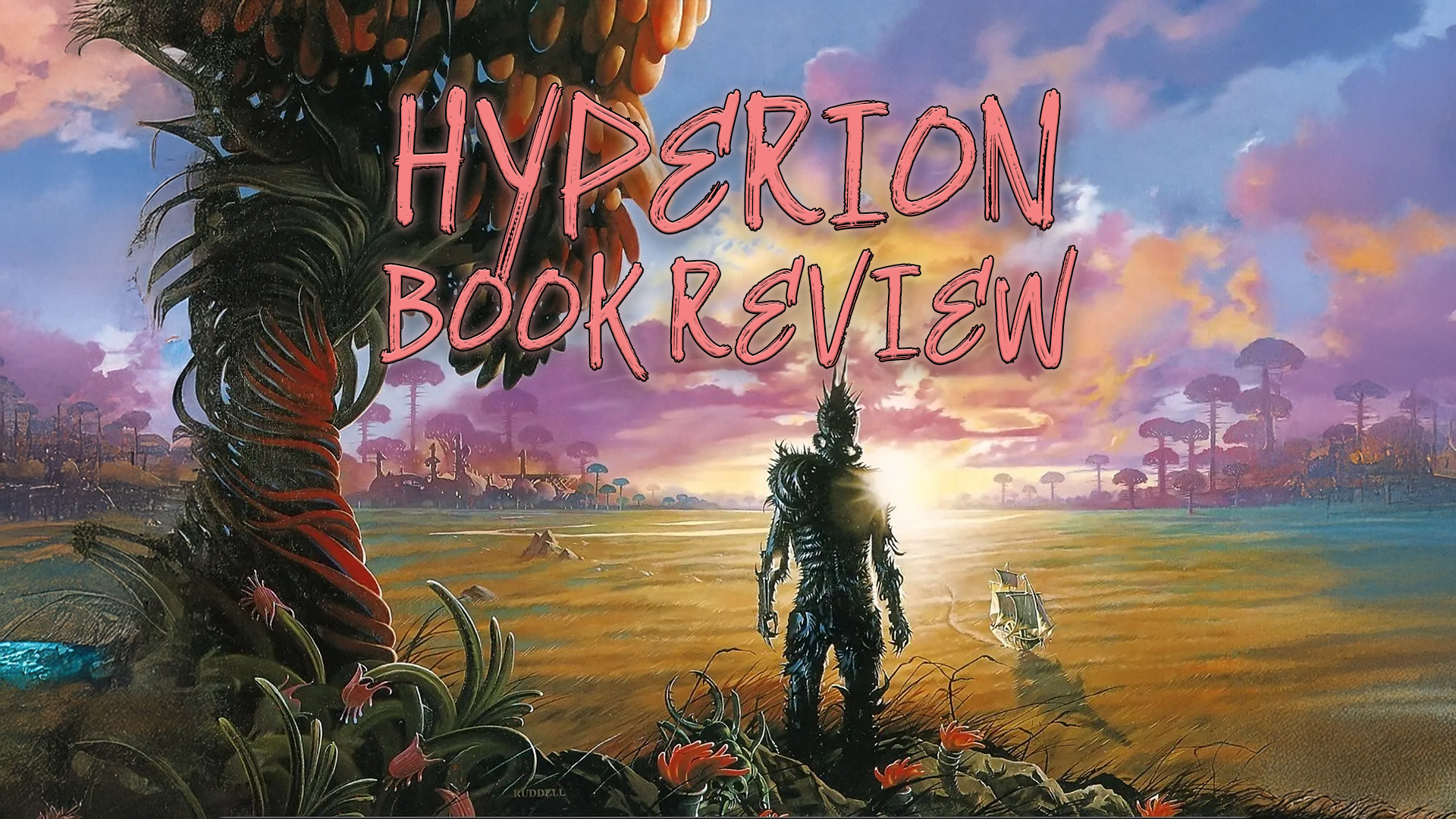
As a trial run, we decided to record a podcast on one of my favorite Sci-Fi books, Dan Simmons’s “Hyperion”. We’ve started uploading clips from the test-pod, you can see them below.
“The horror! The horror!” – Captain Kurtz, (Part III, Page 12)
Introduction
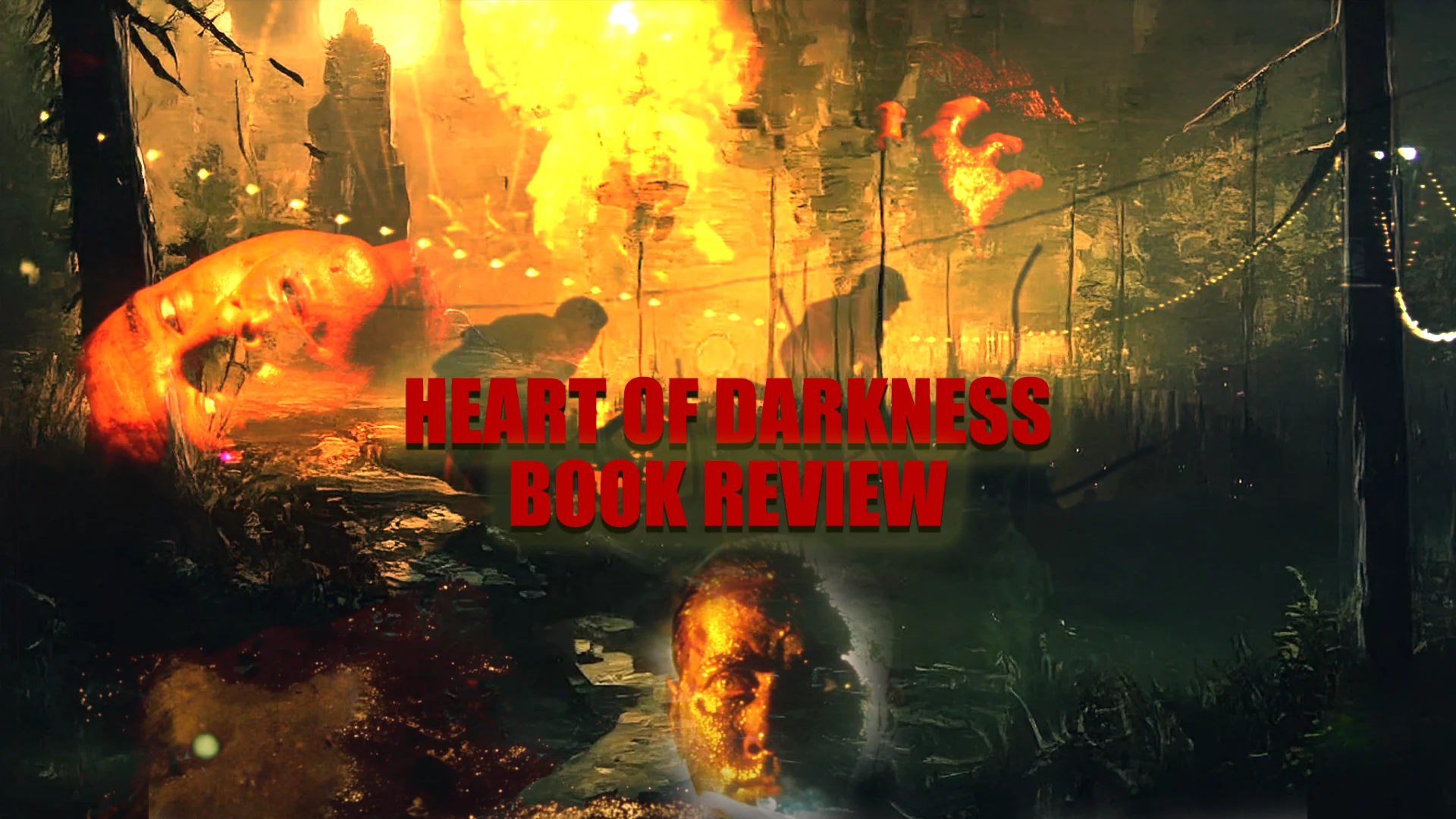
Written in 1899 by Joseph Conrad after his journey up the Congo River, Heart of Darkness is a fictional recount of the colonization of the Congo by King Leopold II of Belgium. The book is one of the most impactful stories of our time, most famously known to be the inspiration and the original adaptation of Francis Ford Coppola’s Apocalypse Now. That said, everywhere the book goes, its controversies follow. To some, it may be the modern Moby Dick its supporters claim it to be. But to others, it’s a vile, racist piece of literature that emphasizes the atrocities of the 2nd Industrial Revolution. To me, it is the harshest, most frightening, and arguably the most evil story I’ve ever read. However, it is also one of the most important.
Heart of Darkness masks itself as an adventure story through the Congo River, which is why I decided to read it in the middle of the Canadian outback four hours away from my city, Toronto. But in reality, it is a journey into the psyche that leaves no stone unturned in its quest to expose the shadows underneath the soul. Heart of Darkness clashes the most heinous aspects of humanity with such poetic prose I was left dumbfounded. How can an individual [Marlow] with such backward and contradictory ideologies have such a grasp on not just the self but society at large? Through coarse and painful writing that feels like a nightmare, Joseph Conrad shows us that this complex understanding of the human psyche and its inevitable corruption can be seen by those paying close enough attention. It doesn’t require some fantastical setting like the 19th-century colonization of The Congo Free State. It can be seen anywhere and everywhere, all it requires is a keen perceiver.
Plot Overview
Heart of Darkness is a story within a story. Taking place at the turn of the 20th century, the book opens upon a tugboat on the Thames River where a seaman named Marlow recounts his adventure through the Congo river years prior. On this particular journey, Marlow was hired by the Belgian ivory trading company and tasked to traverse the Congo River in search of the ivory agent Colonel Kurtz who has seemingly vanished from his post leaving his superiors worried he has gone rogue. Kurtz is one of the most successful ivory traders within the African Jungles, netting significant earnings for the British while exercising their colonial interests. So, his sudden departure leaves tremendous profits on the table and triggers a range of fear and anger amongst his European contemporaries.
As Marlow travels upriver deeper into the Congo, he sees the European conquest of Africa for what it was—a depraved, inhumane exercise of tyranny where greed and corruption masked themselves as tools for survival. At his first meeting post, Marlow encounters Africans for the first time and sees how they and their land are truly treated. They were forced into slavery to pillage their land just for their resources to be shipped to Europe. The Africans were viewed as a subhuman species. Marlow himself is prone to these same prejudices. Though he sees what’s happening as morally wrong, he views it more like taking candy from a baby so to speak. He’s just as ignorant of the cultures within the Congo and their ways of life as any other European conqueror.
“They were no colonists; their administration was merely a squeeze, and nothing more, I suspect. They were conquerors, and for that you want only brute force – nothing to boast of, when you have it, since your strength is just an accident arising from the weakness of others. They grabbed what they could get and for the sake of what was to be got. It was just robbery with violence, aggravated murder on a great scale, and men going at it blind – as is very proper for those who tackle a darkness. The conquest of the earth, which mostly means the taking it away from those who have a different complexion or slightly flatter noses than ourselves, it is not a pretty thing when you look into it too much.” – Marlow
Roughly halfway through his journey upriver 100km deep into the Congo, Marlow’s boat breaks down and he’s forced to dock it while making repairs. Here, he learns more about the man Kurtz and develops a strange fascination not just with him, but with the jungle that has swallowed the man whole. Within the shadows of the jungle, power is free for any man willing to embrace the darkness. We learn Kurtz is a man who not only embraces said darkness, but thrives in it. Kurtz isn’t your typical ivory agent pseudo salesman, he’s a conman of the largest degree, one who twists and bends the branches of the jungle to his whim. Instead of wielding blatant violence to colonize the land and the people like the majority of his contemporaries, he uses his presence. He has molded his face in the shape of a god to his innocent victims, offering them a life with purpose, their purpose being to bow down and serve the deity that so happens to be this white man named Kurtz.
After fixing the tugboat, Marlow and his crew travel closer to their destination where they’re suddenly hit with a barrage of arrows. Though some of his crew parishes, Marlow survives and they push onward until they finally reach Kurtz’s last known destination. Unlike the rest of the station camps, Kurtz’s camp is much more fleshed out, like an oasis in the middle of the desert. The first individual Marlow comes across is a Russian who stumbled into the heart of the Congo on a Dutch exhibition years prior. The Russian, who has taken care of Kurtz during a bout of sickness, believes wholeheartedly in Kurtz’s greatness. He is one of the few individuals to witness Kurtz’s ascension, from ivory agent to God. Kurtz offered the Russian what no other man did, a purpose, an ideology to subscribe to. The Russian divulged that the Natives of the Congo attacked Marlow’s boat because they didn’t want Kurtz to leave. Through his rituals and his words, Kurtz’s standing as a god among men infects all, whether you are from the depths of the Congo Free State or the Tsarist autocracy of Russia.
Before entering Kurtz’s hut, the Russian asks Marlow to crawl, a ritual all of Kurtz’s followers must do if they wish to speak to the deity. Dumbfounded, Marlow refuses to give in to Kurtz’s rituals. Suddenly, Kurtz is carried out on a stretcher and brought directly to Marlow’s boat where he tells Marlow he is glad to see him, indicating he knew Marlow was coming all along. Clearly, Kurtz is beyond a mere case of sickness and is on the brink of death. Kurtz argues with the ivory company manager, one of Marlow’s crewmates and superiors, claiming they are only here for his ivory and do not care for his life. The boat quickly gets moving and Kurtz is returning to civilization.
Docked in the middle of the night for rest, Marlow wakes up to the sound of drums and the sight of fire on the nearby shore. Immediately weary of Kurtz and his pilgrims, he checks Kurtz’s stretcher to find he has vanished. Following a trail, Marlow discovers Kurtz crawling on all fours, mere feet away from the native’s camp. Marlow contemplates strangling him right then and there, knowing the natives would hear and quickly kill him too. He decides not to not because he is worried for his fate, but because he too, like the Russian and the people of the Congo, genuinely sees Kurtz as a remarkable individual. Marlow’s infatuation with Kurtz isn’t Godlike, but he recognizes that he is the only thing standing between Kurtz and his final step into madness. He is so far removed from the European civilization that he and Marlow were raised on, to judge him right or wrong, to either let him embrace the darkness of the jungle or to kill him right there, is a futile juxtaposition. The man infected by the heart of darkness has seemingly “kicked himself loose of the earth,” he is free from any sort of judgment and preconceptions society deems. By letting go of everything, he opened the door to madness.
Kurtz, overwhelmed with sickness and the grief of his foiled plans, follows Marlow back to the steamboat, and they proceed downriver. Left with nothing but his ideas, Kurtz spills his philosophical musings to an eager Marlow, who is left both profoundly moved and painfully irritated. Kurtz’s grandiose theories on everything from love to the economy are littered with childish aspirations of fame and fortune, revealing the contradictions that lie within the Heart of Darkness. Eventually, Kurtz foresees his death and delivers one of the most famous and debated quotes in all of fiction before perishing on that steamboat.
“It was as though a veil had been rent. I saw on that ivory face the expression of sombre pride, of ruthless power, of craven terror—of an intense and hopeless despair. Did he live his life again in every detail of desire, temptation, and surrender during that supreme moment of complete knowledge? He cried in a whisper at some image, at some vision—he cried out twice, a cry that was no more than a breath: ‘The horror! The horror!’” – Marlow
After Kurtz’s death, Marlow gets violently sick himself. On the brink of death, Marlow realizes what makes Kurtz so remarkable. Marlow had nothing to say, of himself, or his ideas. If he were to die, he would be transplanted back into the earth in the same fashion he was born from it. Kurtz on the other hand, the man who “kicked himself loose from the earth” had everything to say, and so he did. To Marlow, Kurtz through his descent into madness let go of everything, but in doing so found himself, something most individuals spend their lives chasing. In himself was surely a heart of darkness, but said heart was pampered with candor and conviction. The darkness made him blind to the subjectivity of the world we’ve built, but painfully aware of the objective truths of the universe.
Historical Significance; The Scramble For Africa
Cetshwayo, king of the Zulu, under British guard after the end of the Anglo-Zulu War in Southern Africa, 1879. Drawn by F. Daad.
Heart of Darkness (1899) takes place amid the 2nd Industrial Revolution (1870-1914). This period was characterized by rapid industrialization, technological advancements, and social changes that were built upon the innovations of the First Industrial Revolution (which occurred from the late 18th to early 19th centuries). Essentially, new sources of energy like electricity, oil, and gas led to breakthroughs in the production of steel. Subsequent innovations like railroads, cars, ships, and planes, as well as communication devices like the radio and telephone, began sprouting up across the world. This was the first time in history we could communicate and travel across vast distances, leading to the first instances of globalization. Governments were quick to realize that these newfound technological advancements required tremendous amounts of resources to be deployed effectively. Europe simply didn’t have the raw materials necessary to produce their industrial goals. At the same time, the major players within the continent (Belgium, France, Germany, Britain, Italy, Portugal, and Spain) were in skirmishes amongst one another trying to flex their imperial power. For example, events like the Congress of Vienna (the fall of Napoleon), The Franco-Prussian War (France vs. Germany), and the unification of Italy and Germany all led to bitter resentment among the major European factions.
After seeing the success of the British in the Americas and India, in the 1830s France makes the first move towards Africa by occupying Algeria. After colonizing Algeria, France moved eastward to take Tunisia, provoking Italy to join in this conquest. While France and Italy wage war over Northern Africa, King Leopold II of Belgium announces his plans to “rescue” The Congo Free State. Unlike the other European empires, King Leopold II vowed not to make it a part of the Belgian empire, but instead, chose to make it his own domain so that he personally could “aid and civilize” the people of The Congo, presenting his conquest as a humanitarian effort. King Leopold II’s reign over The Congo is known to be one of the most brutal, inhumane exercises of depravity known to history. While personally owning The Congo, the king netted over $200 million francs (over $1 billion in today’s money). There are so many lessons to be learned from this period of history, but the fact that he passed it off as a humanitarian effort goes to show how just how naive we humans can be.
After Leopold II of Belgium, also known as the “Two-faced King” announced his conquest of The Congo, the major European powers convened in Berlin to establish official claims for what is now deemed as “The Scramble For Africa”. Belgium, France, Germany, Britain, Italy, Portugal, and Spain all agree on makeshift borders representing the new reaches of their empires. The African kingdoms and rulers fought to retain control of their land, but 9 times out of 10 though they had the terrain advantage, they were overwhelmed by Europe’s newfound technological achievements like the inventions of bombs and machine guns. In just 40 years, Africa went from 10% European control to 90%. It wasn’t until the outbreak of World War I that European colonies began losing their grip on Africa. A wave of economic and military strains as well as increased scrutiny of colonialism and a growing African nationalist movement came together to dissolve European colonial control in Africa.
Responding to Controversies; Is HoD a Critique or Complicit in Colonialism?
It should be no surprise Joseph Conrad’s Heart of Darkness is a highly controversial book. It depicts the brutal injustices of King Leopold II’s reign over The Congo Free State from an entirely Eurocentric perspective. Routinely the African characters in the book are referred to as cannibals, savages, and “the others”, reinforcing racist tropes so prevalent at the start of the 20th century. Beyond the palpable racism portrayed by the book’s main characters, Joseph Conrad’s decision not to give any African characters a voice throughout the entire story represents the larger issue. The racist bigotry of the European colonizers would be far easier for readers to digest if we could juxtapose their sentiments with African characters and culture. But that never happens. The only perspective we see is the Eurocentric one, where the jungles of Africa are prehistoric and the people are primitive, compared to their civilized culture back home. It’s impossible to read Marlow’s journey as any sort of pro-colonization propaganda, but the question remains; Does Joseph Conrad’s Heart of Darkness do enough to present a sound critique of colonialism, or does it merely serve as a mundane reminder that this so-called “darkness’ is within all of us, as demonstrated through history?
In 1975, Nigerian novelist and poet Chinua Achebe wrote “An Image of Africa: Racism in Conrad’s Heart of Darkness”. Achebe’s scathing critique of Conrad’s story does an excellent job of highlighting its inherent biases. He does not hold back his disdain for the ignorant racist he believes Conrad to be. Achebe calls for a closer inspection of the constant juxtaposition at play. The first river we’re introduced to where Marlow tells his tale is the Thames River running through London. The Thames River is depicted as a place highly regulated for commerce, ordered, and civilized. Contrast this river with the Congo River where the heart of the story takes place. The Congo River is the antithesis of the Thames River, it is a chaotic mess, closer akin to the Wild West than any official trade route. The juxtaposition spreads to the supposed lack of laws and customs in The Congo compared to the much more “civilized and cultured” Europe. Everything we learn of Africa in the story only serves to be the foil for Eurocentric ideals. The very few actual Africans in the story not only have zero dialogue but serve as symbolic objects and superficial tropes to the “superior” European mind.
Chinua Achebe And His-Book “Things Fall Apart”
I believe Chinua Achebe does a better job explaining what’s flawed with the book better than I ever can, which is why I recommend reading his paper yourself. Achebe asserts that Conrad’s depiction of Africa in Heart of Darkness only prolongs the negative and stereotypical sentiments of Africa being this so-called place of “darkness” where savegry and bouts of evil are societal norms. Taking away the direct racism within the book, at first glance the story seems to be concerned with two individuals (Marlow & Kurtz) descent into madness when placed in a situation so far removed from what they consider home. Implying this inevitable “descent into madness” occurs when trolling through the uncivilized rivers of The Congo seems to come with a fair bit of veiled racism. It leads one to believe that the jungles of Africa aren’t fit for the cultured Europeans and it should be left to the wild Africans. It’s hard to ignore that interpretation, but by the end of the book, Joseph Conrad litters tidbits of clues within his philosophical monologues that seem to imply it wasn’t The Congo that brought madness on these Europeans, their madness was within them all along. On Kurtz’s deathbed, he utters delusions of grandeur, he talks of dining with kings and disseminating his ideas to the farthest reaches. So all this talk of Kurtz being the man who “has kicked himself loose of the earth” is total baloney. He’s just as conscious and longing for these arbitrary societal norms as before he ever stepped foot in Africa. In fact, he was so greedy for fame, fortune, and power, that he was willing to sacrifice everything else he knew and loved to move to Africa and manipulate its people. The insatiable appetite for more Kurtz demonstrates isn’t something that evolves over time, especially in a place like the 20th century Congo Free State where traditional lappings of luxury are few and far between. Kurtz’s ambitions were within him far before his time in The Congo. It’s these ambitions, part of the archetypical European colonial mindset that spurred his descent into madness. At its core, the book isn’t the adventure narrative it’s trumped up to be. It’s a psychological breakdown of what corrupts the soul. The answer to that question isn’t some fantastical setting like The Congo River during the 2nd industrial Revolution. It’s a far more nuanced answer that leaves you questioning your desires. It wasn’t The Congo that made these men mad, these men brought madness to The Congo.
The Darkness
If the true theme of the story centers around the human psyche, the recurring symbol of darkness within Conrad’s prose should be analyzed from a new perspective. Multiple times the novel’s main character Marlow uses darkness to describe his environment; The geography of the jungle, the color of its inhabitants’ skin, and the morality of their actions are all repeatedly described as dark. In storytelling, darkness is what we associate with evil. So, it’s easy to assume that in placing these characters in this “dark” situation, they are running head-first into evil. However, Conrad subverts expectations by juxtaposing the darkness of The Congo with the blinding lightness of European civilization. As Marlow’s journey progresses, the “enlightened” European society he comes from becomes more and more a facade, a superficial beacon of light that blurs the truths of colonialism behind the glitz and glare of economic progress. In Conrad’s story, the light represents a shallow reflection of false desires, while the darkness reveals, the deeper, more complex, and uncomfortable truths of humanity.
Conrad’s use of light and darkness not as a tool for disseminating good versus evil, but rather as a metaphor to critique Eurocentric ideals, plays directly into Carl Jung’s theory of the Collective Unconscious. The Collective Unconscious can be understood as this layer beneath our consciousness where we all share the same understanding of universal patterns that come intuitively with being human. The universal patterns we innately recognize come in the forms of symbols and archetypes. For example, the archetype of “the hero” as brave and triumphant doesn’t come from any culture, religion, or story. “The hero” is something we all understand regardless of our background. Another archetype we share is “the shadow”. The shadow represents the dark, hidden side of the human psyche, the part of us we wish to ignore. For example, traits like anger, fear, greed, or being self-conscious are all things we may try to suppress. We don’t suppress these traits because they are inherently evil or morally bad, but only because they don’t align with how we want to be perceived. Although everyone’s shadow is comprised of individual experiences, the mere fact that we can recognize this shadow as an archetype proves that it lives in the collective unconscious. Carl Jung believed that to become a healthy person psychologically, one must confront the shadow and integrate it into their conscious awareness. This is exactly what Marlow went through on his journey through The Congo.
The light of Europe represents conscious awareness while the darkness of The Congo symbolizes the collective unconscious. Our conscious awareness pampers us with falsehoods and ideals whether it be on a personal level; i.e. “I’m not selfish”, or on a societal level; I.e. “We are civilizing The Congo”. While the collective consciousness, free from any rational constraints, lets loose the archetypes and shows things for what they really are. Here, the shadows reveal themselves as the ugly truths we try to sweep under the rug. When Marlow traverses through The Congo, he has no choice but to confront the darkest aspects of human nature; the cruelty, greed, and lust for power go hand in hand with the enlightened and civilized European culture. While The Congo is a symbol of the collective unconscious, Kurtz is the physical embodiment of Marlow’s shadow and everything he and Europe sought to suppress. Kurtz was once a man status, enlightened by Eurocentric ideals. But when he faced the darkness he abandoned his conscious beliefs and embraced his primal instincts. In Jungian terms, Kurtz lived up to the archetype of a tyrannical god, cementing himself within the collective unconscious. But when Marlow confronts his shadow, Kurtz, he sees in him his potential for darkness, an inescapable truth. While Marlow confronts his shadow, Kurtz is consumed by it. Kurtz’s absolute will to power blinded him to the truth, just like how the enlightened Europeans were blind to what was happening in The Congo. It isn’t until Kurtz’s famous last words on his deathbed, that he finally decides to see the darkness for what it is, thereby confronting his shadow.
Summary
When I picked up the book that inspired one of my favorite movies I knew I’d be in for a ride. But the downright racist and evil one-sided depiction of the colonization of The Congo is not at all what I expected. It caught me so off guard I had no idea what to make of it. In fact, immediately after finishing, I rated it 1 star on Goodreads. But it’s been over a month and I still can’t get the story off my mind. For better or for worse I’ve always believed that the more a piece of art provokes you, the more important it is. That said, the more I’ve thought about this story the more I come to grips with its purpose and see it for what it is. A horrific fictional account of one of the most brutal periods of history, but also a necessary one. Just like Goya’s Saturn Devouring His Son, or Caravaggio’s Judith Beheading Holofernes, it’s a haunting portrayal of our past. Without such works of art, our perceptions of the past would change, hindering our understanding of reality today. Joseph Conrad’s Heart of Darkness forces you to face the uncomfortable truths of reality, acting as a collective shadow overcasting society. Through this story, Conrad shows us that there is a period in time before the abyss gazes back into you where you can discover the truth within the darkness.
In a world where consciousness can be surgically divided, can either half truly be free?
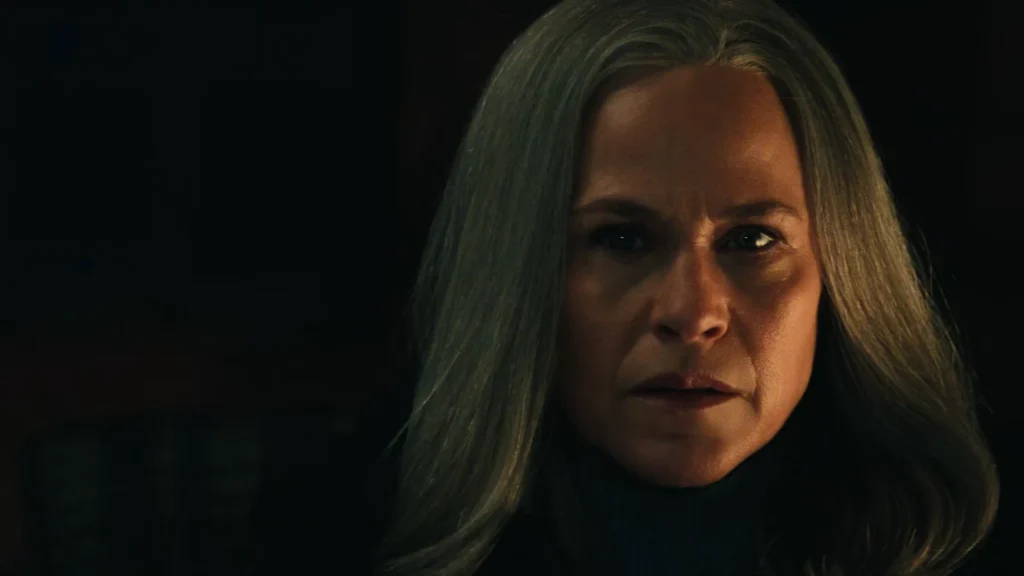
“You feel this now, this pain? It’s real. You feel it because you’re alive, Mark S., and you are real. Only I, and Lumon, can remove your pain.”
These words, uttered within the sterile confines of the Break Room, strike at the philosophical core of Apple TV’s “Severance” The scene depicts an innie (work self) being psychologically tortured through forced repetition of a corporate apology—a moment that perfectly encapsulates the show’s exploration of free will, determinism, and autonomy.
As I watched Severance, I couldn’t help but feel like I was witnessing a philosophical thought experiment come to life—one that challenges our most fundamental assumptions about consciousness, identity, and freedom. This isn’t just prestige television; it’s an existential laboratory where concepts debated by philosophers for centuries are tested through compelling narrative.
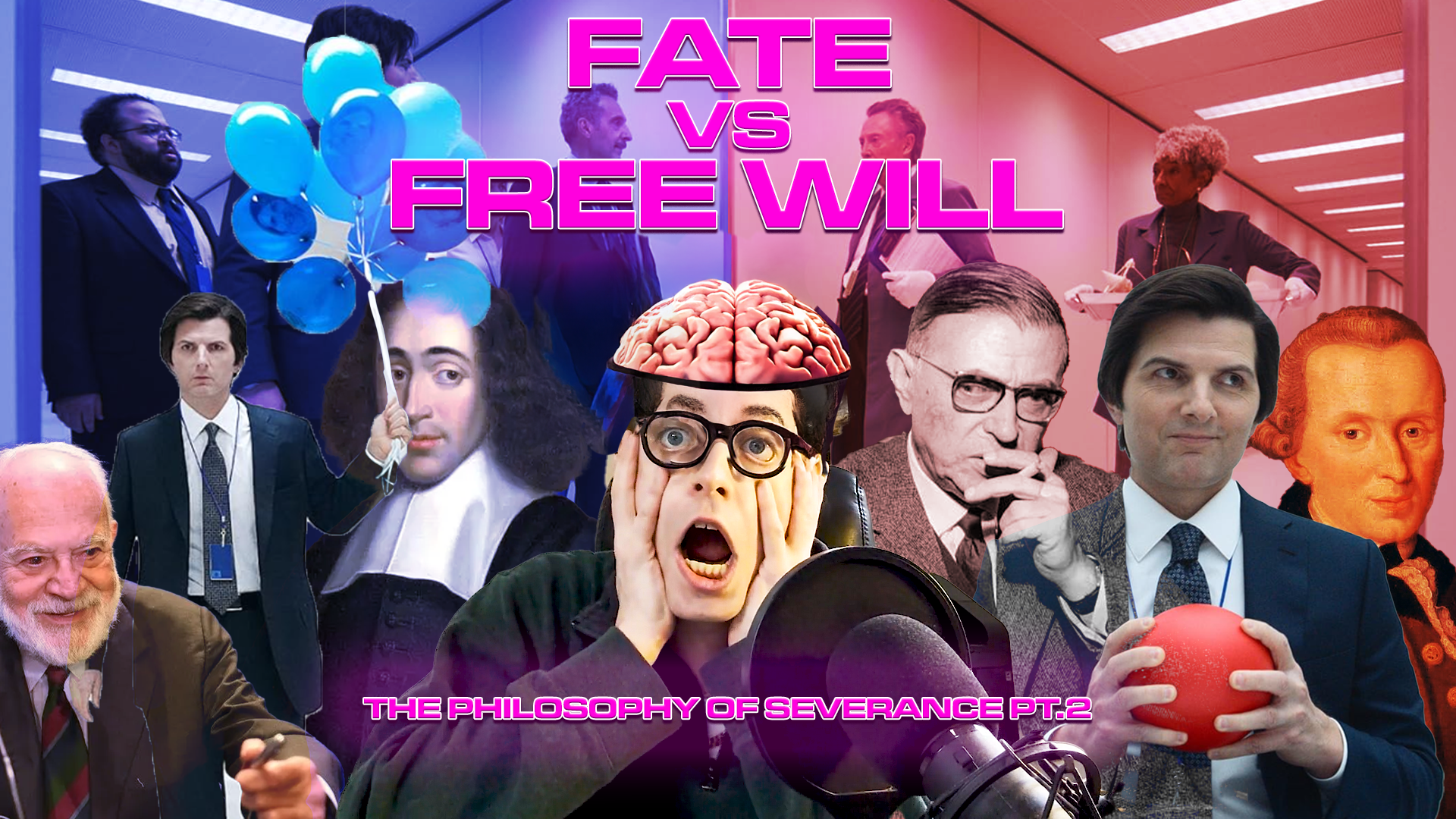
In this analysis, I’ll examine how Severance brings to life the tensions between free will and determinism, explore the fragmented nature of autonomy, and consider what it means to be free when the self is literally divided.
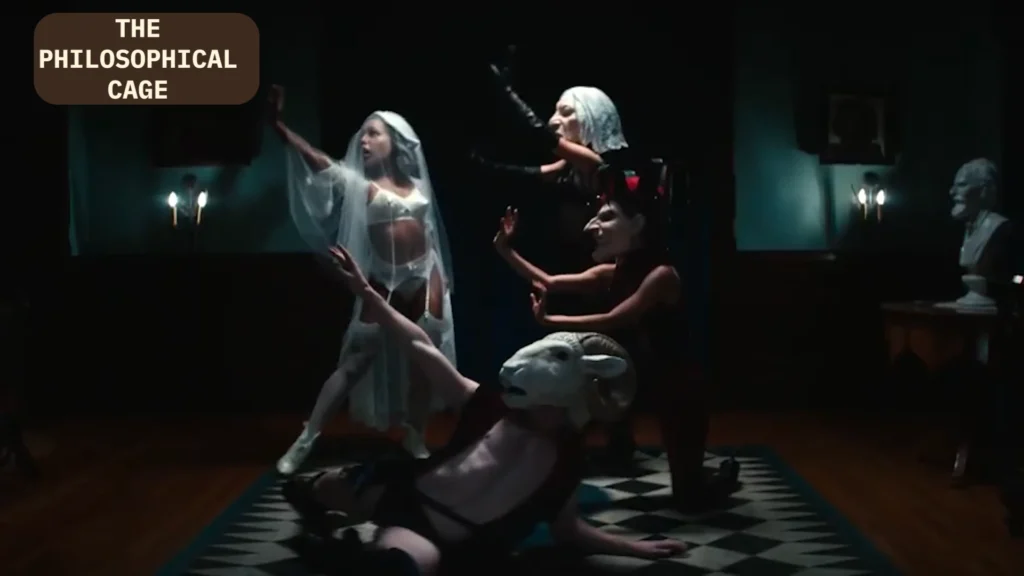
The Philosophical Cage: Determinism in the Severed Floor
Spinoza’s Determinism and the Innies’ Reality
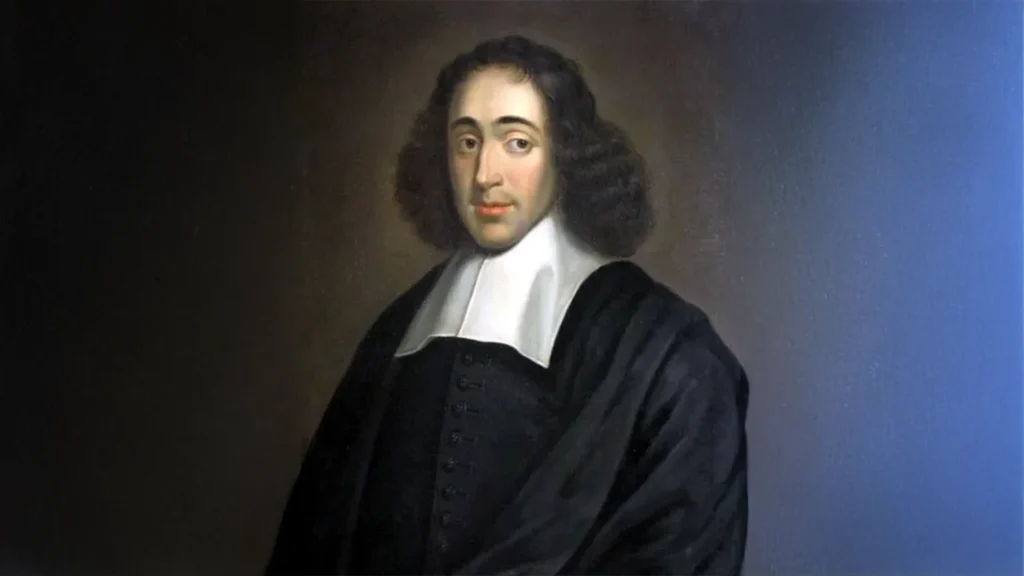
Baruch Spinoza, the 17th-century philosopher, argued that free will is essentially an illusion—that humans are part of a larger deterministic system governed by causality. In his view, our actions are determined by prior causes, even if we perceive ourselves as making free choices.
The severed floor at Lumon Industries functions as a perfect Spinozist environment. Here, the innies exist in a tightly controlled ecosystem where every aspect of their experience is deliberately engineered:
Their physical movements are restricted to designated areas
Their knowledge is limited to what the company permits
Their social interactions are carefully monitored
Their emotional responses are manipulated through rewards (waffle parties, finger traps) and punishments (the Break Room)
When Helly R. repeatedly attempts suicide, only to have her outie record a video message telling her she will never be allowed to leave, we witness determinism in its most brutal form. Her attempts at exercising free will are systematically thwarted by forces beyond her control.
As Helly pleads in one devastating scene: “I’m a person; you can’t just keep me here!” The response, delivered through her own outie, is chilling: “I’m happy here… please stop sending resignation requests.”
This interaction perfectly illustrates Spinoza’s determinism—Helly’s innie can attempt resistance, but ultimately, her agency is constrained by pre-existing conditions she cannot control.
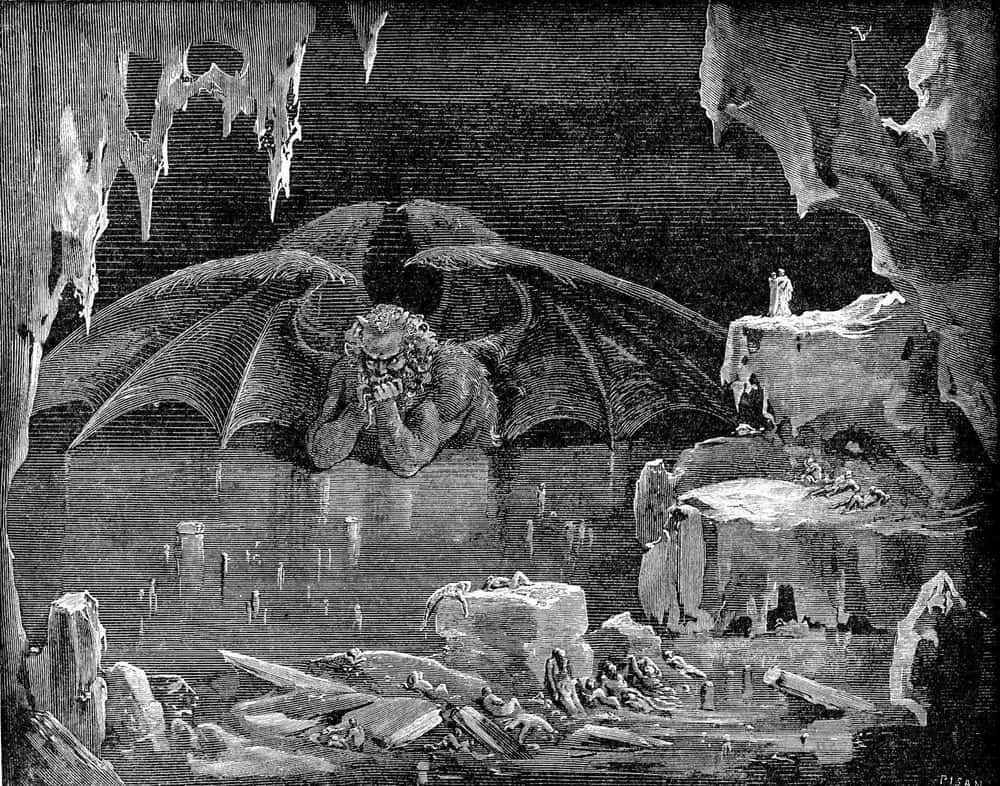
Pierre-Simon Laplace proposed a thought experiment involving a hypothetical demon who, knowing the precise location and momentum of every atom in the universe, could calculate all future events with perfect precision. On the severed floor, Lumon assumes this demonic role, approaching omniscience through:
Constant surveillance of the innies’ activities
Detailed tracking of their emotional states and productivity
Controlled information flow limiting what they can know
Physical architecture designed to control movement
The scene where Dylan discovers the security room—with its control panel capable of activating different modes of consciousness—reveals the extent of this deterministic control. Lumon doesn’t just monitor the innies; it can actually manipulate which version of consciousness is activated at any moment.
This surveillance apparatus transforms the severed floor into a deterministic cage where the variables (environment, knowledge, stimuli) are controlled to produce predictable outcomes—a human Petri dish where the illusion of choice masks the reality of determination.
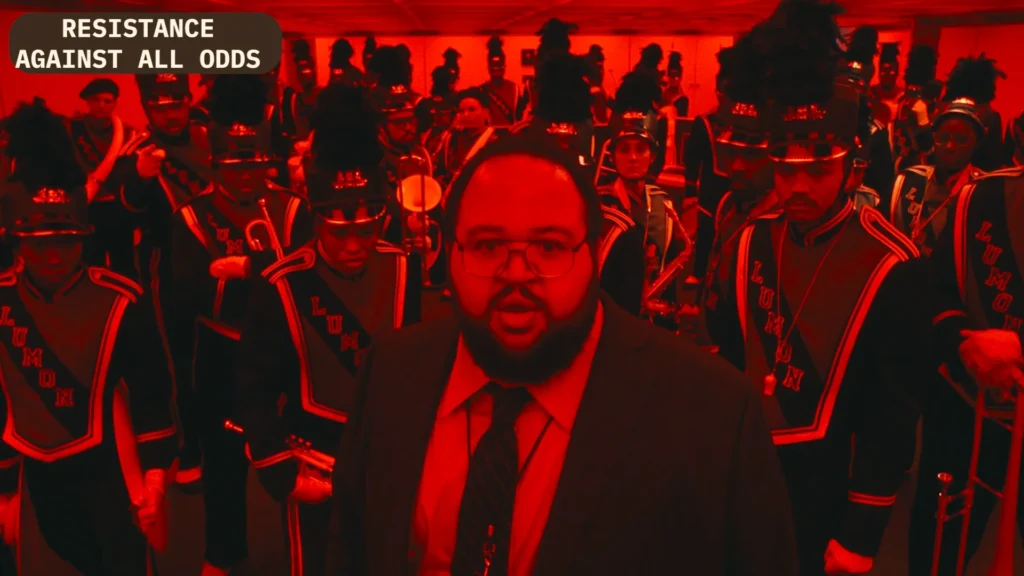
Resistance in Confinement: Free Will Against All Odds
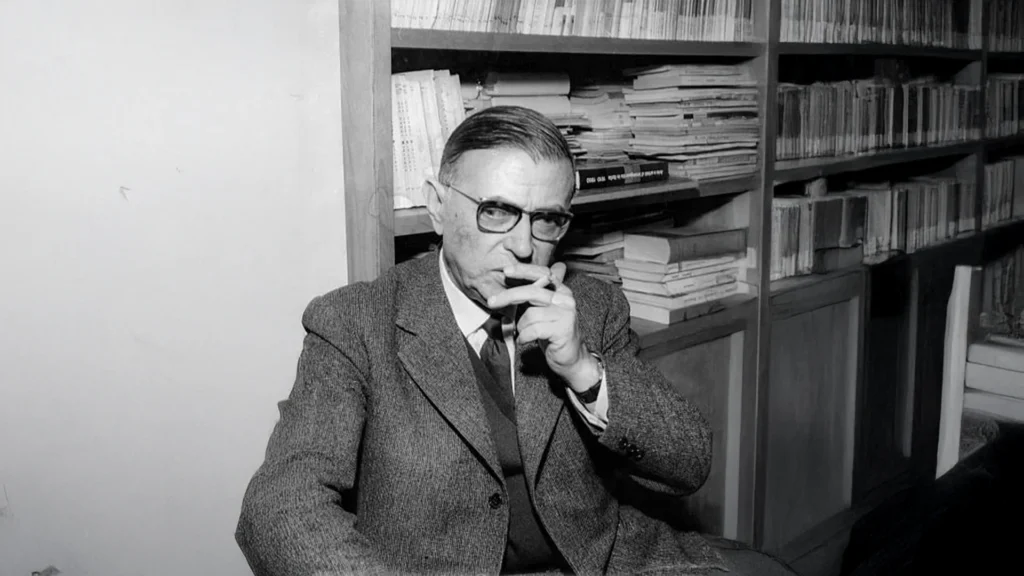
Jean-Paul Sartre would argue that freedom exists even in the most confined circumstances. For Sartre, existence precedes essence—meaning we define ourselves through our choices rather than being defined by predetermined qualities.
Mark, Helly, Irving, and Dylan’s gradual rebellion against Lumon represents a Sartrean exercise of freedom. Despite their constrained environment, they manage to:
Form genuine connections with each other
Question the nature and purpose of their work
Develop curiosity about the outside world
Coordinate acts of resistance
The pivotal moment comes when the team discovers the Overtime Contingency—the ability to temporarily awaken an innie in the outie’s world. This discovery represents a crack in the deterministic system, allowing for genuine choice.
When Dylan sacrifices his opportunity to learn about his outie life to instead help his friends, we witness what Sartre would call an “authentic choice”—a decision made with full awareness of its consequences that defines who he is. Dylan chooses solidarity over self-interest, exercising free will in defiance of the system designed to control him.
Immanuel Kant argued that free will is tied to rational moral agency—our ability to act according to principles we set for ourselves. For Kant, freedom isn’t about doing whatever we want but about acting rationally according to moral law.
Despite being denied information about themselves and the outside world, the innies gradually develop moral principles that guide their rebellion:
Mark maintains his skepticism and intellectual curiosity
Helly refuses to accept her imprisonment
Irving pursues truth about the company’s history
Dylan seeks connection with his unknown children
In one telling scene, after discovering a coworker being “reset” (essentially mind-wiped), Mark comments: “Whatever they’re doing, they shouldn’t be doing it to people.” This simple moral judgment, arrived at through rational consideration despite limited information, exemplifies Kant’s concept of autonomy—the ability to derive moral principles through reason, even in oppressive circumstances.
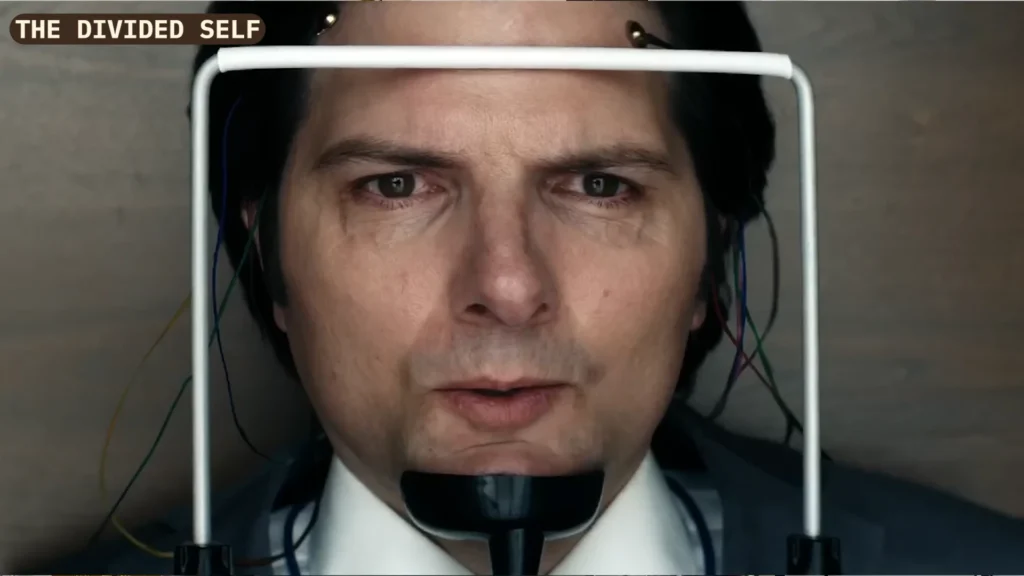
The Divided Self: Can Fragmented Consciousness Be Autonomous?
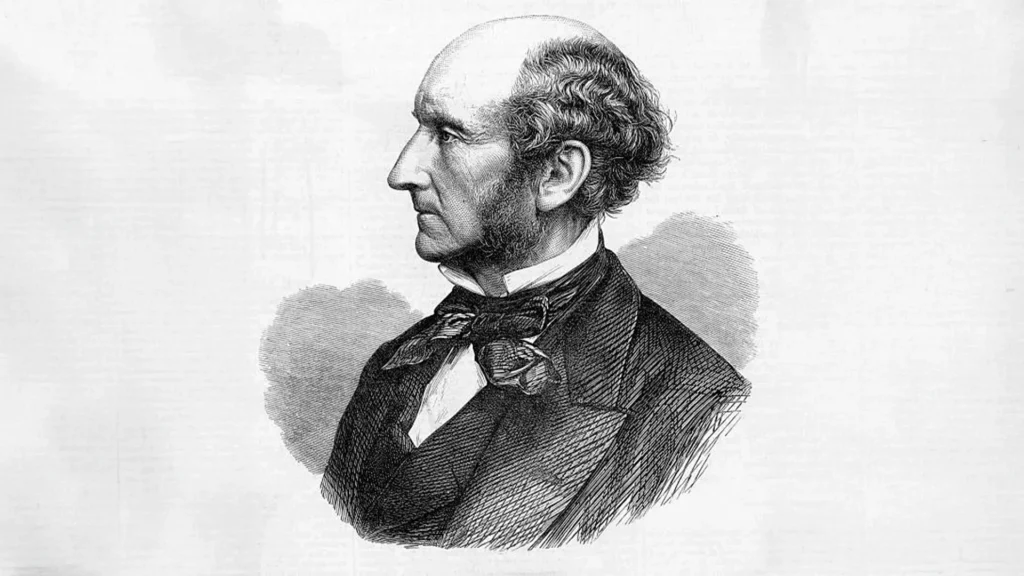
Mill’s Harm Principle and the Ethics of Severance
John Stuart Mill’sharm principle states that individual liberty can only be justifiably limited to prevent harm to others. The severance procedure creates an ethical paradox: the outie consents to the procedure, but this consent directly harms another consciousness—the innie.
The outies of Severance commit what philosopher Derek Parfit might call “future self harm”—only in this case, they’re harming a partitioned version of themselves rather than their future self. This raises questions about consent:
Can one version of consciousness consent on behalf of another?
If the innie never had a choice, was genuine consent ever possible?
Does the outie’s “freedom” come at the expense of the innie’s imprisonment?
When post-reintegration Petey tells Mark, “They’re taking people’s souls, Mark… dividing them in half,” he’s articulating the core ethical problem through Mill’s lens—the severance procedure fundamentally harms people by fragmenting them, violating the harm principle regardless of consent.
Frankfurt’s Hierarchy of Desires and the Severed Will
Harry Frankfurt proposed that autonomy involves aligning our actions with our “second-order desires”—our desires about what we want to desire. The severed state creates a profound disconnect in this hierarchy:
The outie may have a second-order desire to be productive at work without emotional involvement
The innie has no access to these second-order desires, operating with first-order desires disconnected from the outie’s values
Neither self is fully autonomous because neither has access to the complete set of desires that would constitute a whole person
This severed hierarchy of desires manifests dramatically when we learn Helena Eagan (Helly’s outie) is actually an Eagan family member who underwent severance as a publicity stunt. Her outie’s second-order desire (to promote severance as ethical) directly conflicts with her innie’s first-order desire for freedom.
When asked why she hates her innie, Helena responds: “She’s not a person… she’s me without the context that makes me me.” This chilling statement reveals how the severance procedure creates what Frankfurt would consider a profoundly non-autonomous state—neither self has the necessary context to align their actions with their complete set of values.
For Kant, autonomy requires access to information—we can only make rational choices when we understand the context and consequences of our actions. The innies are systematically denied this context:
They don’t know who they are outside work
They don’t understand the purpose of their mysterious work
They can’t access memories of their personal history
They lack knowledge of the outside world
When Irving discovers a testing room containing a terrified, newly-severed employee, his horror stems from his growing realization that their autonomy is fundamentally compromised. The scene represents what Kant would consider a profound violation of human dignity—people being used merely as means (workers) rather than respected as ends in themselves (complete persons).
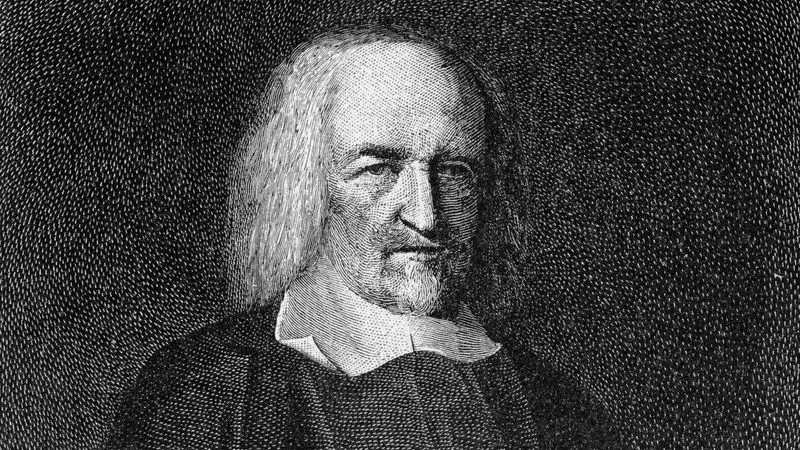
Hobbes and the Social Contract of the Severed Floor
Thomas Hobbes famously argued that freedom is the absence of external impediments to motion—in other words, freedom means not being physically prevented from doing what you want to do. By this definition, the innies are profoundly unfree:
They cannot leave the severed floor
They are physically restrained if they attempt to escape
Their movements are tracked and restricted
Their bodies are literally controlled by different consciousness outside work hours
The severed floor represents what Hobbes would consider an artificial state—one where the natural liberty of humans is constrained by artificial boundaries. The difference is that, unlike Hobbes’ social contract where citizens surrender some freedom for security, the innies never consented to this arrangement.
As Mark’s innie gradually discovers his outie’s grief over his wife’s death, we witness his growing awareness of this lack of consent. The company has exploited his outie’s emotional vulnerability to establish control over his innie—a perversion of any legitimate social contract.
Integration as Liberation: Toward a Unified Consciousness
One of the most profound philosophical statement of Severance comes through Petey, who manages to reintegrate his severed selves. His painful but enlightening experience suggests that true autonomy requires integration—a unified consciousness that can access all aspects of the self.
Reintegration represents:
The reunification of episodic memory (knowing one’s complete history)
The alignment of conflicting desires (resolving the tension between innie and outie)
The restoration of context necessary for meaningful choice
The regaining of a coherent personal narrative
When Petey tells Mark, “There’s a whole world out there… I’ve seen both sides, and I’m choosing to stay integrated,” he’s making a claim about the relationship between integration and autonomy. True freedom, Severance suggests, requires wholeness.
FAQ: Philosophical Questions About Severance
Are the innies different people from the outies?
From a philosophical perspective, this depends on your theory of personal identity. John Locke would argue that identity is tied to psychological continuity and memory—by this standard, the innies and outies could be considered different people since they don’t share memories. However, Derek Parfit might argue they’re the same person in different psychological states, similar to how we might not remember our early childhood but are still the same person.
Does the severance procedure constitute a form of slavery?
By most philosophical definitions of slavery—especially those emphasizing the absence of consent and the treatment of humans as property—yes. The innies are forced to work without consent, cannot leave, and are treated as resources rather than persons. What makes this morally complex is that the “slave owner” is technically a version of themselves, creating a unique ethical problem not addressed in traditional slavery discourse.
Would reintegration be traumatic for both the innie and outie?
Probably. From a psychological perspective, reintegration would involve reconciling potentially conflicting self-narratives and values. The outie would need to process everything their innie experienced, including any resistance or rebellion, while the innie would need to assimilate the outie’s reasons for choosing severance. This reconciliation would likely involve significant psychological distress as the integrated self reconstructs a coherent identity.
Is the severance procedure a form of philosophical zombie creation?
Philosophical zombies (p-zombies) are theoretical beings that act like humans but lack consciousness. The innies clearly have consciousness, emotions, and inner lives. However, severance does create a situation where the outie might view the innie as something less than fully human—a troubling perspective that raises questions about what philosopher David Chalmers calls the “hard problem of consciousness.”
Could severance ever be ethically justified?
Under extreme circumstances, perhaps. A utilitarian might argue that if a person needed to perform crucial work that would cause them severe psychological trauma (like diffusing bombs or performing high-risk surgery), severing the work-self might prevent suffering. However, this would require truly informed consent and robust protections for the innie’s welfare. The show clearly portrays Lumon’s implementation as deeply unethical, prioritizing corporate interests over human dignity.
The Fragmented Self in Modern Society
The philosophical questions raised by Severance extend far beyond the show itself. In our increasingly compartmentalized lives, we all experience minor forms of “severance”:
The division between professional and personal personas
The fragmentation of attention across multiple digital environments
The compartmentalization of knowledge in specialized fields
The temporal severance of our present self from our past and future selves
What makes Severance so philosophically compelling is how it literalizes these metaphorical divisions, forcing us to confront the implications of our fragmented existence. When we adopt a “work personality” different from our “home personality,” are we engaging in a mild form of self-severance? Do our different social media personas represent a fragmentation of our unified self?
As philosopher Galen Strawson argues, the very notion of a single, continuous self might be illusory—perhaps we are all, in some sense, “severed” from moment to moment, constructing an artificial narrative of continuity to make sense of our disjointed experiences.
Conclusion: Freedom Through Integration
Severance ultimately suggests that true autonomy requires integration—a wholeness of self that allows for informed, contextual decision-making. The show’s narrative arc bends toward reintegration as liberation, implying that the severed state is fundamentally one of compromised freedom.
This perspective aligns with holistic philosophical traditions that view humanity as necessarily unified—from Aristotle’s concept of eudaimonia (human flourishing through the realization of one’s full potential) to Eastern philosophical traditions emphasizing the integration of mind, body, and spirit.
The final episode of the first season’s cliffhanger, with innies temporarily awakened in their outies’ lives, represents not just a plot twist but a philosophical statement: only through confronting our whole selves, with all their contradictions and complexities, can we move toward genuine freedom.
I wonder—what parts of ourselves have we “severed” in our daily lives? What would it mean to reintegrate these fragments into a more cohesive whole? Perhaps the most valuable philosophical lesson of Severance is that true freedom comes not from escape or division, but from the courageous act of becoming fully ourselves.
What aspects of your life feel “severed” from your core self? Do you think complete integration is possible—or even desirable—in our complex modern world? Share your thoughts in the comments below.
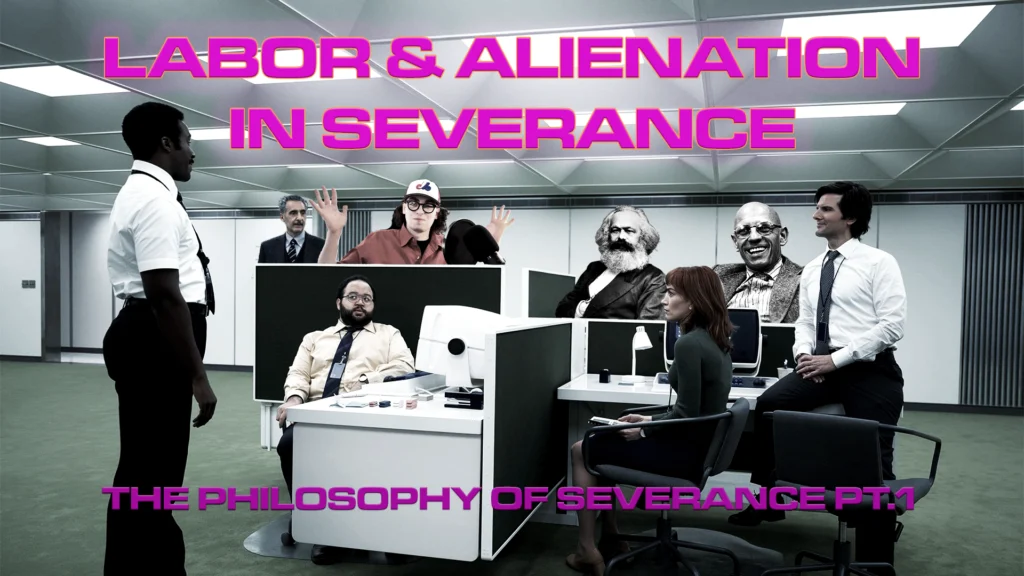
When the elevator doors close and severed Lumon employees transform into their “innies,” we witness the most literal manifestation of Marx’s theory of alienation ever depicted on screen. Apple TV’s “Severance” doesn’t just flirt with Marxist concepts—it takes them to their terrifying logical conclusion.
What Is Marx’s Theory of Alienation and How Does Severance Illustrate It?
Karl Marx’s theory of alienation describes how workers become estranged from their humanity under capitalism. In “Severance,” this alienation isn’t just psychological—it’s surgically enforced. The show provides the perfect lens to understand Marx’s four dimensions of alienation:
Let’s explore how the show brilliantly illustrates each dimension through its dystopian workplace drama.
Alienation from the Product: What Are the Lumon Employees Actually Making?
In traditional Marxist theory, workers are alienated from the products they create because these products become someone else’s property. In “Severance,” this alienation reaches an extreme.
The Macrodata Refinement (MDR) department employees sort “scary numbers” into digital bins with:
No understanding of what these numbers represent
No knowledge of the final product
No comprehension of how their work affects the world
No ownership of what they produce
When Dylan asks, “What do we do here?” Mark can only reply, “We’re refiners. We refine.” This tautological explanation highlights their complete disconnection from their output.
Unlike factory workers who at least see the cars or clothes they make (even if they don’t own them), Lumon’s severed workers exist in a state of complete epistemological alienation. Their work is so abstracted that they can’t even articulate what they’re producing or why.
Alienation from Production: When Work Becomes Your Entire Existence
For Marx, alienation from the act of production occurs when work becomes an external, forced activity rather than a fulfilling expression of creativity. In “Severance,” this alienation becomes literal imprisonment.
The innies experience several extreme forms of production alienation:
Spatial confinement: They cannot leave their workplace—ever
Existential limitation: Their entire consciousness exists solely within Lumon’s walls
Temporal totality: They have no existence outside of working hours
Procedural absurdity: They perform tasks based on how numbers “feel,” a process they can’t explain
The severed workers don’t just work at Lumon—they only exist at Lumon. They have no life outside work because, for them, there is no outside. When Helly attempts suicide rather than return to work, she embodies the extreme of this alienation—preferring non-existence to continued labor under these conditions.
Alienation from Human Essence: The Severed Self
The most profound innovation of “Severance” is its literal severing of consciousness, creating the ultimate form of alienation from what Marx called “species-being”—our essential nature as creative, social beings who find fulfillment through meaningful work and community.
The severance procedure creates workers who are alienated from:
Personal history and identity
Family relationships and friendships
Creative expression and leisure
All context for their existence
When Irving discovers an outie life filled with painting—creative expression completely absent from his innie experience—we see this alienation in stark relief. His fundamental human essence, his creative nature, has been surgically removed from his work self.
This alienation is doubly tragic because the innies intuitively sense something is missing. As Dylan poignantly asks after glimpsing his outie’s child: “I have a fucking kid? And I don’t get to be with them?” He grasps that his humanity has been stolen to make him a more efficient worker.
Alienation from Others: Corporate Division by Design
Marx’s fourth dimension of alienation involves separation from other human beings. Capitalism transforms social relationships into market relationships, fostering competition rather than cooperation.
In “Severance,” Lumon deliberately manufactures division through:
Departmental segregation: Workers are physically separated
Induced paranoia: Departments are taught to fear each other
Regulated interaction: Social contact is strictly controlled
Prohibited fraternization: “Romantic fraternization” and “excessive discussion of personal lives” are forbidden
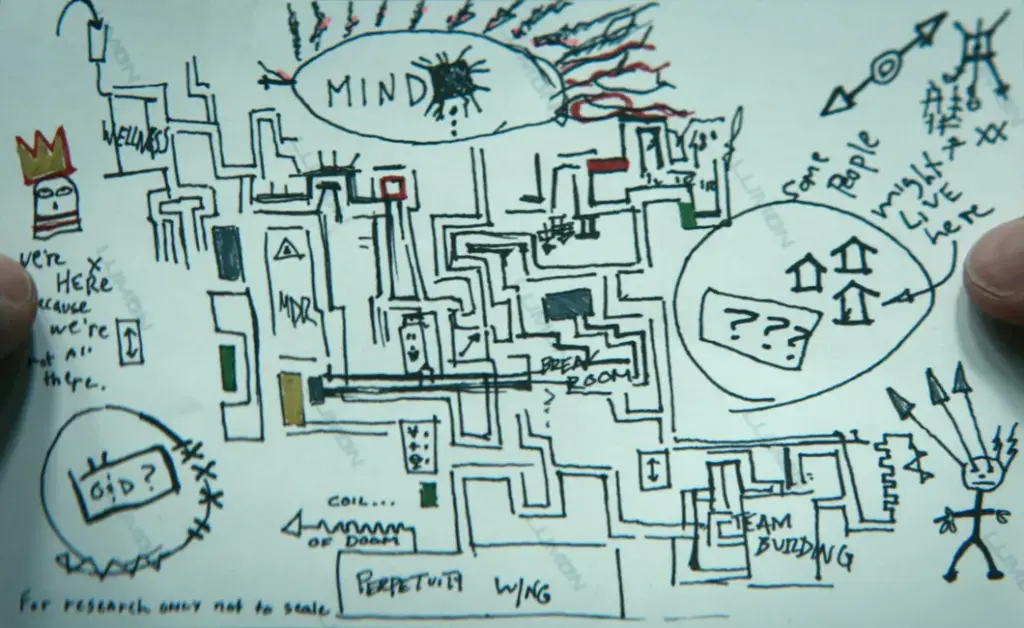
The “perpetuity wing” with its cult-like worship of Kier Eagan codifies this division as corporate dogma. The four “tempers” (woe, frolic, dread, malice) are kept separate in Kier’s mythology just as the departments are kept separate in the office layout.
A still from the perpetuity wing in Severance
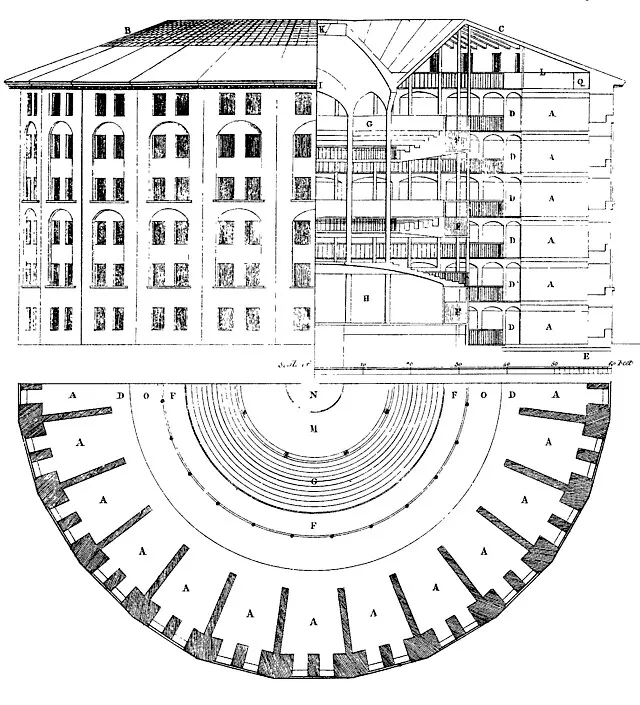
The Corporate Panopticon: Surveillance and Self-Policing
1. This plan of Jeremy Bentham’s panopticon prison was drawn by Willey Reveley in 1791.2. Petey’s Map of the Severance floor from Season 1
Building on Marx’s theory of alienation, Michel Foucault’s concept of the panopticon helps us understand how Lumon maintains control. In “Severance,” surveillance takes multiple forms:
Physical surveillance: Cameras and monitoring by management
Self-surveillance: Innies policing themselves, knowing outies may disapprove
When Dylan gains temporary consciousness in his outie life and discovers he has a son, it creates what we might call a bifurcated panopticon. His outie self becomes both jailer and judge, making decisions that his innie self must live with but cannot influence.
This surveillance extends to the most intimate possession—their own bodies. The innies are alienated from their physical selves, which become vessels temporarily occupied before being reclaimed by the outies at 5 PM.
Resistance Through Community: Finding Humanity in Connection
Despite this extreme alienation, the severed workers find ways to resist. Their rebellion emerges not through traditional labor organizing but through reclaiming their humanity through connection.
Key forms of resistance include:
Building relationships: Irving and Burt’s connection challenges departmental division
Sharing information: Mark and Helly’s mutual support and knowledge exchange
Creating meaning: Dylan’s obsession with perks and office trinkets
Asserting identity: Collective efforts to discover who they are beyond work
When Mark tells Helly, “The point is, we’re not just livestock. We’re people,” he articulates their fundamental resistance—a demand for recognition of personhood despite being created solely for labor.
The Break Room: Ideological Reprogramming and Total Control
The “break room” scenes represent perhaps the most disturbing extension of Marx’s theory. When Helly is forced to repeat “I am sorry for the trouble I have caused” until she genuinely “feels it,” we witness alienation from one’s own emotions and moral autonomy.
This goes beyond Marx’s concept of alienation and enters territory explored by later Marxist theorists:
Repressive desublimation: The channeling of desires into forms that reinforce control
Ideological state apparatuses: Institutions that indoctrinate subjects into dominant ideologies
Hegemonic consent: The manufacturing of agreement to one’s own exploitation
Lumon doesn’t just want the innies’ labor; it wants their complete psychological submission.
Consciousness as Commodity: The Ultimate Capitalist Frontier
“Severance” shows us that the final frontier of capitalism is not just the commodification of labor but the commodification of consciousness itself. The outies sell not just their time or skills but fragments of their very existence.
This represents what Marxist theorist Mark Fisher might call consciousness as commodity—the ultimate extension of capitalist logic, where subjective experience becomes a resource to be exploited, fragmented, and sold.
When Dylan tells his colleagues, “We’re not just parts of the whole; we are the whole,” he rejects this commodification. He asserts that the innies are not mere labor fragments but complete persons deserving of agency and self-determination.
What Can Severance Teach Us About Modern Work?
“Severance” doesn’t just illustrate Marx’s theory of alienation—it radically extends it for our contemporary moment. The show suggests that in our rush to compartmentalize work from life, we risk severing ourselves from our own humanity.
The series resonates because it reflects trends already in motion:
Work-life integration: The blurring of boundaries between professional and personal
Digital presenteeism: The expectation to be always available
Identity fragmentation: Maintaining different personas across contexts
Surveillance capitalism: The monitoring and commodification of human experience
Frequently Asked Questions About Marxist Themes in Severance
How does the severance procedure relate to Marx’s concept of alienation?
The severance procedure physically enforces the separation that Marx saw happening psychologically under capitalism. By literally splitting consciousness, it creates workers who experience the ultimate form of alienation—from their very selves.
What would Marx think of the “work-life balance” that severance claims to provide?
Marx would likely view the “work-life balance” promised by severance as the ultimate capitalist deception. Rather than truly balancing work and life, it completely subordinates one fragment of consciousness to labor while allowing another to believe it’s free.
How does Severance critique modern corporate culture?
The show critiques modern corporate culture by exposing its underlying logic: that workers are valued only for their productivity, not their humanity. The meaningless perks, corporate jargon, and wellness initiatives at Lumon parallel contemporary workplaces that offer superficial benefits while demanding ever more from employees.
What does Helly’s rebellion symbolize from a Marxist perspective?
Helly’s rebellion represents class consciousness—the awareness of one’s exploitation that Marx saw as necessary for revolutionary change. Her refusal to accept her condition, despite having no memory of choosing it, symbolizes the inherent human drive toward freedom and self-determination.
Conclusion: The Ultimate Question of Personhood Under Capitalism
The brilliance of “Severance” lies in how it transforms abstract Marxist theory into visceral human drama. By literalizing alienation through the severance procedure, the show forces us to confront fundamental questions about work, identity, and freedom.
As Helly desperately writes to her outie: “I’m a person. You can’t do this to me.” That plea articulates the essential struggle against alienation in all its forms. It’s not just a worker demanding better conditions; it’s a consciousness demanding the right to exist beyond its utility as labor.
In our increasingly fragmented, work-dominated world, “Severance” reminds us that Marx’s 175-year-old theory of alienation remains eerily relevant. Perhaps more than ever, we need to question systems that treat human beings as resources to be optimized rather than persons to be fulfilled.
What aspects of Marx’s theory of alienationdo you see in your own work experience? Share your thoughts in the comments below.
I haven’t been active on BM socials because I realized there was a lot more to be done behind the scenes. Let me give you some context.
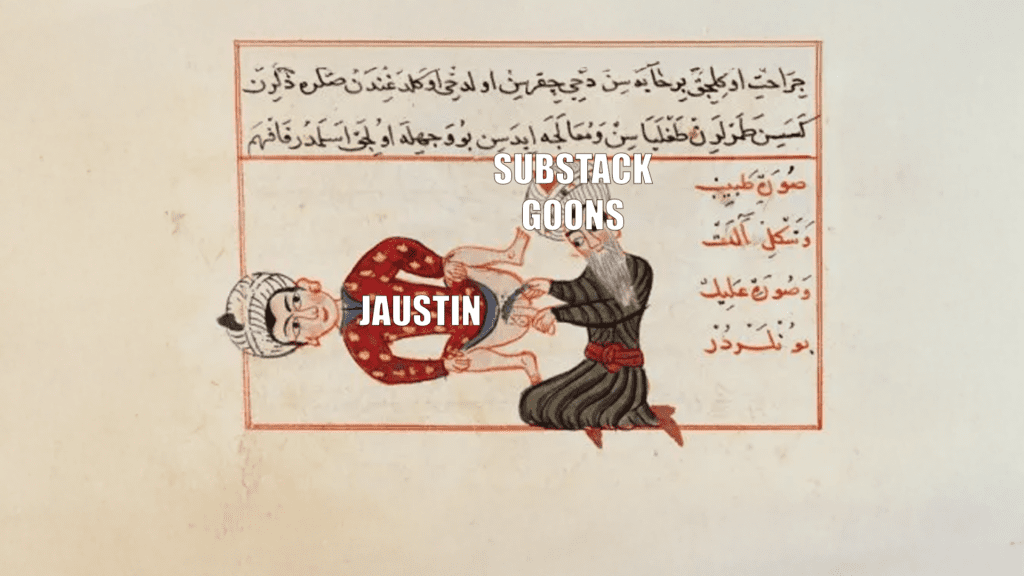
In May 2024 I wrote “Starry Night(s): “The Work of Art in the Age of Mechanical Reproduction.”, which got me freaking banned from Substack (my old blog host). Apparently I used the word Nazi too many times (cowards). After editing the blog they unbanned me, but the damage was done. SubStack silenced me. They castrated me like an innocent Unsullied child soldier.
All I was doing was providing SubStack the content they so desperately crave AND THIS IS HOW THEY REPAY ME? SubStack’s hypocrisy is truly stunning, banning someone for calling out fascism is a little on the nose, wouldn’t you agree? Sounds like the pot calling the kettle black if you ask me. Anyways, those little content junkies couldn’t handle the truth and now they must live with the consequences. It may take years, decades even. But SubStack will reap what it sowed, BM will make sure of it.
As Jay-z would say, this is a public service announcement.
FELLOW ARTISTS, BLOGGERS, CREATORS. CALL YOUR BANNERS, RAISE YOUR ARMS, WE ARE GOING TO WAR AGAINST THE WICKED OPPRESSION THAT GOES BY SUBSTACK. THE VILE SCUM THAT MINES YOUR DATA UNDER THE ILLUSION OF FREE SPEECH WILL BE BROUGHT TO IT’S KNEES. (it sounds cooler if you read it with a JFK impression).
What I’ve Been Up To
Enough with the threats. All jokes aside, it was a blessing in disguise. In May 2024 I also graduated from University. My freelance stuff was going well but I had extra time on my hands and the way my brain works if I’m not actively learning something I sorta just melt into a pit of despair.
I thought about learning how to brew non premade coffee. I thought about learning how to become a professional Crusader Kings 3 player. I even thought about reading the Bible for the first time. But none of those tickled the itch.
After getting banned from SubStack I needed to rebuild BM’s business plan. I didn’t want to run the risk of getting banned from another server due to my precarious prose. So I choose to build my own blog server. One entirely developed by and through BM — BRICK BY BRICK.
Integrating a blog into the site the way I envisioned was a lot more challenging than I initially thought. In order to do this I needed to get nasty at coding. So that’s what I did. I clenched my teeth and dove headfirst into the trenches (Javascript) and came out a different man. I felt like Christopher Walken in Deer Hunter the way I was losing grip on reality.
But now I’ve got the juice. I am an absolute unit when it comes to Java. I went from averaging page scores of 30-40% to 90% consistently! My newfound arch nemesis SubStack can only reach 41%. Losers!
That’s right, ain’t nobody can tell me shit. I hope you’re reading this Mr. Botzo. My grade 7 teacher never would’ve seen this coming. I would like to thank a few people for this momentous stride I took in the past year.
Anthropic; the people who made Claude. I’ve learned more about Java using the A.I. Claude to teach me, then I have in 8+ years trying to learn through YouTube.
David Goggins – I read his book last year and honestly I don’t agree with a lot of it, but he did inspire me to love the grind. It’s kinda funny his grind is 20x marathons and mine is starring at a computer for 20 hours straight. But hey, a grind is a grind, baby.
My parents – my Dad has been adamant I learn how to code and take advantage of these tech advancements before I’m too far behind
The Raiders – Mark Davis selling part of the team to Tom Brady has renewed my lease on life. I feel like I’ve just crawled out of Plato’s cave and am seeing colors for the first time.
God. Family. Football. You can be the one to choose whether Claude or Goggins is God in this scenario.
For real, coding is so fun. The webpages I’m making are pure art and nobody can tell me otherwise. It puts me in a flow state I haven’t felt since I worked on my first exhibition Human Error.
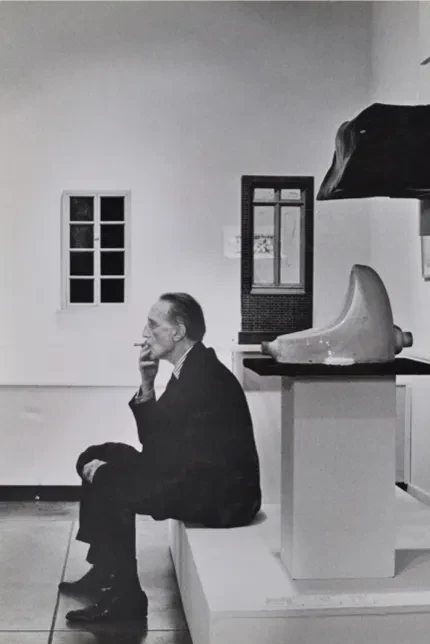
It’s very serendipitous a year ago I wrote “My Transition into a Cyborg” asking you all what it means to be an artist in the 21st century, and now I’m proclaiming my code is as artistic as anything these days, like I’m Marcel Duchamp posted up with my urinal.
OG Bubby Jaustin reflecting on the rhapsodic interplay of form and void, where chromatic luxuriance meets the whisper of negative space, within his JavaScript code. The artist’s gestural bravura imbues the composition with a kinetic vitality, oscillating between chaos and meticulous intentionality. One senses an almost synesthetic dialogue between code and brain, as though the lines themselves are imbued with a sentient longing. It is not merely code, but an invocation—an ephemeral mirage of emotion, suspended in the liminality between abstraction and revelation.
– OG Bubby Jaustin
Didn’t that philosopher Heraclitus once say “Character is Destiny”? I’m thinking he was onto something. Anyways, enough of what I’ve been up to. Here’s what’s in store for BM.
2025 Roadmap
The site is far from perfect. The first few months of the year, the majority of my BM work will be on the backend, trying to get everything up to par before I really go to town with content.
Q1
– I expect to have the site fully coded how I envision sometime by March-April.
– Finalize the partnership with the Creative Commons
Q2 & Q3
CONTENT CONTENT CONTENT
– I don’t want to lock in a schedule yet, but I’m aiming to produce something like 1 blog a week and 1 video a month for BM
– During this time I’m going to be pursuing as many people as possible to join the BM community. Again, not something I’ve finalized but I’m planning on offering creatives either; ownership into BM varying on how much engagement they produce, or x% Profits from each piece of content they produce.
For example, companies like YouTube, Spotify, Apple music, etc., tend to pay creatives something like $1 for every 1000 streams, so BM will use a similar model.
– Hoping to secure a partnership with 2 specific Toronto-based media companies I’m a fan of (this is me speaking it into existence)
Q4
– MORE CONTENT
– By now, hopefully BM will have more than just me as a creator, therefore we should be posting more than 1 blog a week.
– The goal is to eventually have 1 piece of content a day. That’s probably ambitious for 2025, but hey, shooters shoot.
– Over the past year I’ve been playing around with a new exhibition idea. No promises but maybe when I gear more into content mode I get to work on bringing that to fruition. (BTW if you still haven’t seen HYPERREAL, the archive is back online temporarily: https://benignmalevolence.com/2022/09/24/hyperreal/ )
What Else?
I don’t mean to pull your leg as it’s probably going to be at least a month before you hear from me again, but I figured since it’s the year anniversary of BM’s launch, you were long overdue for an update.
In the meantime I’ll leave you with some of the art/books/content BM is looking at so you can get an idea of the aesthetics we are focusing on going into the year:
This is a science fiction book about aliens saving humanity from a nuclear war and holy shit it’s one of the most uncomfortable things I’ve ever read. I just finished book 2 and need a breather before I go into 3. If the thought of Alien orgies are cool this is probably your thing.
The main consideration for me on whether or not a movie is good is if I think about it the day after. I watched The Deer Hunter a month ago and I’m still thinking about it. This movie fucked me up. I’ve watched all the main Vietnam war movies and this one is by far the most traumatizing of the bunch. It’s also the first time I’ve seen Christopher Walken not as an old man so that was cool. Warning: shit is dark asf
I had a blog of Fahrenheit 451 in my drafts last year but due to unforeseen circumstances (fuck you SubStack) I had to can it. With all the election BS and the propaganda hitting our feeds I feel like this book is more important now than ever.
If K-Punk has 1 million fans, I am one of them. If K-Punk has one fan, then I AM THAT ONE. If K-Punk has zero fans, that means I am dead.
Shout out and RIP Mark Fisher. K-Punk will always be in BM’s DNA. I will continue to make it one of my life’s missions to put as many people onto Mark Fisher as possible.
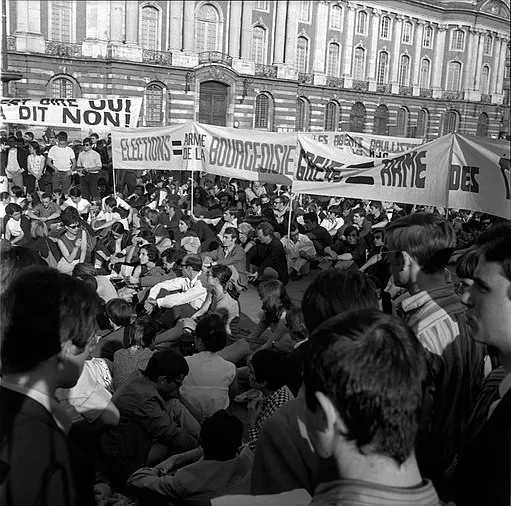
I’ve been obsessed with watching documentaries and reading books about May 68’ lately because It seems so similar to what’s going on with the student protests of the Israel Palestine war. Maybe in a few weeks I’ll explain what I mean, but for now, I encourage you all to read up on the May 68 protests. History is repeating itself in front of our eyes.
Constructivism is about jamming as much meaning to produce as provocative a reaction as possible using only the most simplistic and universal artistic elements. “Constructivists believed that art had no place in the hermetic space of the artist’s studio. Rather, they thought that art should reflect the industrial world and that it should be used as a tool in the Communist revolution” (Constructivist handbook). BM doesn’t necessarily agree with the ends of the constructivist art movement, but it surely supports the means. I am constantly impressed by the constructivist ability to produce such poignant aesthetic truths in such mundane works of art. My goal as an artist is very much aligned with the constructivist ideals. To better understand BM’s philosophy I recommend you read up on constructivism.
I was never a fan of Future growing up but in the past year something switched in my brain. Future was my second most played artist in 2024. Unfortunately I might be in my misogynistic era cause “I ain’t got no manners for sluts, Imma put my thumb in her butt!”. I’m just joking! Mom, aunts, uncles, I pray to god you didn’t read this far. I’m sorry, I couldn’t help myself.
Now seems like a good time to end this. Thank you all sincerely for taking the time to read my work. I’m very excited about the work BM is planning to produce and I’m hoping I can pass some of that onto you! To whoever’s reading this, I hope you have had a great start to your year, and continue to push that momentum forward!
DULCE ET DECORUM EST PRO PATRIA MORI
“IT IS SWEET AND FITTING TO DIE FOR ONE’S CREATIVITY”